
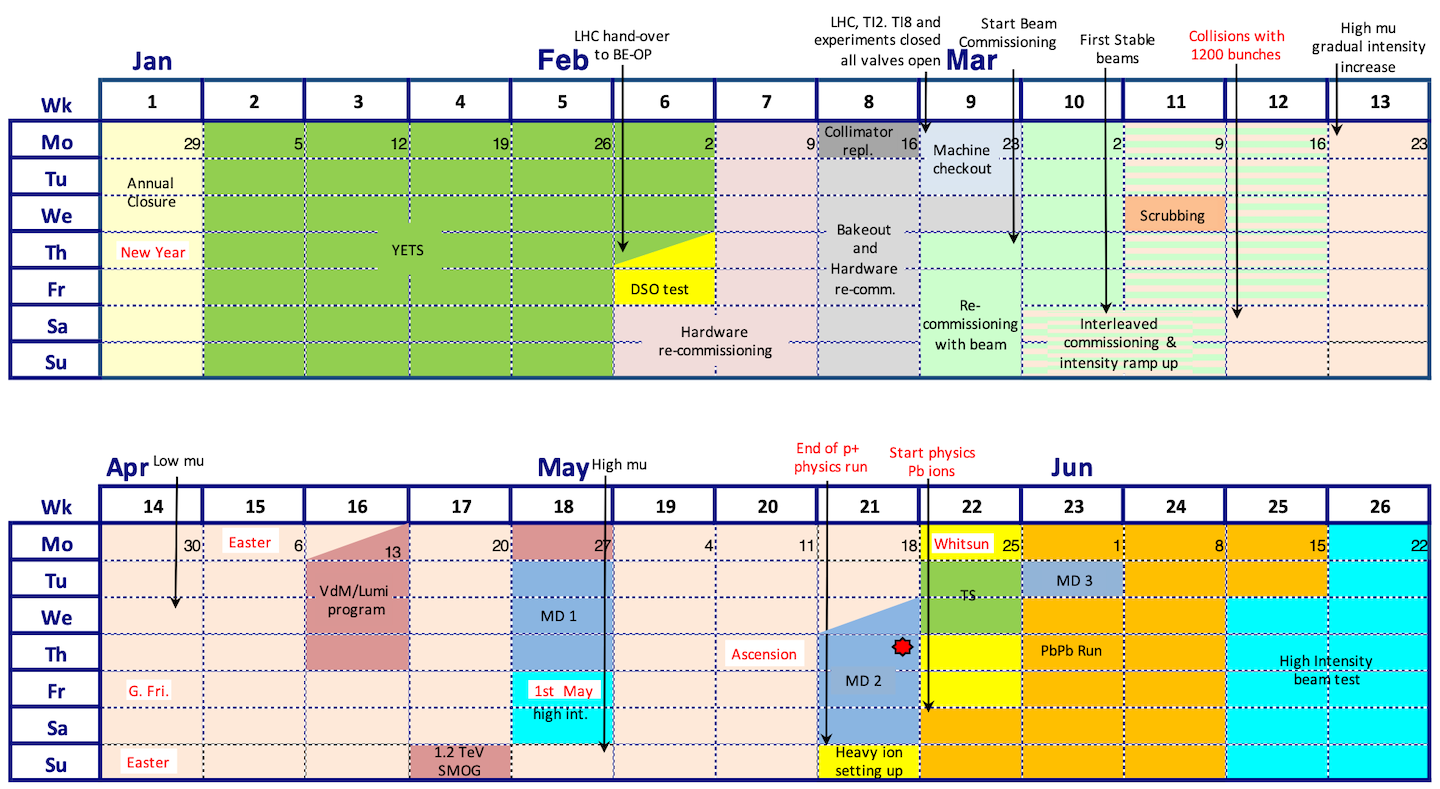
The LHC schedule for the first months of 2026, as approved by the LHC machine committee (LMC) on 4 March 2026. (Image: CERN)
During the recommissioning phase, the operations teams, together with equipment and machine-protection experts, worked around the clock to bring the Large Hadron Collider (LHC) back into operation. Finally, on the afternoon of Saturday, 7 March, stable beams for physics data taking were declared for the first time in 2026. This milestone marks the beginning of the final LHC data-taking run before the High-Luminosity LHC (HiLumi LHC) upgrade.
With Long Shutdown 3 (LS3) scheduled to begin at the start of July in the case of the LHC, the 2026 run will be short but densely packed. Every day counts, and the operations teams have mapped out a precise sequence of running phases to maximise the physics output during the machine's final months.
The LHC restarted with just four bunches circulating per beam. Over the coming weeks, this number will gradually increase to more than 2400 bunches per beam. This intensity ramp-up is not simply a matter of injecting additional bunches: at each new intensity step, beam stability, beam losses and beam-induced effects - such as electron cloud and equipment heat-up - must be carefully assessed before proceeding further.
Once nominal intensity is reached, the LHC proton physics programme will begin, with around three weeks of low pile-up data taking in the ATLAS and CMS experiments. These lower collision rates provide fewer but cleaner events, which is ideal for precision measurements such as determining the mass of the W boson.
This will be followed by a high pile-up phase, pushing up luminosity to extend the integrated dataset beyond the already achieved Run 3 target and increasing the statistical reach for rare processes.
Later in the run, proton collisions will give way to around three weeks of lead-ion collisions, recreating the extreme conditions of the early Universe and producing the quark-gluon plasma that is studied by the LHC experiments, primarily ALICE.
The run will conclude with a two-week high-intensity test, in which bunches containing significantly more protons than in standard operation will circulate in the machine. These tests will probe the LHC's behaviour under conditions closer to those expected at the HiLumi LHC and will help to identify both known and unexpected limitations that will have to be addressed during the upcoming four-year upgrade.
At the end of June, the LHC will fall silent. When it returns in 2030 as the HiLumi LHC, it will operate with a substantially higher collision rate, opening the door to deeper studies of known phenomena and increasing the chances of observing extremely rare processes.
These final months of running are therefore not just an ending, but an essential prelude to the LHC's next chapter.
| The Antimatter Factory roars back to life CERN's Antimatter Factory has also restarted its physics programme. After an unusually short year-end technical stop (YETS), the facility officially began its final six months of physics before LS3 at 17:30 on 27 February. In just two intense weeks of recommissioning, the accelerator teams restored the full chain - from the first beam delivered by the Proton Synchrotron (PS) to the antiproton production target, through the Antiproton Decelerator (AD) and the ELENA (Extra Low ENergy Antiproton) ring - until antiprotons were once again reaching the experiments. The experiments arrived at the starting line ready. Nearly all the collaborations were prepared to begin data-taking immediately, and two experiments - BASE-STEP and PAX - even managed to receive a few shots of beam during the decelerator set-up phase. Together with the other experiments - ALPHA, ASACUSA, AEgIS, GBAR, PUMA and BASE - the programme continues the search for clues to one of the Universe's deepest mysteries: why matter dominates over antimatter. By studying the properties of antimatter with ever-greater precision, these experiments aim to test fundamental symmetries of nature and explore questions such as how antimatter behaves in a gravitational field. |


