
Senior Air Force leaders and industry experts discussed the priorities for Air Force's Future Force Design during a panel at the Air and Space Forces Association's 2026 Warfare Symposium in Aurora, Feb. 25.
The Air Force is currently undergoing a massive modernization effort to equip the service with the tools it needs to win.
"Our Airmen face unrelenting demands across the world today, while the service must prepare for a growing threat environment that ranges from regional bad actors and their proxies, to peer adversaries who wish to reorder the globe," said Heather Penney, moderator for the panel and Air and Space Forces Association's Mitchell Institute for Aerospace Studies director of Studies and Research. "The service must strike a delicate balance between ready to fight tonight while developing and delivering next generation technologies on time and at scale."
Assistant Deputy Chief of Staff, Strategy, Integration and Requirements Thomas Lawhead, Headquarters U.S. Air Force, Air Force Global Strike Command Deputy Commander Lt. Gen. Jason Armagost, and retired Air Force Gen. James Holmes, Boeing Defense senior advisor, joined the panel to discuss how the Air Force and its key industry partners are tackling these issues.
Penney opened the discussion by seeking the origin of the Future Force Design.
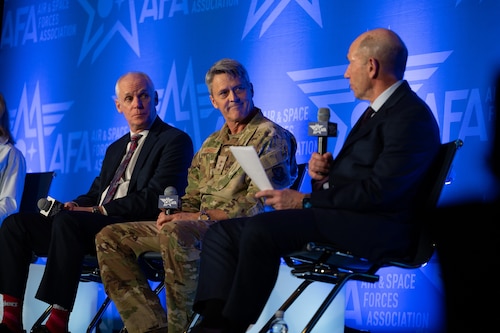
"The driving force behind our focus on Force Design is the urgent need to transform the Air Force into the most lethal and adaptable in the world, capable of deterring aggression and winning in any conflict," Lawhead said. "This required a fundamental shift in our approach, carefully balancing readiness of our current force while aggressively pursuing the modernization needed to stay ahead of emerging threats."
Lawhead added that the Air Force is making changes internally to its acquisition and requirements processes to keep pace with rapid modernization and readiness.
"The force design allows us to identify critical capability gaps," Lawhead said. "This ensures our requirements are not born in a vacuum; they are intrinsically linked to a validated, war-winning concept, providing the 'strategic why' for every investment and ensuring the force is designed from the ground up to enable the entire Joint Force to win."
When asked to outline the key attributes and priorities for the future force design, Lawhead replied that the core priority of the Air Force's Future Force Design is a crucial shift in thinking.
"We've learned that combat success will be based on who can develop the best integrated system, not just who has the best individual platform," Lawhead explained. "The era of measuring strength by simply counting tails on the ramp is over."
Instead of asking "How many F-47s do we need?" Lawhead said we now ask, "What attributes, like lethality, survivability, long-range penetrating capability, and persistent connectivity, do we need to guarantee air superiority?"
According to Lawhead, this approach allows the Air Force to break from the monolithic programs of the past and build a networked, interoperable force.
"The real advantage lies not in the most advanced platform, but rather in how we integrate the array of platforms and capabilities we have into a cohesive, interoperable force," Lawhead said. "Without integration, adversaries can exploit gaps in the spectrum, potentially gaining the upper hand."
The panelists agreed the Air Force faces three major challenges: pacing rapidly modernizing adversaries such as China; balancing readiness and modernization for a force that is the smallest and oldest in its history; and delivering new capabilities at speed and scale.
Armagost emphasized that the Air Force must continue to refine its mix of penetrating aircraft and standoff weapons, stressing that both are essential.
Addressing claims that "stealth is dead," Holmes and Armagost underscored that low observable technologies remain critical to joint operations, particularly when integrated with advanced sensing and electronic warfare capabilities.
Panelists also highlighted the need for fleet wide approaches to electromagnetic spectrum operations. Rather than relying on isolated capabilities, they said the future force must integrate apertures, sensors, and spectrum tools across platforms to complicate adversary targeting and maintain decision advantage in contested environments.
With the imperative to increase the lethality of the fight tonight force, Lawhead shared his thoughts on how to balance the cost to acquire the future force, while also maintaining enough available and mission capable aircraft capacity to train and fight.
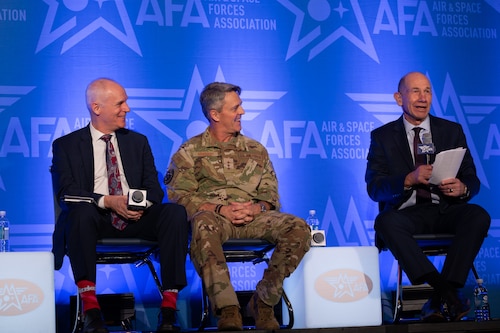
"Readiness and modernization are not competing priorities, but two sides of the same coin," he said. "Readiness without modernization leads to an obsolete force, while modernization without readiness delivers capabilities that can't be fielded. As the chief of staff says, we must be able to 'fly and fix to deter our adversaries and, if necessary, fight to win.'"
From Collaborative Combat Aircraft, to the B-21 and F-47, there's a lot of new programs for the Air Force, but how are they introducing these airframes into the service, Penney asked.
"One way we're beginning to assess the impact of these emerging capabilities is through wargaming," Lawhead said. "This year, we're working with a new wargaming engine, called 'WarMatrix,' that allows us to assess the operational success of these future platforms, acting in concert with our existing fleet and the Joint Force."
By leveraging AI to generate adaptive opposition and automate adjudication, WarMatrix allows the service to rapidly test new capabilities like the B-21 and F-47 against a strategic adversary that learns and changes its behavior to present a contested environment.
According to Lawhead, WarMatrix will allow the service to move beyond archaic metrics and measure how these new airframes truly "move the needle."
"We will be able to analyze their impact across the entire kill chain, from logistics and basing to their integration with the joint and combined force," Lawhead said.
In summary, this panel discussed the Air Force's Future Force Design, emphasizing the need for multi-domain, multi-spectral, and Joint Force capabilities required to compete and win in a complex threat environment. Key drivers include the evolving strategic landscape and the necessity of balancing readiness today with modernization for future threats. This discussion highlighted the importance of agility, survivability, and reform, and the enduring need for both penetrating and long-range capabilities.


