

Weeds. It's a simple term for a simple idea: plants growing where we don't want them, where they don't belong, or where they're doing harm. But is it really as simple as it seems at first glance?
Whether it's the gazanias growing in Jindabyne, willows along creek and riverbanks, or the blight of blackberry bushes — there are countless examples of garden plants becoming serious weeds across Australia, including here in the Snowy Monaro.
Skip to section:
What's the word?
Ask the average Aussie to name a weed on the spot and there is a long list of plants that will spring to mind: Paterson's curse, dandelions, blackberry, bindies, thistles, ivy, or lovegrass — to name only a few.

IMAGE: Paterson's curse growing in Bega, to the east of the Snowy Monaro
Most of us know these to be unambiguously bad plants, and that this is what we mean when we use the word weeds.
Ask the same average group of people to name a good plant, and you're likely to get back a list of things like gum trees, wattle, bottlebrush, waratahs, tea tree, grevillea, and banksias. Native plants are good plants, after all.
So if we know what's good and we know what's bad, what's the problem?
A weed by any other name…
The problem with a term like weeds doesn't lie with the obviously bad or the obviously good at either end of the weed-or-not scale.
After all, few among us would be thrilled to spot a big paddock packed with thistles, or find ourselves barefoot on a lawn full of bindies.
Instead, the problem with the defining weeds boils down to two main things:
- Most plants fall somewhere in the middle of the scale between good and bad
- How do we decide where to draw the line between weeds and normal plants?
Weed legislation, regulation and intervention in NSW is focused on preventing and combatting the worst-of-the-worst weeds and the ones that are at such low levels that eradication or containment is still considered feasible.
A lot of the species we all commonly know to be weeds aren't considered by regulators at all because they are already too widespread. Control costs would be too high to make any tangible outcome achievable through government intervention.
This means that local authorities like councils are limited to controlling only the worst weed species in the highest risk areas—in most cases.
With close to 30,000 exotic plants in Australia, government, industry and the community are limited in their capacity to manage additional weed species. This is particularly the case for those that are commercially available and continuously spreading to the environment from residential gardens.
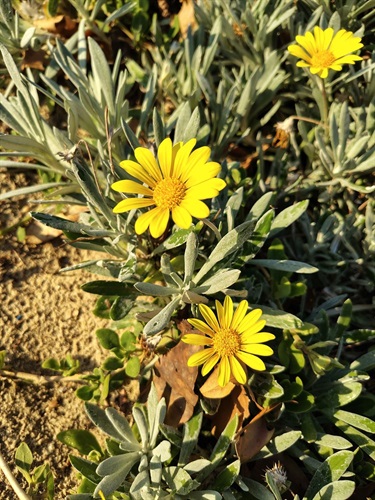
Gazania × splendens flowering outside of Melbourne, Victoria
Plants like gazanias, for example, behave a lot like weeds.
Widespread gazanias in Jindabyne and other Snowy Monaro towns
Gazanias are a common flowering plant, popular in gardens due to their hardiness and bright, multi-coloured flowers. They are available at most nurseries and can be propagated easily from seeds and cuttings. Due to their light, wind-borne seeds and their ability to spread by root-system runners and dumped garden waste, they are very difficult to contain within a normal garden setting.
As a result, gazanias have spread widely since their introduction and present a significant risk to both the local environment and agricultural production.
Why gazanias are a difficult problem to tackle
Gazanias can thrive in almost any environment from cropping land to coastal dunes. They display allelopathic properties, meaning that they release chemicals into the soil that can stop other plants from growing entirely. All of these properties allow gazanias to spread rapidly and dominate a broad range of environments.
Despite the very weedy character of gazania plants, South Australia is the only state or territory that officially recognises them as a significant enough weed that they have banned them from sale.
Everywhere else, these flowering daisy-like plants can be bought openly at nurseries and hardware stores like any other garden plant.
Garden responsibly: Know your weedy plants
The flowers that you plant in your garden can impact on the entire community through their uncontrolled spread.
Weeds are estimated to cost Australia $5 billion every year. With an estimated 75% of established weed species in Australia starting out as garden plants, the choices we make about what to plant at home can make a real difference.
Do your bit for the environment and the economy. Before purchasing and planting something new, consider the weediness of the species.
It's easy to check before you check out, and there are plenty of native and non-invasive alternatives to every weedy garden plant variety.
Replace weedy plants with non-invasive alternatives, and please, never dump garden waste on roadsides or natural areas.
Visit www.growmeinstead.com.au


