
This report provides an update on the technical feasibility of using administrative (admin) data, supported by surveys, to measure New Zealand's population and dwellings. It outlines Stats NZ's readiness to shift towards an admin data-first approach for the census, and identifies key challenges and development areas as we progress through design and implementation.
In June 2025, following Cabinet endorsement, details were announced about upcoming changes to Aotearoa New Zealand's census. In future, census data will rely more on information already collected by government and other organisations (known as administrative or admin data).
Surveys will remain important for validating admin data and collecting additional information. Stats NZ will also work closely with iwi Māori and other priority communities to develop tailored approaches that help meet their data needs.
Download the PDF of the full paper below, or read the scope and summary online.
Scope
This paper focuses on how well core statistical units - people, dwellings, households and families - can be measured using admin data, supported by surveys, to provide census-type information.
Aotearoa New Zealand's next census is scheduled for 2030 (subject to legislative amendments). Modernising the census outlines the reasons for the change, the decision-making process, and planned next steps. Proposed data collection approach and content for the census provides further detail on Stats NZ's current thinking as at November 2025.
This paper updates the version in September 2024. Revisions reflect the 2025 decision on the next census model, summarised in Modernising New Zealand's data system; methodological development since then, and updated comparisons with the 2023 Census and the 2023 estimated resident population (ERP). The methodological progress made since 2024 is summarised in the report in the section 'Progress since initial publication'.
Summary
Transforming the New Zealand Census of Population and Dwellings: Issues, options, and strategy (2012) addressed concerns about the sustainability of the traditional census and the opportunities offered by the admin data and technology. At the time, an admin data-first census supported by surveys was aspirational.
Since then, sustainability risks have become evident. The 2018 Census fell short of historic response rates, and while the 2023 Census improved, it did not return to pre-2018 levels despite greater effort and investment. Producing reliable data in both censuses relied on using admin data to fill the gap, made possible by methodological research through the Census transformation research programme.
The decision to change the model for the next census shifts from a survey-first to an admin data-first approach. Rather than administrative data supporting survey responses, surveys will be targeted to fill gaps in administrative data.
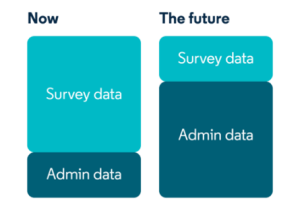
The transition will be gradual, with transitional outputs planned from 2026 and 2027; official key population measures expected in 2028; and a full set of annual census data from 2030. The shift is underpinned by extensive methodological research undertaken since 2012, experience from the 2018 and 2023 Censuses, and three releases of the experimental Administrative Population Census (APC).
New Zealand does not have a national identity number that links person-centred admin data to a central population file, unlike many countries with register-based censuses. Over the last decades, robust probabilistic linking methods have been developed to integrate multiple datasets. These methods, used to create the Integrated Data Infrastructure (IDI) and an admin-derived population file, have been critical to enabling an admin-first census, placing New Zealand ahead of other countries without a population register or national population identifiers that are seeking to use admin data in their census.
High coverage of the admin-derived population relies on combining data sources that provide comprehensive coverage and largely unbiased information - such as birth registrations, visa data, and tax records, which are less affected by the non-response biases typical of field-based censuses and surveys. Population statistics derived from linked admin data are more up to date, timelier, and better able to capture demographic change than those produced through a traditional survey-led census. This enables more responsive population information in a context of natural disasters, high migration flows, and an ageing population.
These changes increase demand for more frequent population statistics and for greater ability to integrate population data with other datasets that are only possible through an admin data driven approach. The IDI, and in the future, the Integrated Statistical Data System (ISDS), links admin datasets, Stats NZ surveys, and the historic Censuses at the individual level. Using multiple sources improves coverage and reduces reliance on the quality of any single dataset for key demographic variables.
Admin data allows for annual - or more frequent - production of information at more granular detail, and coverage down to small geographies. However, gaps remain for variables not captured in admin data, which require sample surveys. Collecting high-quality survey data is increasingly challenging and costly, so innovative survey approaches will be needed to sustainably produce detailed small-area data.
The success of an admin-first census depends on the trust of our Te Tiriti partners, customers, and the public. The combined census model and the release of the experimental APC products have increased awareness of how admin data supports the statistical system, but engagement insights consistently show that partners, customers, and communities are seeking more information about the quality of admin data. Experimental administrative population census has more information about the APC.
Several areas require further development, outlined under Critical areas to progress:
- Limited coverage of iwi affiliation, and to a lesser extent, Māori descent.
- Lack of admin data identifying people in rainbow communities and providing information on disability.
- Improvements required in the ethnicity data collection to support detailed population statistics for small ethnic communities.
- Development of the infrastructure to support a high-quality listing of dwellings.
Some of these gaps can be addressed through improvements to admin data and methodology, while others require a targeted survey programme. Delivering an admin data-first census supported by surveys is complex and involves managing change and risk. We are on track with key improvements, building on the existing foundations. Admin data continues to support timely population measures, while statistical methodologies and survey supplements are being developed to close remaining gaps and ensure robust, high-quality population statistics.
Methodological progress
We have demonstrated we can derive a high-quality list of people in the resident population using linked admin data. The admin-derived resident population closely tracks the age distribution of the official estimated resident population (ERP), with a relatively evenly distributed undercount of around 2 percent. This population provides the foundation for other census information: characteristics for each person can be derived from linked admin sources or surveys and individuals are grouped within dwellings to form households. The admin-derived resident population was used in both the 2018 and 2023 Censuses to include admin enumerations in the census file.
Although the admin-derived resident population is very close to the actual population, as measured by official population estimates, it is not accurate enough to meet user requirements for high-value uses, such as in health funding models and for local government electoral needs. As with the current census approach, methods to adjust for coverage error in the population listing will still be implemented to provide the accuracy required for official population statistics.
The administrative population census (APC) is an experimental product released by Stats NZ that demonstrates to customers our current ability to derive census-type information from linked admin data in the Integrated Data Infrastructure (IDI). As well as core demographic variables (age, sex/gender, ethnicity, location, and Māori descent), the APC includes variables on the topics of birthplace, income, work, and education, and in 2023 some household variables were included.
Our population estimation methods have become much more sophisticated in the last two decades (moving from a direct-weighting estimation approach to a Bayesian dual-system estimation model to adjust for census coverage errors). We have identified the key errors that our population estimation system needs to correct for under an admin-first census model supported by surveys, and are progressively developing a population estimation system that can correct for these errors. Core methodology has been internationally peer-reviewed and published (Graham et al, 2024), but more investigations are required to account for the error structures inherent when working with multiple admin data sources that differ from traditional census errors.
Population estimation models that account for subsets of the errors seen are currently in development, and these will eventually be merged and extended to correct for all known errors. Our current priority is to ensure that we have all the necessary components of the estimation system for a scenario where two admin lists of the target population are available.
Constructing admin-based households and families has progressed. Placing everybody in admin-derived households is methodologically challenging as errors compound. As addresses are used as a proxy for households, selecting the best address for a person for a given reference date is crucial. Developing a machine-learning model for this task has significantly improved accuracy compared to census data, outperforming the rules-based approach. It was used in the 2023 Census and to form APC households. There are still challenges, particularly with placing more mobile groups (for example, young people and recent migrants) in the correct households and identifying informal relationships and those formed overseas. Future work will include providing family information as well as determining the role that surveys will play in delivering household information.
Approximately half the census attribute variables for individuals can be derived using admin data. We have built up a comprehensive and detailed understanding of the quality of census characteristics that can be derived from admin data and identified the types of information collected by census that are unlikely to be obtained (Bycroft et al, 2021). High-quality variables have been released in the third iteration of the APC (Stats NZ, 2023b). For certain variables, information is of comparatively lower quality for some groups, such as recent migrants to New Zealand. Future work will focus on exploring additional data, including the sustained use of the electoral roll for Māori descent. Statistical imputation methods for any remaining missing values are being developed to improve the representativeness of the data.
A survey programme is required to deliver the full range of census information needs, and the initial design work for this is complete. Examples of information needs not currently well supported by admin data include gender, sexual identity, languages spoken, religious affiliation, activity limitations (disability), household tenure, and housing quality (such as dampness and mould). Surveys will be designed to provide information for small area geographies. While there will be loss of detail for those variables that rely on the new annual survey (Census Attribute Survey), compared with a high-coverage full-field enumeration census, the new survey will offer opportunities to improve timeliness, and to evolve content flexibly.
Critical areas to progress
Substantial admin data sources exist on properties, buildings, and addresses, and the development of the Places Index is underway. While we have not yet demonstrated the ability to provide a full census of dwellings and their attributes without field enumeration, the proof-of-concept phase is nearing completion, and the programme is now moving towards linking in historic census data for production testing. Significant work is required to complete sourcing the data, infrastructure, and methods required to produce national and subnational dwelling counts from admin data, and this will likely not include temporary dwellings. A shift away from an address-centric approach to a location-centric one allows a more detailed view, and the use of property, ratings, and buildings data. A coverage survey is planned to assess the quality of the derived dwelling list, and additional, complementing strategies will be needed to measure complex dwelling situations.
To maximise the value we get from our admin data-first census is to further improve how we form admin-based households. There is a vast array of regular address notification data in the admin data, and our methods for forming households from this data have been improving iteratively. The next step will be to expand the approach to exploit patterns of address changes that help us link individuals together to improve the chances of identifying those living together at a particular reference date. This, and the more extensive use of family data that can be found in admin datasets, will contribute to the next iteration of household and family data available in the admin population census.
Iwi affiliation is a core population identifier for Māori and an essential requirement for census that cannot yet be met through available admin data sources. The data collected in the census provides a rich resource for producing a wide range of population measures for iwi. These include core topics collected in the census, such as population size and location, language, and housing, as well as the ability to link population summaries to admin data. However, we also know that the traditional census model was not meeting all the data needs of iwi and Māori. We are actively working with our iwi partners on solutions to ensure iwi affiliation data meets their needs.
Further data sources will be required to improve the coverage of Māori descent. Without a full enumeration census, the combination of Māori descent information collected in electoral roll data and DIA birth registrations would provide the Māori descent indicator for around 90 percent of the population. The missingness mostly affects the overseas-born population. In the short term, historical census data will further reduce the amount of missing data. Statistical methods such as imputation and the population estimation process can account for missing data, although the level of adjustment would possibly be higher than some users would find acceptable. Wider collection of Māori descent in admin data would reduce the reliance on existing data sources and improve the coverage. Ongoing collection of Māori descent in survey collections will still be needed to validate data collected in admin sources, and to inform statistical imputation models.
The quality of ethnicity data (down to the most detailed level of the ethnicity classification, level 4) will need to be improved to support the sustainable production of population measures for ethnic communities. Improvements in the collection and coding of ethnicity are likely to add value to different agencies' abilities to monitor outcomes within their own data systems. These improvements will take time and resources from the agencies involved. Where to prioritise quality improvement will be identified in partnership with the agencies involved, to ensure the work aligns with their data strategy. Work with other agencies is already underway to improve data quality and how frequently it is collected. Ethnicity is a priority in these efforts.
The collection of representative and complete information for rainbow communities is limited in admin data settings, and may continue to be, because in many contexts it will not be necessary or appropriate to collect. With the census model moving away from a full enumeration approach, the loss of population-level identifiers for rainbow communities will reduce the quality of detailed population counts, the ability to report on attributes collected in the census, and the ability to link to admin data to report on measures such as health outcomes, income, and education. The new annual census survey (Census Attribute Survey or CAS) will provide support for measuring these outcomes, but will not provide the same level of detail as a full enumeration census, particularly for small populations such as trans and non-binary populations. The development of a census survey programme offers potential to deliver a wider set of social measures, such as wellbeing, that are not able to be provided by existing surveys due to sample size. It will be important to partner with rainbow communities to understand the impact and opportunities of a change in census model for supporting data needs for rainbow communities.
Data supplied by agencies is currently a mix of sex and gender. The mandated data standard for gender, sex, and variations of sex characteristics specifies the collection and output of gender data by default, as opposed to sex. Increasingly, agencies are collecting gender data, and Stats NZ is working with agencies to ensure that collection aligns with the data standard, and metadata is available describing the variable that is being collected.
Data standard for gender, sex, and variations of sex characteristics has more information.
The development of a survey programme will extend the range of information needs that can be met by admin data. The initial sample and collection design includes the development of the new annual (mixed-mode) census survey (CAS), sampling around 3 percent of the population annually. This will be supported by more targeted surveying of key communities, with the continued delivery of the New Zealand Household Disability Survey and Te Kupenga, and the development of a Pacific Wellbeing Survey being examples. The development of a survey programme of this scale will introduce competing information needs, and a transparent process of balancing these will be important. Stats NZ has a lot of experience running social surveys; however, the development of a survey programme of this scale will require a careful approach to ensure the collection remains in budget and is able to deliver high-quality information for small communities. Investment in methods to reduce the decline in response rates, and to mitigate the impact of non-response, is needed for the CAS and our survey programme more widely.
The continued development of data and analytical infrastructure to support the use of integrated admin and survey data in a production setting is critical. The Integrated Data Infrastructure (IDI) has provided an invaluable test environment for research, but this environment is not suitable as an enterprise register-based statistical system, which an admin data-first census requires. The statistical location register (SLR) was developed and used as an operational frame for the 2018 and 2023 Censuses. As the SLR provides a list of addresses, and as its design does not include maintenance processes, it cannot function to provide dwelling statistics, because it does not have the functionality to adequately identify dwellings or allow determining changes to the dwelling stock over time.
The development of the Integrated Statistical Data System (ISDS), a register-based statistical system that enables integrated data to be used in a production setting, is a critical component of an admin data-first census.
ISBN 978-1-991307-11-8


