


A first-of-its-kind ASIC questionnaire has shown significant differences in the whistleblower policies and practices adopted across corporate Australia, and highlighted opportunities for companies to better support and protect those who speak up.
Report 827 Insights from the ASIC Whistleblower Questionnaire: July 2024 to June 2025 (REP 827) benchmarks whistleblower policies and practices across 134 entities in 18 industries, examining how far companies have adopted better practices outlined in previous ASIC publications.
ASIC Commissioner Alan Kirkland said: 'Whistleblowers play a crucial role in identifying and exposing misconduct that can harm customers, shareholders, companies and the broader community.
'Without effective policies and programs to encourage whistleblowers to come forward, misconduct may otherwise go unreported and undetected,' he said.
ASIC's questionnaire found significant variation in the maturity of whistleblower practices.
There are opportunities for companies to adopt better practices for whistleblower disclosures. ASIC's review found:
- over one third of participating entities did not provide a dedicated whistleblower web page for raising concerns
- a quarter failed to provide regular staff training on their whistleblower program, and
- more than half had not sought employee feedback on their whistleblower program in the past year.
ASIC observed larger companies and companies within the mining sector were most likely to have mature whistleblower practices and higher disclosure rates. Some smaller companies also demonstrated better practices, suggesting firm size was not an impediment to strong whistleblower programs.
Commissioner Kirkland said ASIC's review highlighted actions Australian companies could adopt to improve their whistleblower programs and practices.
'While whistleblower processes need to be tailored to the circumstances of each company, providing dedicated web pages for whistleblower reporting, enabling communication with anonymous disclosers, and fostering a stronger speak-up culture are all steps companies can take to support whistleblowers and encourage disclosures,' said Mr Kirkland.
'Strong, appropriate and effective whistleblower practices go to the core of good corporate governance. These programs provide important information for directors to oversee their company's operations and compliance with the law.
'We encourage companies to benchmark themselves against the findings of the report and consider how they can improve their own whistleblower policies and practices,' he said.
ASIC will continue to monitor whistleblower practices across corporate Australia and engage with companies identified as having non-compliant or significantly less mature practices.
Companies are reminded that they are required to provide specific protections for whistleblowers and to manage whistleblower disclosures confidentially. Proper whistleblower policies should reflect these protections and outline how they will support and protect whistleblowers, taking into account the specific circumstances and characteristics of the company.
Snapshot: Whistleblower programs in corporate Australia
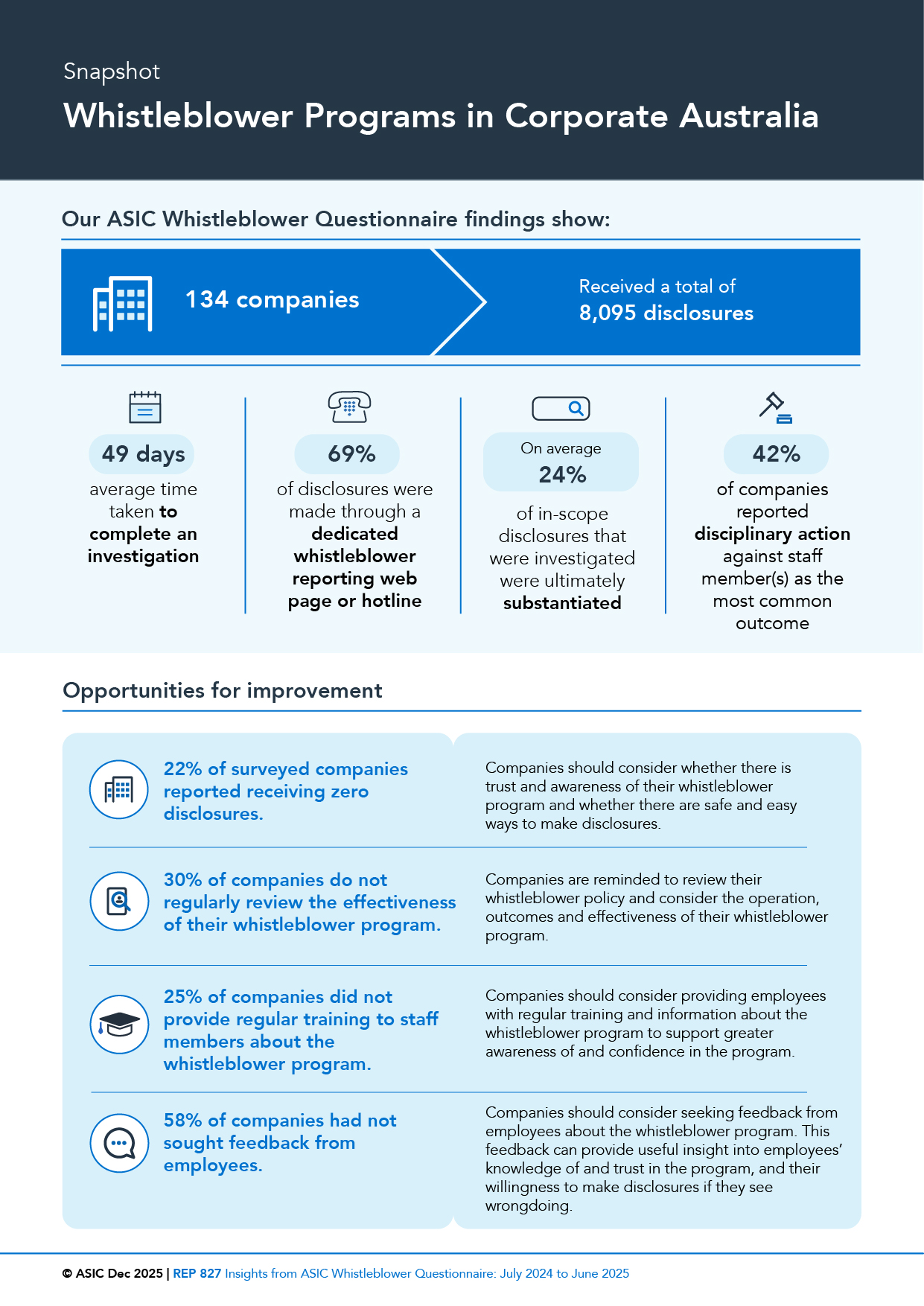
Snapshot Whistleblower programs in corporate Australia - text version
Our ASIC Whistleblower Questionnaire findings show:
- 134 companies received a total of 8,095 disclosures
- 49 days average time taken to complete an investigation
- 69% of disclosures were made through a dedicated whistleblower reporting web page or hotline
- On average 24% of in-scope disclosures that were investigated were ultimately substantiated
- 42% of companies reported disciplinary action against staff member(s) as the most common outcome
Opportunities for improvement:
- 22% of surveyed companies reported receiving zero disclosures.
- Companies should consider whether there is trust and awareness of their whistleblower program and whether there are safe and easy ways to make disclosures.
- 30% of companies do not regularly review the effectiveness of their whistleblower program.
- Companies are reminded to review their whistleblower policy and consider the operation, outcomes and effectiveness of their whistleblower program.
- 25% of companies did not provide regular training to staff members about the whistleblower program.
- Companies should consider providing employees with regular training and information about the whistleblower program to support greater awareness of and confidence in the program.
- 58% of companies had not sought feedback from employees.
- Companies should consider seeking feedback from employees about the whistleblower program. This feedback can provide useful insight into employees' knowledge of and trust in the program, and their willingness to make disclosures if they see wrongdoing.


