
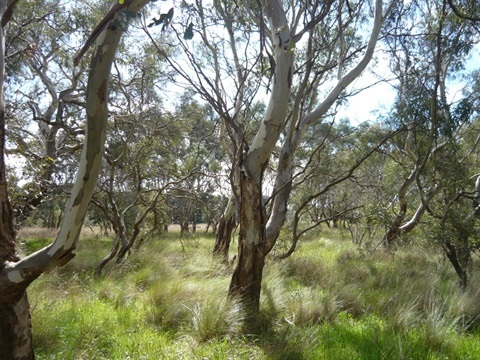
Property owners who place permanent environmental protections on their land will be rewarded with a rates rebate under a new Council initiative.
Landowners who are entered into a conservation covenant with Trust for Nature (Victoria) will be eligible for a rebate of $20 per hectare, up to a maximum of $500 per property, as of 1 July.
The rebate was added to the final 2026-27 Council Budget adopted on Tuesday night, as the major change resulting from community feedback on the draft budget released in April.
A Trust for Nature covenant is a permanent and legally binding agreement on private land, designed to protect native vegetation, wildlife habitat and other environmental values.
Mayor Libby Stapleton said the concept aligned closely with Council's strategic aims around climate and environmental leadership.
"Protection of the environment was a strong theme of the feedback on the draft budget and the rebate was a specific suggestion that we felt had a lot of merit," Mayor Stapleton said.
"It acknowledges a long-term commitment by these landowners to protect biodiversity on their properties, contributing to the overall health of the natural environment we all value so much."
The rebate is forecast to cost Council around $4,200 next financial year.
The other key adjustment to the final budget in response to community feedback is a change to Council's 2026-27 road safety program to include timber bollard installation on Illawong Drive, Torquay.
This will be a safety measure to separate parked cars and pedestrians along the frontage of St Therese Primary School.
Mayor Stapleton said councils across the state are facing an increasing challenge to remain financially sustainable in the face of rising costs.
She said the budget represents a measured approach to managing Council finances, while maintaining service levels and investing in valued community facilities.
"In a challenging financial environment, we've aimed to deliver a responsible budget that provides maximum value to the community," Mayor Stapleton said.
"It will allow us to deliver the actions set out for year two of our Council Plan, which focuses on the things the community has told us matter most.
"There's a strong focus on maintenance and renewal of our public assets such as roads and community facilities, environmental leadership, and initiatives that support community wellbeing – which are all strategic priorities for us during this four-year Council term."
Adoption of the final budget confirms a total average rate rise of 2.75 per cent, in line with the Victorian Government's cap, and continuation of rates relief for farms and commercial properties for an additional year, via a lower rating differential.
Reflecting the need to operate efficiently to maximise ratepayer value, the budget has incorporated $331,000 in new ongoing operational savings.
This takes Council's accumulated operational savings for the past three financial years to $3.67 million.
While the impacts of the global fuel crisis stemming from the conflict in the Middle East will continue to be closely monitored, it has not necessitated changes to the budget at this stage.
The draft budget was available for community feedback between 29 April and 25 May, generating 123 submissions.
Community members were given an opportunity to speak directly to the Council at a budget submissions hearing on 2 June, and all submitters will receive a direct response.
The final budget and a summary engagement report are available on the budget Your Say page.
BUDGET SNAPSHOT – KEY DETAILS, FACTS AND FIGURES
Rates
Rates are Council's main source of revenue.
The budget contains a total average rate rise of 2.75 per cent.
This is in line with Victorian Government cap, and is important in helping cover the rising cost of delivering Council services and projects.
Continued temporary relief for farms and commercial/industrial land
Last year, in recognition of the drought and difficult business environment, Council lowered the rating differential for farmland and commercial property, as a temporary relief measure.
Council has decided to maintain those lowered differentials for another year, providing savings for these ratepayers.
(The 'rating differential' is the percentage used to calculate how much each property category contributes to overall rates.)
The Farm Rate Land differential will stay at 64 per cent (remaining down from 75 per cent in 2024-25) and Commercial/Industrial Rate Land will stay at 165 per cent (down from 190 per cent in 2024-25).
The aim of continuing these reductions is to help ease financial pressure on commercial, industrial, and farming ratepayers for a further year, recognising the impacts of drought and reduced visitation caused by extreme weather events during January.
NOTE: These measures do not necessarily result in a reduction in rates for these property types, but provide a lower increase than would be the case via a return to the 2024-25 differentials.
Waste Service Charge:
The charges for 2026-27 are:
- Urban waste service charge: $533 (up 3.5 per cent)
- Rural waste service charge: $519 (up 6.1 per cent)
The waste service charge does not sit within the rate cap.
It covers the rising costs of kerbside collections, waste disposal and recyclable material processing, public litter management, and the operation of Council's resource recovery centres and the Anglesea landfill.
In setting these charges for 2026-27, Council has factored in:
- The significant upcoming cost of the closure and rehabilitation of the Anglesea landfill (estimated at $12.6 million); and
- Continued annual increases in the Victorian Government's EPA waste levy, which has risen more than 163 per cent since 2019-20.
Council is progressively aligning the Urban and Rural waste services charges, which is why the Rural charge is increasing more than the Urban charge.
Capital works spend:
- Total: $43.01 million in 2026-27
- Newly funded projects: $21.18 million
- Multi-year projects continuing or projects carried forward from 2025-26: $21.83 million
Our capital works budget includes projects funded partly or entirely via external sources such as state and federal government grants.
Capital works expenditure by category includes:
- Buildings $17.22 million
- Bridges $1.56 million
- Drainage and sewerage $1.83 million
- Footpaths and cycleways $1.34 million
- Parks, open spaces and streetscapes $912,000
- Recreation, leisure and communities $4.84 million
- Roads $9.71 million
- Waste management $487,000
Capital works highlights
- Barwon Terrace, Winchelsea upgrade ($1.34 million)
- Bambra-Boonah Road, Bambra unsealed road renewal ($276,000)
- Ervins Road, Mount Moriac unsealed road renewal ($209,000)
- O'Donohue Road, Anglesea sealed road renewal ($115,000)
- Replacement of the synthetic Parwan Soccer Pitch at Torquay's Banyul-Warri Fields ($1.87 million);
- Australian National Surfing Museum refurbishment ($1.5 million)
- Completion of the Wurdi Baierr Aquatic and Recreation Centre, Torquay
- Repair of the Pollocksford Road bridge in Gnarwarre
Asset Renewal Program:
Asset renewal budget by category includes:
- Active Play items $150,000
- Bridges $100,000
- Buildings $850,000
- Drainage $150,000
- Facility signage $30,000
- Fencing $200,000
- Footpaths $500,000
- Park furniture $100,000
- Playgrounds $200,000
- Sealed roads $2.95 million
- Skate parks $300,000
- Unsealed roads $1.04 million
By the end of the 2026-27 financial year, Council will be responsible for the upkeep of $1.58 billion in assets, taking in property, infrastructure, plant and equipment.
Other noteworthy funding allocations:
- $873,857 Geelong Regional Library Corporation contribution for library services in Surf Coast Shire (up $23,357 from $850,500 in 2025-26)
- $300,000 for technical investigation and design of a Resource Recovery Centre in Torquay
- $160,000 for year three of Council's 'Branching Out' public tree planting project
- $150,000 allocation towards Great Ocean Road Regional Tourism
- $63,000 to operate the Anglesea Art Space
- $10,000 new annual public art restoration allocation
- $33,000 Christmas decorations and activations shire-wide
- $27,000 Major event support for the Cadel Evans Great Ocean Road Race (including the Lorne to Torquay Surf Coast Classic)
- $240,000 Municipal Emergency Management Program with Colac Otway and Corangamite Shires
- $170,000 Torquay Town Centre and Baines Crescent precinct revitalisation planning
- $100,000 Winchelsea Structure Plan
- $98,000 Design of a Duffields Road upgrade
- $41,700 to support Community Houses shire-wide
- $66,377 Life Saving Victoria contribution for professional patrols on Surf Coast beaches
- $24,740 Surf Coast Arts Trail
- $148,600 Community Grants
- $242,000 Solar and Energy Transition Program
- $30,000 to create a Biodiversity Strategy
Budgeted result (Cash Surplus/Deficit): $1.7m deficit
This forecast deficit has been planned for in advance and will be accommodated via savings from our Future Cash Fund Reserve, set aside for this purpose.
The planned deficit is largely driven by an increasing investment in renewing Council's growing and ageing asset base for the community.
Council's 10-year financial plan also forecasts cash deficits in the following three financial years, until 2029-30, which will all be accommodated via the Future Cash Fund.
This trend will reverse in the latter stages of the 10-year financial plan and Council will return to delivering cash surpluses, as the cash available for allocation grows at a higher rate than the asset renewal allocation.
Borrowings: up to $6 million
Council is budgeting for up to $6 million in new borrowings, taking total borrowings to $11.9 million by the end of the financial year.
This new borrowing has been forecast as part of the funding strategy for the Wurdi Baierr Aquatic and Recreation Centre in Torquay.
Council's debt level remains manageable and well within the local government prudential guidelines.
Debt is forecast to reduce back to $5.6 million by 2029-30.
Emergency Services and Volunteers Fund levy:
Councils must collect the Victorian Government's Emergency Services and Volunteer Fund Levy via rates notices.
Council passes this levy directly to the Victorian Government, in full, to fund emergency and volunteer services.
Hardship:
Council's Hardship Policy is in place to support ratepayers experiencing financial pressures.
Those experiencing hardship are encouraged to reach out for a confidential discussion by calling 03 5261 0600.
Visit our payment help


