
Limited awareness and understanding of Human Rights trigger a number of challenges, including discrimination, access to fair and independent justice, and conflicts. To this end, fostering knowledge, skills and attitudes in this field enables more inclusive, prosper, resilient, and peaceful societies. As a contribution to this end, the Saudi Human Rights Commission, UNITAR and Majmaah University, developed and implemented the Expert in Human Rights Programme in the Kingdom of Saudi Arabia .
Structured across seven months, four modules and two phases, the programme combined selfpaced learning, online lectures, and face-to-face training sessions in Riyadh and Geneva. Saudi professionals from different sectors explored the foundations of International Human Rights Law, national and international mechanisms, leadership, public policies, geopolitics, as well as communication. By the end of the programme, 53 participants successfully completed all requirements and were awarded a Certificate of Fellowship. This impact story was guided by the 4 levels of the Kirkpatrick-Phillips evaluation approach and details the experiences of participants who have successfully completed all programme phases.
Programme results
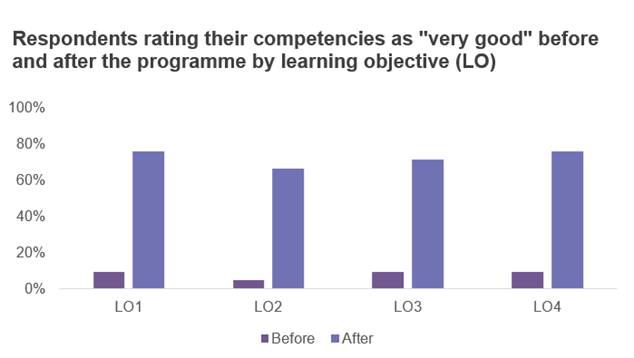
Participant feedback collected throughout the programme suggests that it was well positioned to meet participant needs, effectively addressing knowledge gaps while maintaining a strong connection to real-world professional contexts. Across all modules, 87 per cent of participants reported that the content presented was new to them, and 80 per cent indicated that it was relevant to their job. Thereby creating a strong foundation for meaningful learning. This became evident in the follow-up survey conducted several months after programme completion, which invited participants to reflect on how the experience had influenced their competencies and professional practice. Respondents described a substantive shift in their knowledge and skills. While most initially rated their knowledge, skills and competencies as low to fair before the programme, the majority reported the highest level of self-assessed competence after completion. Figure 2 illustrates that the proportion of respondents who rated their knowledge, skills and competencies as "very good" increased substantially for each learning objective (LO), reflecting strengthened confidence and perceived mastery. 1 The large majority, 79 per cent, reported having applied learning from at least one module in their workplace. Respectively 67 per cent and 78 per cent, indicated doing so often or frequently and either fully or very confidently. Male respondents reported slightly higher application rates across several modules, whereas female participants demonstrated more consistent application overall. All attributed the application of Human Rights knowledge and skills to the programme, although to differing degrees. However, transfer of competencies developed through the Training of Trainers component proved more challenging with approximately half of respondents reporting having used these skills in practice.


