
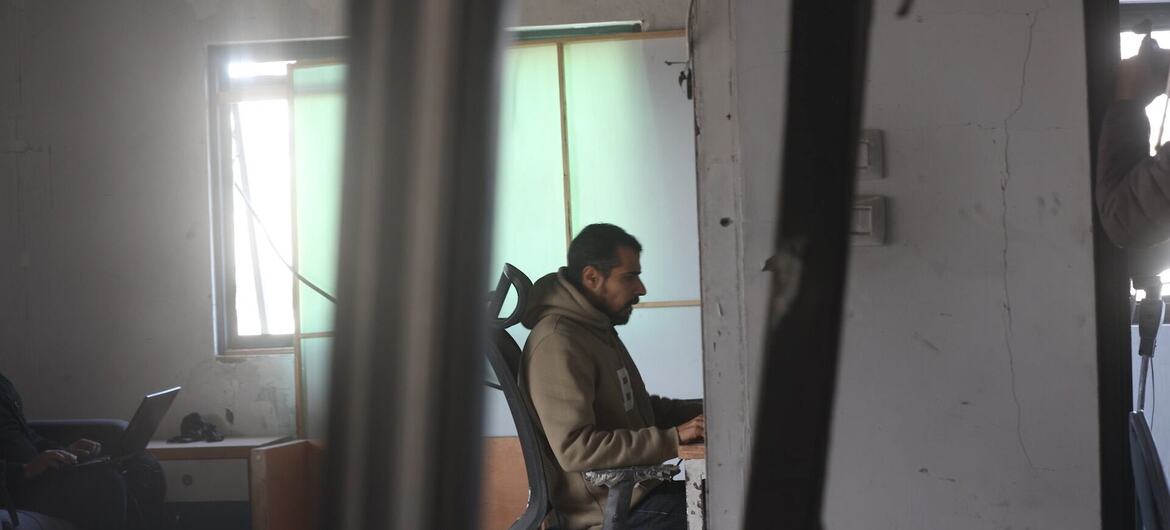
Broadcaster Rami Al-Sharafi works on a laptop inside the damaged Zaman FM radio station building in Gaza, marking what may seem an unlikely return to the airwaves amid the rubble of the deadly two-year Israel-Hamas war.
While 23 local radio stations were operating in Gaza before the conflict erupted, they were all destroyed and ceased broadcasting, he told UN News.
"Today, we are the only radio station broadcasting on FM from within Gaza after this widespread destruction," he said. "We hope that other local radio stations will resume broadcasting, thus allowing competition in providing media services to the people of the Gaza Strip."
Ahead of World Radio Day , observed on 13 February, the resumption of broadcasting comes at a time when Gaza's media infrastructure still faces significant challenges amid local and international calls to support journalism as part of broader recovery and reconstruction efforts in the sector.
Digging through the rubble
After a hiatus of nearly two years due to the war, some local radio stations in the Gaza Strip are transmitting again, in a move showing gradual efforts to revive the media landscape in the war-ravaged Strip - much of which has suffered widespread destruction of infrastructure and civilian institutions from Israeli attacks.
Zaman FM operates in the Tel al-Hawa neighbourhood of Gaza City, where Israeli attacks triggered a famine and left mountains of debris in the streets.
The cracked walls of the station's building tell a story of immense destruction and the scene inside is unlike any other radio studio in the world.
Employees dig through the rubble to keep the station broadcasting, working with minimal technical resources while behind them, awareness posters warn people of the dangers of dilapidated buildings.
On-air messages of hope
Local radio remains vital in Gaza as humanitarian crises persist, power outages continue and access to other media remains limited. This makes radio one of the most effective ways of getting key messages out to the public, along with health guidance and information about other services.
Gaza is in dire need of professional local radio stations capable of broadcasting awareness messages and guidance bulletins in light of the spread of diseases, the deterioration of the education system and the disruption of many basic services, said Mr. Al-Sharafi, director of the radio station and host of the morning programme, An Hour of Time.
"We need to deliver information to the population and guide them to the services that have stopped and are gradually being resumed," he said, "especially in light of the difficult health conditions and the spread of epidemics."
Amid the destruction all around, Mr. Al-Sharafi sits behind his dust-covered microphone and does just that.
He sends morning greetings to Gaza residents and provides them with important information and updates, bringing some much-needed hope to the airwaves across a devastated landscape that has only just begun to recover.


