
Global unemployment remains stable, but progress toward decent work has stalled, according to a new report from the International Labour Organization (ILO), which warns that young people continue to struggle in a job market which risks being further undermined by AI and trade policy uncertainty.
According to the data compiled for the latest Employment and Social Trends 2026 report, the global unemployment rate is projected to stay stable at around 4.9 per cent this year, equivalent to some 186 million people out of work.
The biggest area of growth is in poorer countries - a reflection of the ageing population in richer economies, where fewer people of working age are available to enter or remain in work.
Job growth is projected to be 0.5 per cent in upper middle-income countries as opposed to 3.1 per cent in low-income nations.
However, being employed is not necessarily the same as having a quality job or a decent wage: nearly 300 million workers are living in extreme poverty, earning less than $3 a day.
It is expected that around 2.1 billion people will be working in the informal sector this year, with limited access to social protection, rights at work, and job security.
Youth employment at risk
The global job situation for young people in low-income countries is described in the report as "daunting": more than a quarter (27.9 per cent) are neither in education, employment or training.
Educated youth in high-income countries are not immune from uncertainty: the study warns that AI and automation could make it harder for them to find work and calls for "close monitoring" of the technology.
Gender gap remains
There's little good news in the report for those fighting for women's equality in the workplace; the data shows that social norms and stereotypes remain entrenched.
Previous gains have stalled, slowing progress towards gender equality at work, and women are today around 24 per cent less likely than men to participate in the labour force.
Trade uncertainty
In 2025, the global economy was marked by the upheaval in international trade rules and tariff rates, led by the United States.
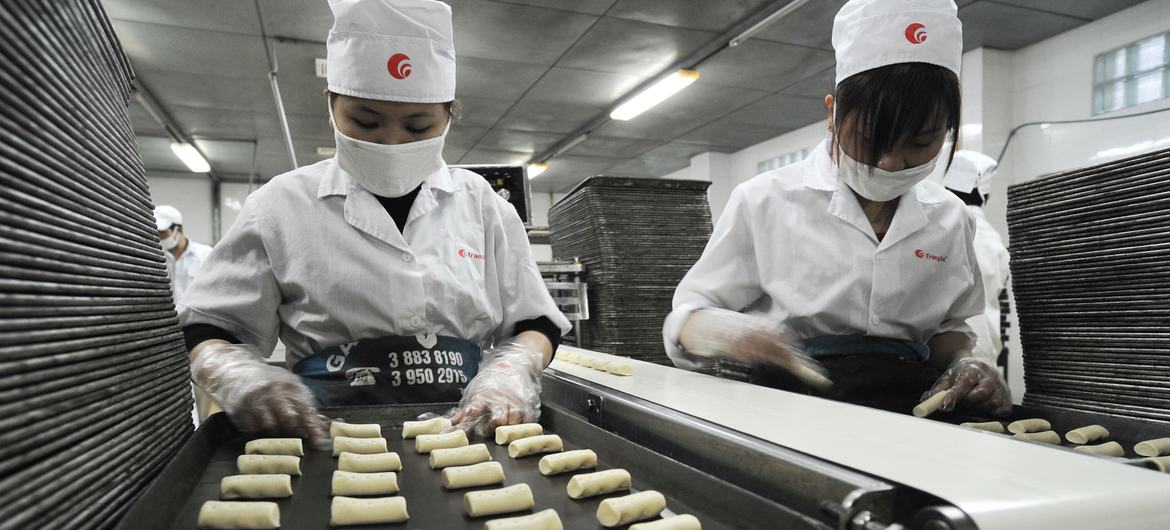
Trade supports around 465 million workers worldwide, more than half of them in Asia and the Pacific, and the uncertainty is cutting into workers' wages, especially in Southeast Asia, Southern Asia, and Europe.
'Coherent and coordinated' response needed
Responding to the findings in the report, ILO Director-General Gilbert Houngbo called for coordinated action and stronger institutions to advance decent work and social justice, particularly in poorer economies that risk being left behind.
"Unless governments, employers, and workers act together to harness technology responsibly and expand quality job opportunities for women and youth - through coherent and coordinated institutional responses - decent work deficits will persist and social cohesion will be at risk," said Mr. Houngbo.
Regional Outlook
Africa:
- In sub-Saharan Africa, the number of decent jobs is not keeping pace with the rapid growth of the population
- Nearly nine in 10 workers in sub-Saharan Africa are in informal employment
- Working poverty is widespread, with over half of workers living below the moderate poverty threshold
Latin America and the Caribbean:
- Employment increased by 4.4 million between 2024 and 2025, raising the employment-to-population ratio slightly from 59.1 per cent to 59.3 per cent
- However, 51.1 per cent of all employment in 2025 was informal
- Youth unemployment remains high at 11.9 per cent, nearly three times the adult rate (4.3 per cent)
North America:
- Employment growth is slowing, and job vacancies are declining
- Unemployment rates are expected to increase in the medium term in both Canada and the United States
Arab States:
- In the Gulf Cooperation Council economies (Saudi Arabia, Kuwait, UAE, Qatar, Bahrain and Oman), women's participation in the labour market in 2025 was 39.5 per cent, less than half the men's rate (86.7 per cent). In non-GCC economies, the gap is even wider: men at 66.1 per cent, women at 10.8 per cent
- GCC economies are advancing rapidly in digitalization and AI strategies, while non-GCC economies lag behind due to weak infrastructure and investment
- The unemployment rate in all Arab states in 2025 was 9.5 per cent (unchanged from 2024)
Asia and the Pacific:
- The regional unemployment rate in 2025 was 4.1 per cent, down from 5.1 per cent a decade earlier
- Manufacturing employment remains significant: 16.1 per cent of total employment in 2025 overall, 20 percent in Eastern Asia
- There are persistent challenges for youth employment, especially in China, where urban youth unemployment reached 17.8 per cent in mid-2025
Europe and Central Asia:
- The unemployment rate across the regions remains stable at 5.5 per cent
- 31.5 per cent of workers in Central and Western Asia are in the informal economy (13.8 per cent in Eastern Europe, 3.6 per cent in Northern, Southern and Western Europe).
- Ageing populations pose long-term risks: the old-age ratio is projected to rise significantly by 2050.
Key UN recommendations
- More investment in skills, education, and infrastructure
- Address gender and youth gaps by tackling barriers to participation and harnessing technology responsibly
- Strengthen trade and decent work for all regions
- Coordinated global and domestic policies to mitigate risks from debt, AI, and trade uncertainty.


