
Partners of the International Labour Organization's (ILO) RISE for Impact project have agreed on measures to sustain efforts to promote fundamental principles and rights at work (FPRW) among cotton-growing communities in Madhya Pradesh, including stronger coordination, locally anchored awareness-raising and clearer links between farmers and government services.
Representatives of trade unions, the cotton industry, civil society organizations and cotton-growing communities met in Indore on 25 August 2026 to review progress, challenges and lessons from the project and identify ways to carry its work forward.
Discussions highlighted the importance of collaboration among local leaders, trade unions, community organizations, government institutions and other partners to integrate labour rights into rural and agricultural communities. Participants identified stronger inter-agency coordination, repeated community-level awareness-raising, evidence-based identification of gaps and greater attention to the root causes of migration and child labour as priorities.
Partners also agreed to map organizations according to their geographical reach and expertise, strengthen referral and coordination mechanisms, share training materials and innovations, and establish a minimum set of responsibilities to help sustain the project's work and achievements.
The event also saw the launch of a joint ILO and Dr. B.R. Ambedkar University of Social Sciences (BRAUSS) report, Socio-economic assessment of the cotton growing community in Madhya Pradesh. The study draws attention to farmers with extremely small landholdings who depend heavily on their own or family labour for cultivation, describing them as "cultilabourers". It highlights how fragmentation of agricultural holdings can contribute to labour vulnerabilities.

Participants discussed other persistent challenges facing cotton-growing communities, including limited government and institutional reach in remote areas, difficulties in reaching geographically dispersed communities, seasonal migration and limited engagement of young people in agriculture and skills programmes.
Insaf Nizam, FPRW Specialist at the ILO Country Office for India, highlighted the connection between the ILO's global work on fundamental principles and rights at work and interventions at national, state and community levels. "Mainstreaming FPRW in the rural sector necessitates effective collaboration among stakeholders," Nizam said.
The discussions continued in Ratlam on 26 August, where more than 100 farmers participated in a field-level workshop organized by the Confederation of Indian Textile Industry (CITI) and its subsidiary Cotton Development and Research Association (CITI-CDRA). Participants included cotton farmers and members of farmer producer organizations (FPOs), self-help groups (SHGs) and prospective entrepreneurs from RISE for Impact focus districts in Madhya Pradesh.
Farmers highlighted challenges affecting the sustainability of cotton farming and rural livelihoods. These included labour shortages, limited interest among educated young people in farming, the inability of some small farmers to afford hired labour, and the double burden of paid and unpaid work faced by women farmers, which can also prevent them from participating in training opportunities.
The workshop connected farmers with information on labour laws and grievance mechanisms, agricultural and rural finance, government programmes and opportunities for collaboration with agricultural institutions and government departments.
Participants also explored the potential of "care cooperatives" as community-based, member-owned enterprises. Discussions considered how cooperatives could respond to unmet care needs while creating livelihood opportunities, improving working conditions and giving workers and community members a greater voice in how services are organized.
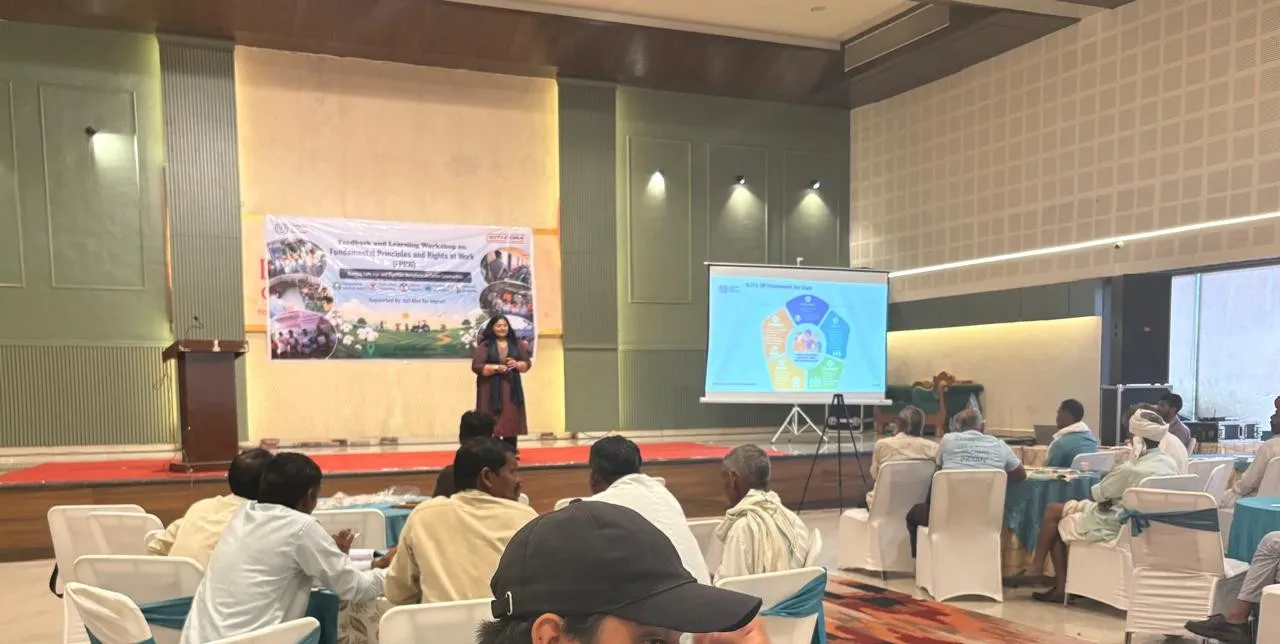
Bharti Birla, Enterprise Development Specialist at the ILO Country Office for India, highlighted the importance of affordable, high-quality care, particularly where public care infrastructure is limited. She noted that community-based care models can help formalize and professionalize informal care work, improve wages and benefits, and give workers a democratic voice in shaping their working conditions.
Participants and stakeholders agreed to pilot initiatives promoted by the ILO for member-owned enterprises to improve working conditions, create sustainable jobs, and address community care needs.
The two engagements underscored the importance of moving from awareness of labour rights towards locally owned mechanisms that can continue beyond individual project activities. By strengthening partnerships, referral systems, access to government services and community-based organizations, RISE for Impact partners aim to embed fundamental principles and rights at work more firmly within cotton-growing communities in Madhya Pradesh.


