
An older adult in hospital for an infection suddenly becomes fearful, irritable and doesn't recognise their lifelong spouse. The confusion and distress are frightening for loved ones and hospital staff are concerned.
While this scenario looks like – and is often mistaken as – dementia, what's unfolding is delirium. Delirium is one of the leading hospital-acquired health complications in Australia.
Early recognition is crucial for better patient outcomes and can potentially save the Australian healthcare system millions of dollars annually.
Southern Cross University has stepped up to lead a national project that empowers carers and nurses to prevent, recognise and respond to early signs of delirium.
Quick facts
What is delirium?
Delirium is a sudden, temporary, and severe state of confusion, characterised by disturbances in attention, awareness, and cognition that develop over hours or days. It happens while a person is in hospital.
Unfortunately, delirium is often misdiagnosed in older adults as dementia. Unlike dementia, which is usually chronic and progressive, delirium is acute and typically temporary. Early recognition is crucial for better patient outcomes.
Innovative delirium research project
Professor Christina Aggar of Southern Cross University is leading an innovative delirium research project that has the backing of a $1.34 million grant from the National Health and Medical Research Council (NHMRC).
Southern Cross University, in conjunction with Northern NSW Local Health District, along with the University of Canberra and Canberra Health Services, has developed an innovative, easy-to-use model of care, known as PREDICT – Prevention & Early Delirium Identification Carer Toolkit – that is now in a clinical trial phase.
The PREDICT co-designed model of care empowers carers and nurses to prevent and respond to early signs of delirium.
/prod01/channel_8/media/scu-dep/news/images/2026/Delirium-clinical-trial_2026-March-11_DSC_2411_credit-Southern-Cross-University-LOW-RES.jpg) Play video
Play video Video transcript
KATE, a carer: I found that my mum changed personalities. Um, she went from being a person that would listen and do things to a person that was totally cranky, wouldn't do what she was asked to do. And she was disorientated, not knowing which room she was actually going to.
ERIN DAVIS, lecturer at Southern Cross University: Delirium is completely dependent on the person and then also the underlying cause. So, we can have a hypoactive delirium that kind of mimics almost like a depression. So people can be really low mood. They can be really withdrawn, not wanting to participate. We can also have a hyperactive delirium which is more when we see um wandering behaviours, loud verbalisations. It might be people crying out for help. It could be agitation and aggression. There can also be a mix of the two as well.
PROFESSOR CHRISTINA AGGAR, Project leader, Southern Cross University: It affects around on average 20% of patients over 65 being admitted to hospital and up to 10% of those once they've been admitted. Delirium traditionally is a hospital-acquired complication and it still is, but we were seeing more and more cases of delirium coming through the emergency and we were seeing more and more cases of patients being discharged with either an unresolved delirium or an undiagnosed delirium.
ERIN DAVIS: Carers are vitally important to the diagnosis and the management of delirium. They understand nuance changes that us as clinicians cannot perceive sometimes.
CHRISTINA AGGAR: PREDICT was co-designed with not only clinicians and carers but also patients.
ERIN DAVIS: The PREDICT toolkit it's a really easy to understand toolkit that they can take home. They can give to other family members as well.
CHRISTINA AGGAR: When we piloted the program in Tweed Hospital, we found that there was a statistically significant reduction in the incidence of delirium. So PREDICT was not only useful for carers in hospital, but it was also useful for when they went home because once you've been diagnosed with a delirium once, you're more likely to get a second and a third delirium.
ERIN DAVIS: If we can start to understand the small changes that people go through and we can start putting a plan in place to manage and resolve the delirium earlier, it actually leads to better long-term outcomes for that patient.
A 'fire' that wasn't there: a carer's distress when a loved one behaves out of character
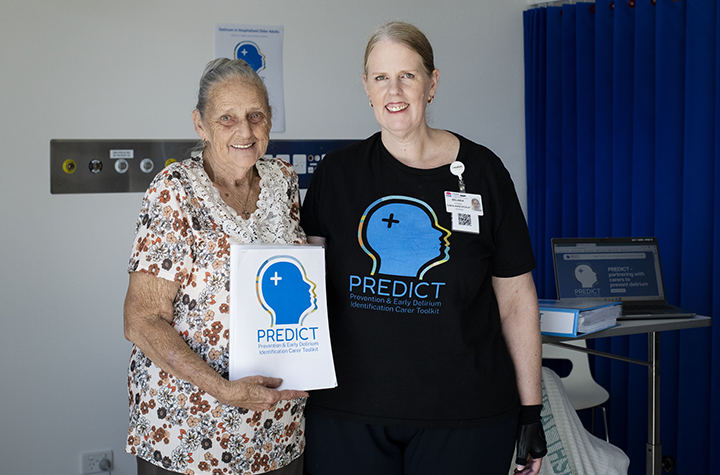
Evelyn Rigney (left), who looked after her brother-in-law when he experienced delirium, holds the PREDICT delirium toolkit alongside Belinda Lincoln, Clinical Nurse Consultant PREDICT at the Northern NSW Local Health District.
What was meant to be a joyous event – a wedding in Tweed Heads for Evelyn Rigney's daughter 15 years ago – turned into a nightmare for the extended family.
Evelyn's brother-in-law Graham Smith, who'd travelled from Townsville for the occasion, fell while out walking alone, breaking his arm.
In Tweed Hospital for treatment, Graham's condition took a distressing turn: he experienced vivid hallucinations, at one point believing people were having a campfire in his hospital room.
"He became extremely agitated trying to pull out his IV, and even becoming abusive to staff," said Evelyn.
Eventually, Graham was discharged locally to Evelyn's house in Tweed Heads before finally travelling home to Townsville. He fully recovered.
Evelyn said a better understanding of delirium among hospital staff and an improved ability by family to support loved ones could make all the difference.
"The toolkit tells you step-by-step what to do. PREDICT will be brilliant for carers," said Evelyn.
"And carers know their loved ones best. A lot of people say, 'they're in hospital, the nurse should know'. Nurses do not know your person like you do, so you can't blame it on nurses, they do a brilliant job.
"I wish PREDICT was around years ago with Graham as it would have made me understand it more."
Alex went months not knowing he had delirium; it can affect young people, too

Alex was on a snowboarding adventure in the US before he became unwell.
ACT resident Alex* was just 39 when an illness caught on a snowboarding holiday in the United States turned his life upside down. What started with a heavy cold towards the end of his three-week adventure left him in a psychiatric facility with suspected schizophrenia.
Eventually a correct diagnosis determined a series of events had left Alex with delirium – a short-term cognitive impairment that is a stress response caused by acute illnesses or medical complications. It is most commonly seen in older people in hospital, where the confusion, agitation and delusions can be mistaken for dementia.
It was January 2022 when Alex was left feeling exhausted and unwell in the US, along with a slight sense he couldn't make rational decisions. A COVID-19 test came back negative, so when the time came, he got on the plane home.
"Essentially, I had a panic attack on the plane. I didn't have any history of mental ill health or illicit substance use or anything like that. And it got worse and worse," he said.
"By the time I had landed back in Australia, I was experiencing a whole range of different psychiatric symptoms."
Once back on home soil, Alex was put on anti-psychotic drugs – which have a suite of side effects that can include, paradoxically, delirium – before he was discharged and could then see a psychiatrist for a post-discharge review of his case. The psychiatrist retrospectively diagnosed him with hyperactive delirium. It was the first time he had heard of it.
"She thinks the underlying cause was the pneumonia-like illness that I had," Alex said.
Alex believes the PREDICT delirium trial has the power to help prevent future cases like his.
"If delirium had been on the hospital staff's radar, I probably would have been treated differently, but because of my age, and because of my state when I came in, I think they just thought I smoked some ice or something!" said Alex.
*A pseudonym has been used to protect Alex's privacy.
The health partnerships aiming to make a difference in people's lives
Over the next 12 months, the PREDICT toolkit (web, smart phone or paper-based) will be trialled with more 2,500 patients, aged 65 years and older, admitted to surgical and medical trial wards at hospitals in NSW, the ACT and Queensland.
Partner hospitals include Tweed Valley Hospital, Lismore Base Hospital, Canberra Hospital, North Canberra Hospital and University of Canberra Hospital.
"Delirium can be very serious and stressful for the carers, family and health care workers as well as the person who acquires it," said Professor Christina Aggar of Southern Cross University.
"It is a stress-response while a person is in hospital, usually caused by a number of underlying acute, short-term illnesses and medical complications, for example infection, pain, surgery or changes in the environment. It is often mistaken for dementia because both conditions have similar symptoms, such as confusion, agitation and delusions. However, unlike dementia, delirium comes on very quickly and is potentially reversible."
Professor Aggar said carers played an important role alongside clinical staff in preventing and recognising the onset of delirium.
"Carers can detect subtle changes in the health and behaviour of a patient that health professionals may miss, for example a nurse who has never met the person before might not realise the patient doesn't always behave in such an erratic way," said Professor Aggar.
Northern NSW Local Health District Director Nursing and Midwifery Katharine Duffy said it was exciting to see this project proceed to clinical trial.
"Northern NSW is home to a significant aging population, with one in four people in the region expected to be aged 70 years or older by 2041," Ms Duffy said.
"And we know 50 per cent of patients aged over 65 years are at risk of delirium while hospitalised, so the importance of this project cannot be overstated.
"We are excited to have been involved in this innovative research project since it was successfully piloted in our hospitals in 2023-24. Delirium is a serious condition and anything we can do to better manage it will lead to improved outcomes not only for our patients and their families and carers but also for our staff."
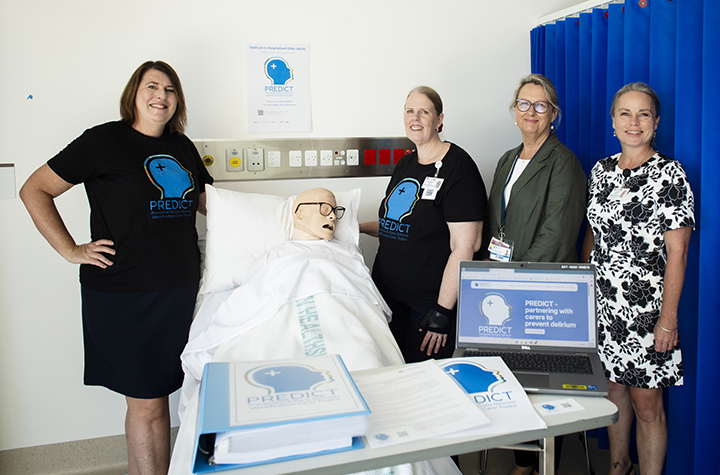
The NSW partnership (l to r): Dr Carla Sunner, Project Manager for the PREDICT delirium clinical trial at Southern Cross University; Belinda Lincoln, Clinical Nurse Consultant PREDICT at the Northern NSW Local Health District (NNSWLHD); Professor Christina Aggar, Chief Investigator for the PREDICT delirium clinical trial at Southern Cross University; and Karen Bowen, Nurse Manager Clinical Practice Nursing and Midwifery Services, NNSWLHD.
Canberra Health Services spokesperson, Ms Kellie Lang, Executive Director Nursing and Midwifery, says delirium is one of the most distressing experiences a patient and their family can face in hospital.
"Delirium can be hard to identify early. Working in partnership with carers through the PREDICT model will help us recognise changes and intervene quickly," she said.
"Canberra Health Services is pleased to be working alongside Southern Cross University and the University of Canberra to introduce this model of care into our trial wards. It is the result of the long-term sustained effort to make a difference in cognitive care in hospital.
"This trial reflects our commitment to safe, person-centred care and to supporting families and carers as essential partners in a patient's recovery," said Ms Lang.
Professor Kasia Bail from the Centre of Ageing Research and Translation at the University of Canberra has spent the last decade researching delirium and advocating for more awareness of the condition.
"This trial, developed in conjunction with Southern Cross University, has been a longstanding team effort between CHS and UC to improve care of people with cognitive impairment in all settings, and particularly in hospitals," said Professor Bail.
"Anybody can get delirium, however, it's most common in older adults in hospital. Delirium is likely to last longer in older people and have more consequences, like other complications and long hospital stays. That's why this program is so important, so we can recognise and reduce the impact of delirium on people most at risk.
"Hospitals can be a bit like a long-haul flight: confined in a restricted space with strangers and limited choices, and this situation, combined with complex illness and medications, can affect brain function. PREDICT will help people stay oriented or identify changes early for safer landings.
"Our UC research team always says 'cognitive care is everybody's business'. This program is the next intervention in our suite of cognitive care changes we need to improve health workforce interventions and health services," Professor Bail added.
Ethics Approval
The PREDICT clinical trial has ethics approval: 2025 MNH 1173312.


