
South Australian Track Injuries
2026
South Australian statistics supplied by the Coalition for the Protection of Greyhounds (CPG) on 12 March 2026.
Greyhounds carry a long list of myths on their narrow shoulders, most of them shaped by the racing industry rather than the dogs themselves.
Spend even a few minutes with an ex-racer and you quickly realise how far those myths are from the truth.
These dogs are gentle, sensitive, affectionate, and often just trying to make sense of a world they were never prepared for.
Myth: "Greyhounds are aggressive"
We're tired of this myth. Greyhounds aren't born aggressive – they're recovering from an industry that denied them a normal life. In reality, they're one of the most soft‑natured, docile breeds you'll ever meet. Historically, they worked alongside humans as hunting companions, which meant cooperation, not combat, was essential.
Many greyhound puppies spend their critical socialisation period (3-18 weeks) in paddocks with minimal human contact. Of the puppies whelped, around 60% enter race kennels, and a significant number have had almost no exposure to normal life.
Once in racing kennels, the situation often worsens. Many greyhounds are kept in small, barren, single-dog pens with little opportunity for play, mental stimulation, or social interaction. Some codes of practice even allow pens as small as 1.2 × 1.8 metres with only 30 minutes of exercise a day.
Any behaviours that look like aggression – fearfulness, resource‑guarding, or reactivity – aren't inherent traits. They're learned responses shaped by racing life: isolation, lack of enrichment, and training that heightens their instinct to chase.
With time, patience, and proper socialisation, these behaviours fade as the dog learns that the world is finally safe.
Myth: "Greyhounds can't live with small animals"
Another myth that refuses to die is the idea that greyhounds are universally dangerous around cats or small pets. While some do have a strong chase instinct, many actually have no prey drive at all.
Racing trainers try to build prey drive to improve performance, but not every dog responds. Many greyhounds are dropped from racing because they're too slow or simply uninterested in chasing a lure.
Combine that with poor socialisation and long hours in kennels, and you get dogs who aren't dangerous – they're underexposed to normal life. They've never lived in a home, never met a cat, never learned how to behave in a normal environment.
Myth: "Greyhounds aren't affectionate"
This is perhaps the most heartbreaking myth of all. Greyhounds are incredibly affectionate, but many have never been shown affection before.
When a dog has spent up to 23 hours a day in a kennel, with minimal human contact and no enrichment, it takes time to learn that hands can be gentle, that voices can be kind, and that they are finally safe.
Once they feel secure, they blossom. They lean in, they snuggle, they follow you from room to room, and they become the world's most devoted couch potatoes.
Molly's Story
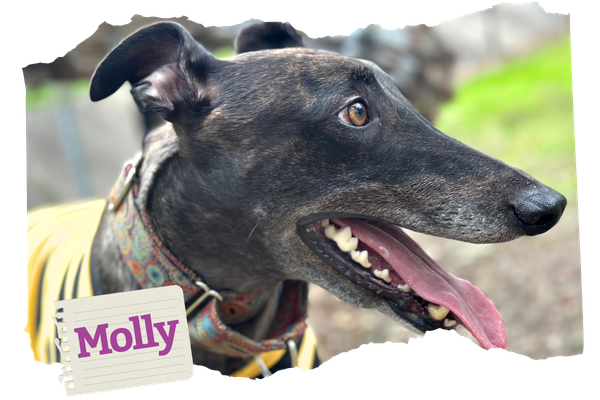
Meet Molly, an ex‑racing greyhound whose life proves just how wrong these myths can be.
Molly "failed" race training at just 16-18 months old. Not because she was aggressive or high‑drive, but because she had zero prey drive. After more than a year waiting in limbo, she was finally listed for adoption as "cat potential".
But when she arrived in her new home with her mum, Karen, it wasn't her new cat‑sister that challenged her – it was the world itself. The toaster, the TV, footsteps outside the window… everything was terrifying. Molly had never known a home, never heard household noises, and never been held with love.
"Molly was a terrified, scrunched up bundle. Everything, and I mean everything, was scary to her," said Molly's mum, Karen.
Karen patiently desensitised her to every sound and every fear, one by one. The greyhound community rallied around her, walking with her daily to help her build confidence.
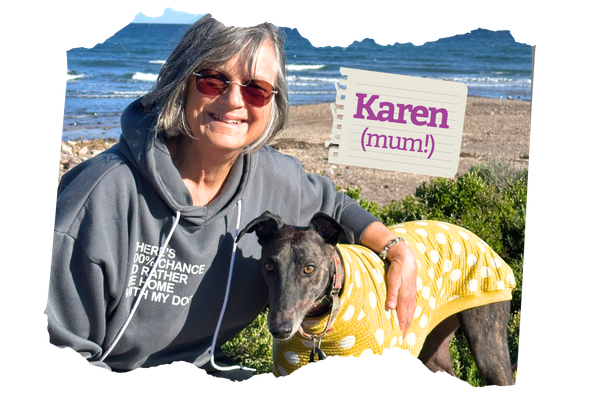
Eighteen months later, Molly confidently leads group walks, plays every day with her cat‑sister Cayleigh, and wakes each morning expecting (and demanding) her chest massage and ear rubs.
She sleeps upside down on the couch, legs in the air, completely trusting the world that once overwhelmed her. She is, as her mum says, "the joy of her life."
Greyhounds like Molly remind us that behind the racing numbers are gentle souls waiting for patience, safety, and love. Once they find it, they give it back in ways that change lives.
Rest In Peace - Major Ando
And then there are individual stories that cut through the statistics.
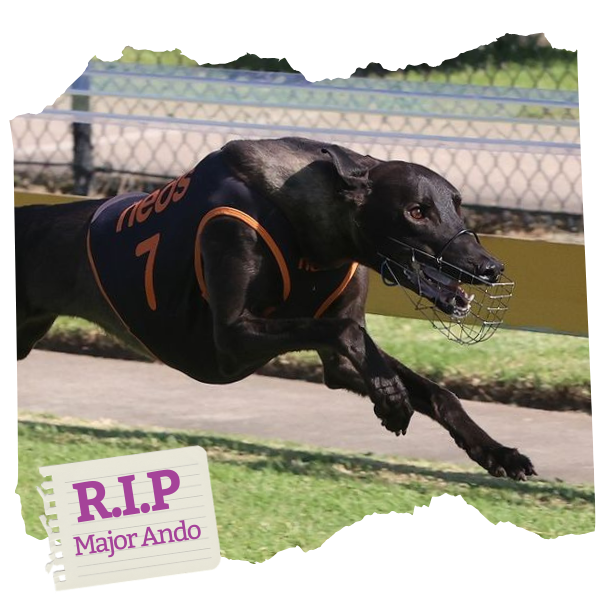
Major Ando, an older greyhound forced to keep racing in a "Masters" event in Townsville, suffered a catastrophic spinal fracture just seconds after the start and was euthanised on the track on 9 January.
His death, described by the commentator only as "going amiss," highlights the extreme risks older greyhounds face when the industry continues to race them despite their vulnerability.
In 2023, the report from the independent inquiry into South Australia's greyhound racing industry laid out 87 recommendations to address the governance and grievous animal welfare issues in greyhound racing.
As much as RSPCA South Australia welcomes reform that will genuinely improve the lives of greyhounds in the racing industry, we have serious doubts that SA's greyhound racing industry will clean up its act by the Inquiry deadline of 7 July 2026.
And even if the industry does implement all inquiry recommendations, it's doubtful that these measures will fix the deep‑rooted animal welfare problems that have resulted in thousands of greyhounds being injured or killed over so many years.
If the industry wants to earn the community's trust, it must clearly and consistently demonstrate, with evidence, that every greyhound is afforded good welfare from birth through to the end of their life.
Until that happens, Greyhound Racing SA cannot claim a social license to operate.
Greyhounds deserve better.
If you believe this too, please stand with us.


