
Vietnam Housewares is an Australian-owned business that has spent more than 30 years building a thriving manufacturing and design partnership in Vietnam.
What began with a single container of ceramics in the 1990s has evolved into a global supply chain, with over 1,500 factory workers and thousands of weavers producing hand-crafted homewares for major retailers across Australia, Europe and North America.
The company's success has created new roles and capabilities in Australia while supporting sustainable material innovation and rural employment in Vietnam. Now preparing to launch its first global homewares brand, Vietnam Housewares offers a powerful example of what long-term, values-led investment in Southeast Asia can make possible.
A handmade beginning
When Australian wholesaler Mark Etinger first received a random batch of Vietnamese ceramics in the early 1990s, he didn't expect it to mark the start of a decades-long business journey. The shipment wasn't even intended for him - a friend couldn't sell the goods and offered Mark a small trial.
'Apparently the product sold out within three days,' recalls Nathan Etinger, a senior leader at the company. 'They said "We want more. We want more".'
For Etinger, the message was clear. There was something in Vietnam's hand-crafted ceramics that resonated deeply with Australian shoppers. This was an era when nearly all homewares supply chains pointed toward China.
'Vietnam wasn't necessarily a place that was looked to for manufacturing and importing products,' he says. 'It very rarely was ever done.'
Vietnam Housewares was born from that curiosity - and a belief in being different. 'Mark loves to go left when everyone's going right,' says Nathan. 'He loves to be innovative. He enjoys being a pioneer.'
From trading house to manufacturing pioneer
The business, founded by Etinger and his Vietnamese partner, Lai Tri Moc, began as a trading house, sourcing and exporting goods from Vietnam to major Australian retailers. What set them apart was their early commitment to building trust between cultures - including opening one of the first Westernised showrooms in Ho Chi Minh City.
The company evolved again in the early 2000s when retailers began sourcing directly from Vietnam and Southeast Asia. Instead of losing relevance, the founders doubled down and built their own manufacturing capacity. The new era started with a single factory - and now includes more than 1,500 factory workers and 10,000 hand-weavers.
'We became one of the biggest exporters of woven handicraft baskets out of Vietnam,' Nathan says, describing the iconic water hyacinth storage baskets and plant holders that took over Australian homes.
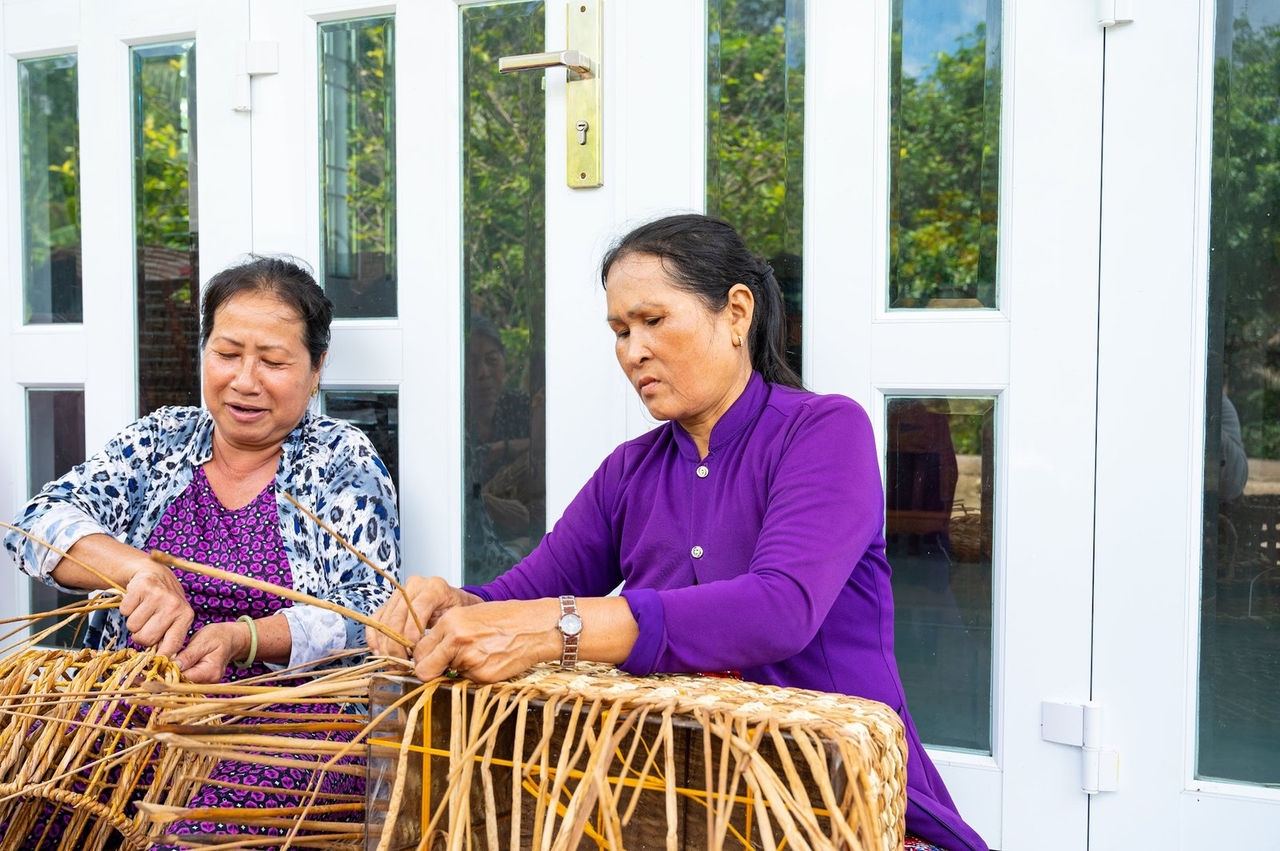
Vietnamese weavers using bulrush to create housewares that are exported to Australia, Europe and North America.
Building bridges, not just business
One of Vietnam Housewares' most significant milestones has been its work with local partners in pioneering the use of bulrush - a fast-growing, climate-resilient water plant - as a sustainable material for the company's woven homewares.
'There's nothing better than feeling you can make change and do good in the world,' Nathan says, explaining how the project supports both environmental restoration in the Mekong region and income opportunities for rural craft communities.
By introducing bulrush into the global supply chain through major Australian retailers, the company shows how commercial design and climate action can be aligned - creating products that don't just look natural, but genuinely contribute to ecological and economic resilience.
Despite operating its factories in Southeast Asia, the company's growth has created demand back home.
'It did grow our Australian business exponentially,' Nathan says. 'We needed the people in Australia to manage that demand - account managers, designers, technical people.'
That jobs pipeline is part of a broader, layered structure: Vietnamese craft, Australian design sensibility, and global retail distribution.
'We knew the Vietnamese makers would find it hard to understand Australian design and aesthetic,' he explains. 'And the Australian labour market was never going to have the skill to weave these products. The whole supply chain is beautifully linked.'
Why Southeast Asia matters now, more than ever
As Australia seeks to diversify its trade footprint, the Vietnam Housewares experience offers a timely perspective.
'The big one is the diversification of our partners and supply chains,' says Nathan. 'If we'd had more of Asia online when China's borders shut down during the pandemic, it would have maybe softened some of the disruptions caused to the global supply chain.'
Beyond risk mitigation, there's opportunity: 'Southeast Asia is one of the fastest-growing economies. It's got a lot of investment happening and I think that's exciting for Australia,' says Nathan.
Stronger ties give Australia more than economic advantage - they build regional trust. 'The more we build these ties, the more we're able to make sure all our interests are aligned,' he says.
Factory and brand ambitions
The company's next chapter is already taking shape. 'We've opened our new factory down in Vinh Long and we've got our next 3 to 5-year plans to expand capacity and build out a much bigger workforce or the region,' says Nathan.
But the biggest leap may still be ahead: a move into branding. 'We've never had a furniture brand or a housewares brand, but we're looking at going into that in the next 12 to 24 months. It's an Australian success story, if it happens,' says Nathan.
Lessons from 30 years on the ground
Three decades on, the advice is simple and earned: 'Do your due diligence,' Nathan warns. 'Make sure you get the right advice from experts in the right field.' Misunderstanding legal or tax structures costs more later.
Above all, he says, expanding into Southeast Asia requires patience, humility - and the willingness to learn in both directions.


