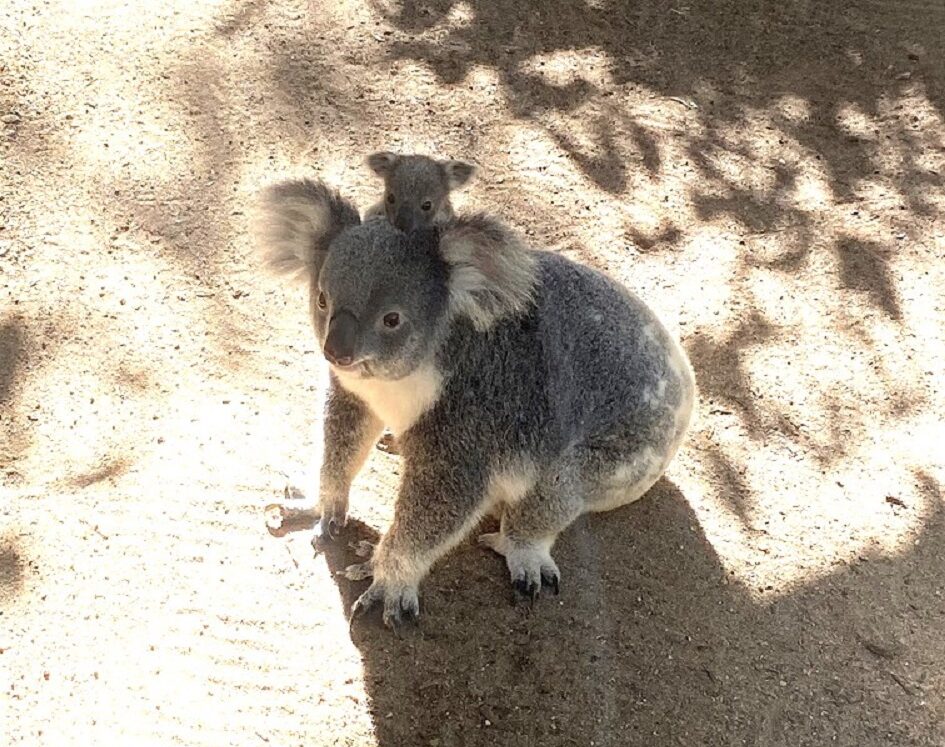
A prototype artificial intelligence-powered camera incorporated into an intelligent road sign has successfully detected and recorded a koala crossing a road in real-time on Redlands Coast, marking the first time this technology has been proven in the field.
This development expands on previous research led by Griffith University that built an AI-powered database to detect and record koalas at various high-use transport crossings, and confirms intelligent detection systems can play a critical role in preventing wildlife-vehicle collisions and saving lives.
The trial, led by researchers from Griffith's School of Information and Communication Technology (ICT) in partnership with the New South Wales Department of Climate Change, Energy, the Environment and Water (DCCEEW), Telstra and Redland City Council, was part of a broader initiative funded under the New South Wales Koala Strategy to reduce koala road fatalities and support population recovery.
Griffith University had been trialling the system on the Redlands Coast since March 2025. Using edge computing - which is a decentralised IT architecture that processed data near its source - and real-time video analysis, the technology demonstrated it could detect koalas in real time as they approached or crossed a road.
This successful detection laid the groundwork for future systems that could trigger roadside warning signs and improve driver responsiveness.
Deputy Head of School of ICT Professor Jun Zhou said traditional static road signage failed to address the unpredictable timing and location of koala movements.
"Drivers become desensitised after repeated exposure to signs without encountering wildlife, reducing their responsiveness when real hazards arise," Professor Zhou said.
"This issue is further amplified during low-light conditions - particularly between dusk and dawn - when koalas are most active and visibility is poor."
Koalas were facing unprecedented threats, with populations at risk due to habitat loss, disease, dog attacks and road mortality.
As urban development continued to encroach on koala habitats, koalas were increasingly at risk of a car strike as they attempted to cross roads.
"The successful detection of a koala proves the concept works," Professor Zhou said.
"With further investment, this pilot can be expanded into a scalable solution that protects more wildlife and improves public safety across high-risk corridors.
"This is more than a tech milestone - it's a turning point. We now have the ability to intervene before tragedy strikes. Expanding this system could be a game-changer for koala conservation and road safety."
Professor Jun Zhou
"By creating responsive infrastructure that adapts to koala behaviour, we're aiming to reduce road fatalities and safeguard one of Australia's most iconic species."
This development followed research contributed to by Griffith University's Dr Douglas Kerlin that found the koala population in Redlands City Council had stabilised with no evidence of continued decline since 2018.
Redland City Council Mayor Jos Mitchell said the findings reflected years of council investment in science-based conservation, technology and community-led programs.