
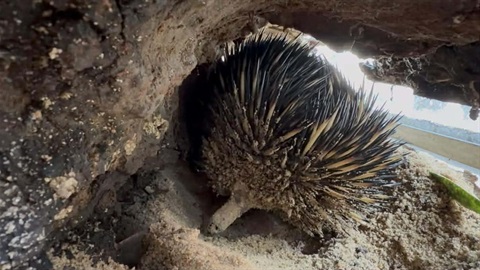
A short-beaked echidna has joined Rockhampton Zoo, taking up residence in a newly refurbished Aussie animals enclosure.
Mono -named after the word "monotreme," meaning egg‑laying mammal - arrived from Currumbin Wildlife Sanctuary and has now completed her settling in period.
Councillor for Sports, Parks and Public Spaces Cherie Rutherford, said the team is thrilled to introduce Mono to the community.
"Mono is making her debut today after being in quarantine, and we're thrilled to welcome her," Cr Rutherford said.
"She's about 25 years old, which may sound like an older animal, but echidnas can live up to 50 years in captivity - so she's really only middle‑aged.
"Our keepers have been getting to know her, and she is settling in beautifully.
"She's taken to her new enclosure very well, which includes a mix of sand, soil, logs and rocks that give her plenty of places to dig, forage and burrow.
"She has a very healthy appetite and eats all her food - with the exception of fly pupae - which she funnily picks it out of her dinner every time."
Cr Rutherford said visitors will enjoy getting to know Mono also, though they may need to be patient.
"As a nocturnal and naturally shy species, Mono can be tricky to see, but the enclosure includes two viewing windows to maximise the chances of spotting her," Cr Rutherford said.
Mono's enclosure is located beside the kangaroo exhibit and forms part of the zoo's expanding Australian wildlife precinct.
Zoo Director, Liz Bellward, said Mono will be joined by additional native species in time.
"It's incredibly special to experience more of Australia's unique animals up close, especially for our international visitors," Ms Bellward said.
"An additional enclosure has been built beside Mono's, and we hope to bring more native species to this area.
"We would love more echidnas, and potentially small macropods such as quokkas or pademelons, and some arboreal species such as possums or gliders.
"We are still in the planning stages of this but look forward to keeping the community updated."
As well as Mono, the Aussie animals precinct currently includes dingoes, a wedge-tailed eagle, wombats, koalas, bushbirds, freshwater turtles, cassowaries, perenties, crocodiles, lizards, emus and kangaroos.
Rockhampton Zoo is open from 9am until 4:15pm daily and entry is free.
Fast fact on short-beaked echidnas:
- Short-beaked echidnas are found across Australia and parts of New Guinea.
- They are solitary and mostly nocturnal, emerging at night to forage.
- During the day, they shelter in hollow logs, dense vegetation or burrows.
- Short‑beaked echidnas are covered in distinctive brown‑black and golden spines, with a coat of fur beneath.
- They measure between 35 - 55cm and weigh up to 6kg.
- There are only 5 monotreme species alive today. The platypus and 4 echidna species.
- Baby echidnas are called "puggles," and females carry their leathery eggs and young in a temporary pouch.
- Echidnas have no teeth and grind their food between the tongue and roof of their mouth.
- An Echidna's tongue is about 15cm.
- Their scientific name, Tachyglossus, means 'fast tongue.
- Their favourite foods are ants and termites, though they also eat beetle larvae and worms.
- They can eat up to about 40,000 ants and termites per day


