
A more streamlined tidal barrier structure will cut costs and construction complexity and provide the same level of protection for 12,800 homes and businesses.
The Environment Agency has undertaken a design efficiency review to ensure the Bridgwater Tidal Barrier scheme continues cost-effective delivery without compromising outcomes while maintaining construction progress.
The core purpose of the Bridgwater Tidal Barrier scheme, protecting 12,800 homes, businesses, and vital infrastructure from tidal flooding remains unchanged. To date, the design changes are to the tidal barrier superstructure. These changes allow the use of more modern methods of technology and construction, which will reduce costs.
The same level of flood risk reduction will be achieved, while ensuring the scheme stays affordable and sustainable for the long term.
What has changed?
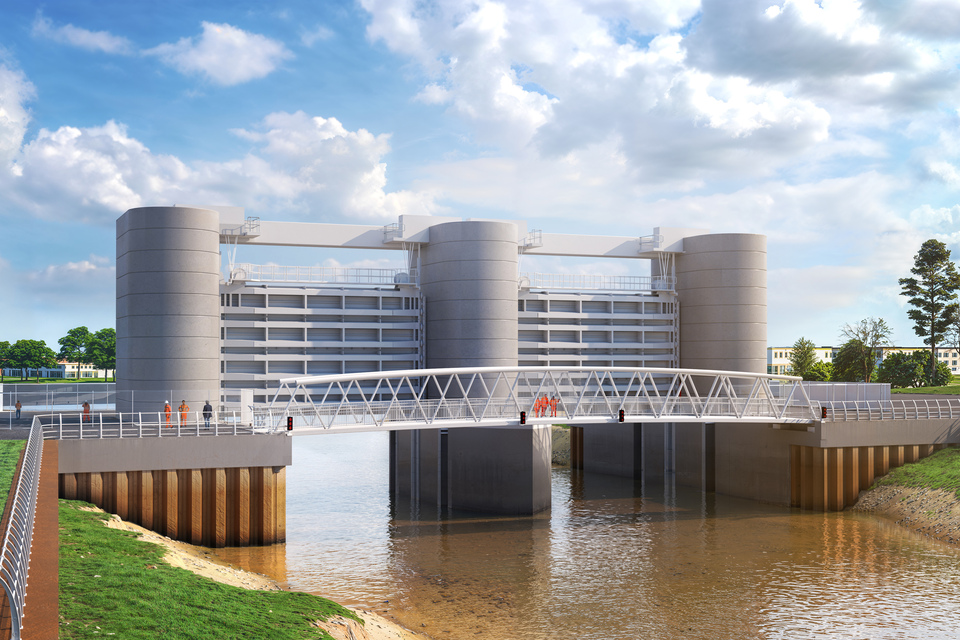
Key refinements include:
A 10 metre reduction in overall height: the three towers will now be approximately 13 metres high.
Streamlined, more uniform tower shapes with more modern mechanical systems.
Relocation of drive equipment (that moves the barrier gates) to the base of the towers, making easier and safer access for maintenance, while reducing long-term operating costs.
Lighter, high-level walkways in place of the former overbridge, providing operational access between the towers.
The Bridgwater Tidal Barrier scheme is hosting public drop-in sessions on 21 and 23 January to show recent progress to date, and to share outcomes in relation to the design efficiency review. Project team representatives will also be on hand to answer questions.
What else is being reviewed?
While affordability is a key consideration, the review also assessed constructability, operational efficiency, carbon reduction and long-term maintenance requirements.
The review is ongoing, and further work is underway to reduce increased costs in areas such as the operational building and landscape design. Once this work is complete, an updated timeline will be published later in 2026.
Ross Barton, project director for the Bridgwater Tidal Barrier scheme, said:
The review outcomes have strengthened the delivery of the scheme. It confirms we can deliver the same high level of flood protection in a more efficient and affordable way, while keeping construction moving and creating a lasting benefit for local communities.
Bill Revans, Leader of Somerset Council, said:
The Bridgwater Tidal Barrier Scheme is vital to the future of our communities and local economy. We welcome this responsible approach, which maintains flood protection while ensuring the Scheme remains affordable and on track.
Progress and funding

The jack-up barge working on the substructure of the Bridgwater Tidal Barrier across the River Parrett and the completed bypass channel.
Significant progress has been already made with construction of the barrier substructure and downstream defences. Construction of the barrier substructure will continue while the updated design for the superstructure is incorporated.
Enabling work started in early 2023. While we cannot confirm a specific end date at this stage, we expect works to continue for a further 5-6 years, including final landscaping. Our priority is to make the barrier operational as soon as possible, so flood protection is in place for Bridgwater and surrounding areas.
The Bridgwater Tidal Barrier scheme continues to receive strong support from central government, Defra and the Environment Agency and has secured significant funding already, including full approval of its business case to date (since September 2024) for £249 million.
The cost to deliver the scheme includes the barrier and its operating buildings, new and improved downstream flood defence banks, and improved fish and eel passage at up to 12 upstream sites.
While cost pressures remain, as is common in schemes of this scale, the review has already identified meaningful savings, and further efficiencies are being developed. These steps ensure we continue to optimise every pound invested and maintain momentum.
The final cost will be confirmed once the review is complete and will be published after it has been through standard government reporting.


