
To boost business investment, enhance certainty and simplicity for businesses, and strengthen Canada's tax competitiveness, the Government of Canada proposes to implement the Productivity Mega Deduction, which will provide immediate expensing for a broad-based range of depreciable property on a permanent basis. Immediate expensing allows taxpayers to fully write off the cost of an investment in the year that it becomes available for use. This powerful investment incentive will create the conditions for an extended period of higher investment-a Canadian investment supercycle.
This measure builds on the Productivity Super-Deduction announced in Budget 2025, which provides immediate expensing to about 15 per cent of investment in capital assets, including machinery, equipment, and buildings used for manufacturing and processing, clean energy generation and energy conservation equipment, zero-emission vehicles, patents, data network infrastructure, and computers.
The Productivity Mega Deduction would permanently provide immediate expensing to a much wider range of assets and expenses (i.e., about two-thirds of investment in capital assets would be eligible). The estimated incremental fiscal cost of the measure is $36 billion over five years, beginning in 2026-27.
Assets not eligible for immediate expensing will continue to receive an enhanced first-year deduction under the Accelerated Investment Incentive.
Boosting Investment, Productivity and Competitiveness
The Productivity Mega Deduction offers a strong combination of investment support, cost-efficiency, competitiveness, and simplicity.
Immediate expensing makes it easier and more attractive for businesses to invest by allowing them to deduct the full cost of a new asset the year the asset is available for use. This lowers the cost of capital, strengthens the business case for modern equipment, and encourages companies to invest and expand in Canada. By targeting new investment decisions, immediate expensing represents a sea-change in how Canada intends to stimulate business investment decisions, and is a central part of the Government's plan to catalyse $1 trillion in additional investment.
Making immediate expensing permanent under the Productivity Mega Deduction will provide businesses with greater certainty for long-term investment decisions.
The new Canadian investment supercycle will have wide-ranging economic benefits. Private investment in new machinery and technology is one of the most effective ways to increase productivity, encouraging businesses to invest in their workers, and boosting Canada's long-term growth.
Broad-based immediate expensing generates one of the best economic returns for each dollar of fiscal cost among a range of tax incentives the government could provide.
Over a ten-year horizon, the $8.5 billion in average annual investment support from the Productivity Mega Deduction could result in an estimated increase in economic activity between 1.4 and 3 times the federal cost, translating into an average economic output of up to around $22 billion annually. The strengthened outlook is expected to support sustained labour market gains, with long-term employment increases estimated at up to 80,000 jobs annually ten years from now.
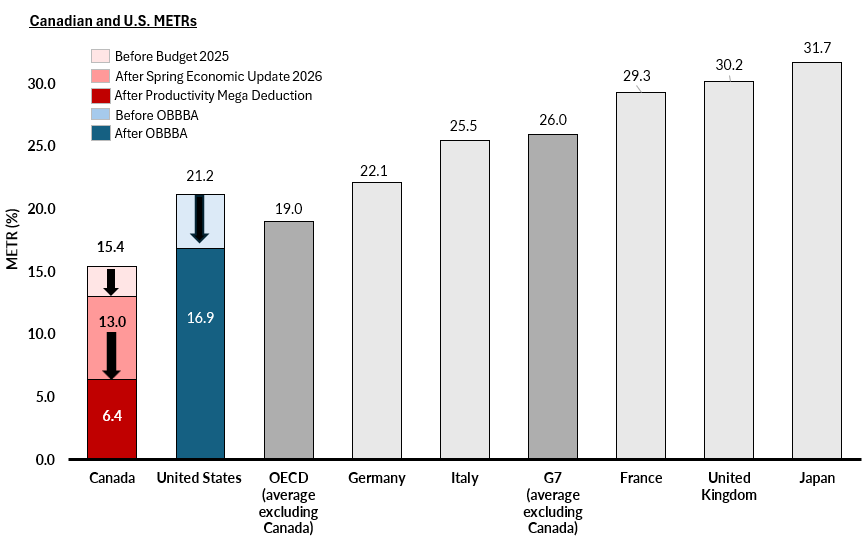
The marginal effective tax rate (METR) is the tax imposed on an additional dollar of business investment. It provides a comparable indicator of tax competitiveness across countries by accounting for national and subnational corporate tax rates, investment tax credits, capital cost allowances, and sales and capital taxes.
Accelerated capital cost allowance measures announced in Budget 2025 reduced Canada's METR from 15.4 to 13.0 per cent.
The Productivity Mega Deduction will further reduce the METR, cutting it in half to 6.4 per cent.
In comparison, as of 2026, the U.S. METR is 16.9 per cent, while the OECD average is 19.0 per cent (Chart 1).
Marginal Effective Tax Rate
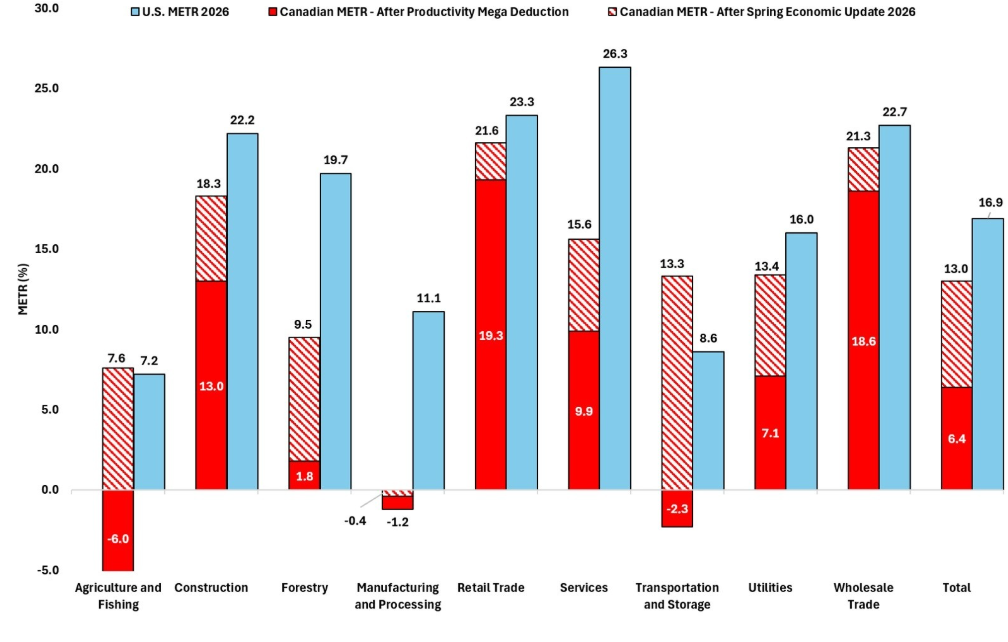
With the Productivity Mega Deduction, Canada is more tax competitive than the U.S. across all major sectors of the economy (Chart 2).
Canada's business tax competitiveness also reflects the value-added taxes employed federally and in most provinces in Canada, the alignment of federal and provincial/territorial tax bases and the fact that provinces/territories employ investment tax incentives of their own, which contribute to competitiveness.
Marginal Effective Tax Rate, by sector
The Productivity Mega Deduction builds on previously-announced accelerated capital cost allowance measures, as well as other tax competitiveness actions taken by the Government to strengthen Canada's investment climate and support productivity growth, including:
- improving the suite of refundable Clean Economy investment tax credits to incentivize investments in clean energy production and the adoption and manufacturing of clean technologies
- enhancing the Scientific Research and Experimental Development (SR&ED) tax incentive program to support innovation
- cancelling the proposed increase in the capital gains inclusion rate
- increasing the Lifetime Capital Gains Exemption limit to $1.275 million for eligible entrepreneurs
Supplementary Information
The government is proposing that immediate expensing be provided on a permanent basis for most depreciable property that is acquired on or after September 15, 2026.
A portion of the capital cost of a depreciable property is deductible as capital cost allowance (CCA) each year for income tax purposes, with the CCA rate for each class of property prescribed in the Income Tax Regulations. CCA deduction rates are generally determined based on the class to which the property belongs and calculated on a declining-balance basis.
Immediate expensing allows taxpayers to fully deduct the cost of an investment in the year that it becomes available for use.
Eligible Property and Expenses
Depreciable property eligible for immediate expensing would include all capital property that is subject to the CCA rules acquired on or after September 15, 2026, except buildings (and additions to buildings) included in CCA classes 1 and 3; property included in CCA classes 14 and 14.1 (e.g., franchises, licenses and goodwill), and class 51 (e.g., regulated natural gas distribution pipelines); certain vehicles in classes 10 and 10.1; and property depreciated under Schedule V and VI of the Income Tax Regulations.
Immediate expensing would also be available for Canadian development expenses incurred on or after September 15, 2026.
Manufacturing and processing buildings would not be eligible for the Productivity Mega Deduction due to the exclusion of Class 1 buildings, but would continue to be eligible for temporary immediate expensing as announced in Budget 2025.
Property that is not eligible for immediate expensing would continue to be eligible for the existing temporary Accelerated Investment Incentive.
Restrictions
Eligible property that has been used, or acquired for use, for any purpose before it is acquired by the taxpayer would be eligible for immediate expensing only if both of the following conditions are met:
- neither the taxpayer nor a non-arm's-length person previously owned the property; and
- the property has not been transferred to the taxpayer on a tax-deferred "rollover" basis.
In addition, rules will apply to restrict the ability of individuals, and partnerships with members who are individuals, to create or increase a loss, consistent with those that applied as part of the temporary immediate expensing measure for small businesses that was announced in 2021.
Liquefied Natural Gas Facilities
Immediate expensing in respect of Class 47 liquefaction equipment used in liquefied natural gas (LNG) facilities would take the form of an additional allowance that would bring the CCA rate for such property up to 100 per cent. This additional allowance would only be able to be claimed against income of the taxpayer that is attributable to the liquefaction of natural gas at that facility.
The 10-per-cent accelerated CCA rate for eligible Class 1 non-residential buildings used in LNG facilities, announced in the Spring Economic Update 2026, would continue to apply.
LNG facilities would not be required to satisfy the expected emissions intensity requirement proposed in Spring Economic Update 2026 in order to qualify for either immediate expensing for Class 47 liquefaction equipment or the accelerated CCA for eligible Class 1 non-residential buildings.
Immediate expensing for Class 47 liquefaction equipment used in LNG facilities represents a modification of the Productivity Super-Deduction proposed in Budget 2025. As such, it would be available for eligible assets acquired on or after November 4, 2025.


