
On Nov. 18, a group of teenagers and preteens were making magic inside a Cornell Cooperative Extension classroom in Watertown, New York. Clay wands and decorated potion bottles littered the tables, where youth worked together to concoct invisible ink, writing with Q-tips and then revealing their writing with a mixture of rubbing alcohol and turmeric.
All the while, the participants - aged 9 to 15 and enrolled in the Community Assets Resiliency Education (CARE) program offered by Cornell Cooperative Extension (CCE) Jefferson County - talked and connected.
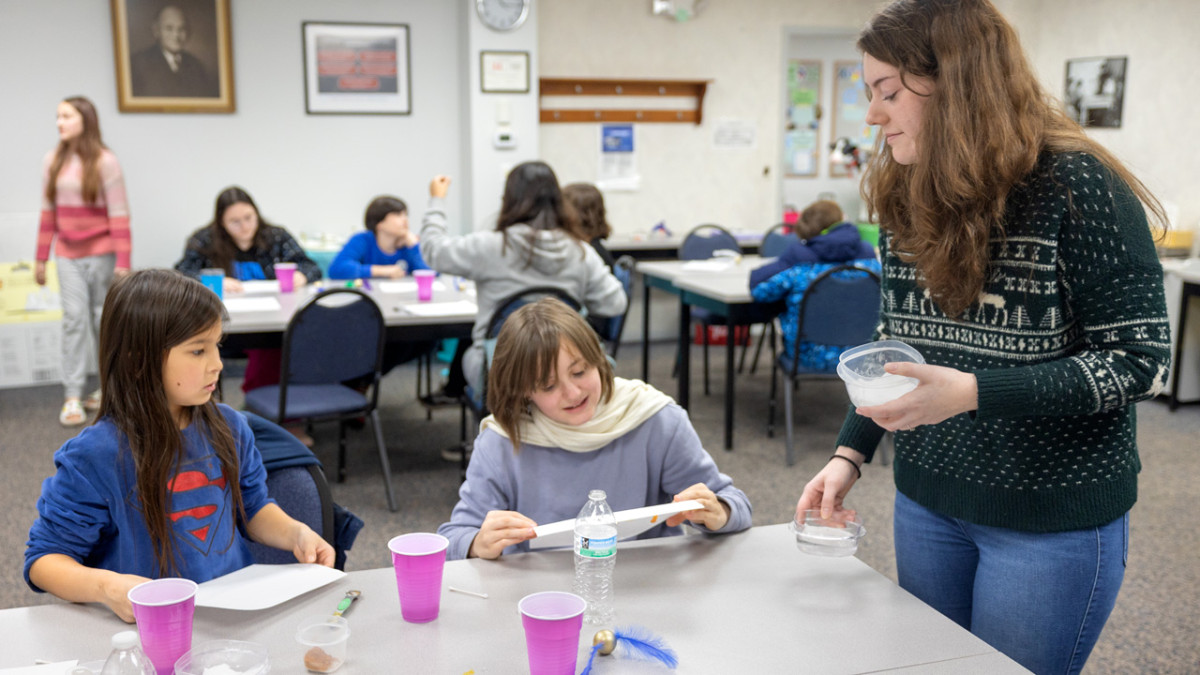
Gabrielle Dion (right), 4-H CARE wellness educator at Cornell Cooperative Extension Jefferson County, leads a group of students in a STEM activity in Watertown, New York, on Nov. 18.
"I have seen such a change in my children since they started going to this program," said Charmane McConnell, whose daughter McKenna, 15, and son Kayden, 11, participated in the latest CARE session for homeschoolers, which used the 4-H Wizarding World curriculum, based on the Harry Potter books. "My daughter has made so many friends. She gets excited to go, she enjoys all the lessons and speaks up in the program. My son has also flourished in it. It's been just fantastic for them."
Now in its second year, the CARE program, funded by the New York State Department of Health, uses multiple evidence-based curricula to strengthen communication skills, goal planning and connection to community, with components for both youth and their caregivers. With around 100 students currently participating, the program runs as a 4-H afterschool club in three middle schools across Jefferson County and, this year, has run two sessions so far for homeschoolers, with families eager to sign up for future cycles.
Participants engage in community service projects, career planning and 4-H STEM enrichment, as well as lessons that promote social and emotional well-being, such as how to intervene when someone is being bullied or reframing "I can't" to "I haven't learned that yet."
"Seeing the social emotional learning that comes from it, the ability to speak out, to find their voices is amazing," said Jennifer Howland, CARE program manager for CCE Jefferson. "We've watched a transformation of some very quiet youth who are now able to stand up not only for themselves but for others. Overall, the goal is to give them the tools to maintain positive influences and make positive choices for their futures."
The program, funded as part of New York state's Sexual Risk Avoidance Education Initiative and open to all youth, is especially aimed at helping underresourced students, or those who struggle socially or emotionally. CCE educators said the program has been particularly helpful for the large population of military families in the region.
"Youth in military families are moving around a lot, so having a concentrated time where they're building connections with others is really useful," said Gabrielle Dion, 4-H CARE wellness educator at CCE Jefferson. "We also work with at-risk youth and are able to find new ways to connect them and get them centered around work in a way that's really fun and engaging for them."
When McConnell picks her kids up, she said they fight over who tells her about the day's activities. "They're just so excited to tell me what they've done, which is not normal," she said.
McConnell also said the program has contributed to a sense of community for her, and that it's unique because it's free.
"All of us are actually a little stressed about making sure we're on the list for the next session," she said.
'Full spectrum'
Before making their invisible ink on Nov. 18, the youth spent an hour discussing another mysterious topic: their futures. They created a timeline that plotted their career goals and how they would get there.
The activity is part of the evidenced-based Project Adult Identity Mentoring (AIM) curriculum, created by Children's Hospital Los Angeles, which helps youth envision positive futures and make safe and healthy choices to achieve their goals.
For the second hour, the group switched to the 4-H Wizarding World curriculum, gluing feathers onto Styrofoam balls to make Quidditch snitches and mixing baking soda and water to create their invisible ink.
Dion, who ran the session with Kara Coon, 4-H youth development educator, said the combination of activities allows the youth to express themselves in different ways.
"We really get to see the full spectrum of the kids' abilities, socially, academically and then creatively," she said.

McKenna McConnell, 15, shares her Quidditch snitch at a Cornell Cooperative Extension program for homeschoolers on Nov. 18.
The afterschool iteration of the CARE program, which meets weekly during the school year, covers much of the same ground, implementing 4-H programming and career planning. But through the evidence-based Teen Outreach Program (TOP) curriculum, created by national youth development nonprofit Wyman, there's also an emphasis on community service. Last year, students in the schools planned and executed drives for local animal shelters, food pantries and the children's hospital. Students earn 20 hours of community service learning through the program.
Jessica Lowe said her son Jonah, 11, a student at Carthage Middle School, was most engaged by planning a donation drive for the Lewis County Humane Society. "Jonah has become more aware of what the community would benefit from," she said of the program. "He has grown as an individual socially and become more confident in himself."
Mobilizing a village
The overall CARE program also supports caregivers and facilitates communication between parents and their teens, offering multiple events, workshops and class series. One is the 11-week Strengthening Families program, which uses an evidence-based curriculum developed by Iowa State University Extension. Every week, CCE educators bring parents and their children together for meals and conversation. In last spring's session, Howland, again, witnessed transformation.
"One of our families, the mom was having a very rough time with the child and communication, and when they came in, you could feel the tension," she said. "By the end of the 11 weeks, they would come in laughing and giggling. We definitely saw this change in the way they talk to each other and the way they thought about each other - it was a fantastic revelation."
While the CARE program is only in its second year, Howland said it has already built a strong network to support youth, including a referral system to provide help and support beyond the program.
"It does take a village," Howland said. "We're building that connectedness and helping kids build meaningful relationships with the adults in their lives."


