
From the desk of Dr. Andy
Andrew C. Agwunobi, MD, MBA, Chief Executive Officer, EVP for Health Affairs, UConn Health
Dear Colleagues,
This week President Radenka Maric and I, along with the UConn and UConn Health CFOs, the UConn vice president for student life and enrollment, and the government relations team, presented at the General Bonding Subcommittee of the state legislature. Just for background you often hear me talk about the "block grant," funding UConn Health receives from the state, now about 8% of our budget (If you recall it was approximately $200M in FY 25, $143M in FY 26 and will be $138M in FY 27). These block grant funds represent operating dollars or funds we apply to operations such as paying salaries. What I refer to less often are the capital dollars we receive from a state bonding process that we use for deferred maintenance, construction, Information technology, some equipment, and so on.
The bonding process has various steps but the bonding subcommittee's role is to prepare recommendations for what projects should receive bond authorization, how much bonding authority should be granted and any adjustments to prior authorizations. These recommendations are forwarded to the full Finance, Revenue and Bonding Committee for a vote.
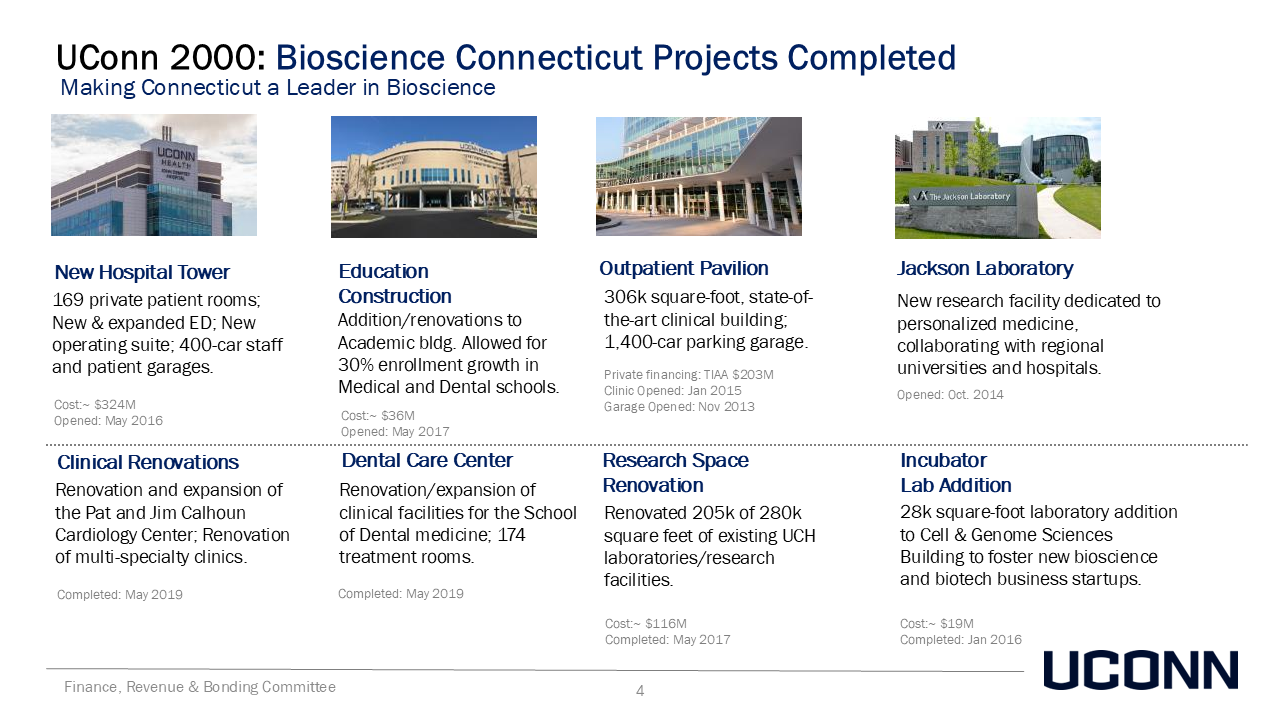
In my testimony I informed the subcommittee that over the past 30 years, the UConn 2000 capital program (i.e. state bonding) has enabled major investments at UConn Health, including:
- A new hospital tower
- Renovations to John Dempsey Hospital and the clinic building
- Expansion of the Cell and Genome Sciences Building to support bioscience startups
- An addition to the academic building to accommodate larger medical and dental school classes
I thanked them and requested that the FY27 authorization (previously approved but not yet disbursed) be maintained.
Specifically we are requesting a total of $43 million comprising:
- $30 million for deferred maintenance to ensure our facilities remain safe, modern, and compliant with codes and accessibility standards.
- $13 million for clinical equipment and IT security, which supports:
- replacement of aging equipment
- protection of patient data
- strengthening cybersecurity infrastructure and monitoring.
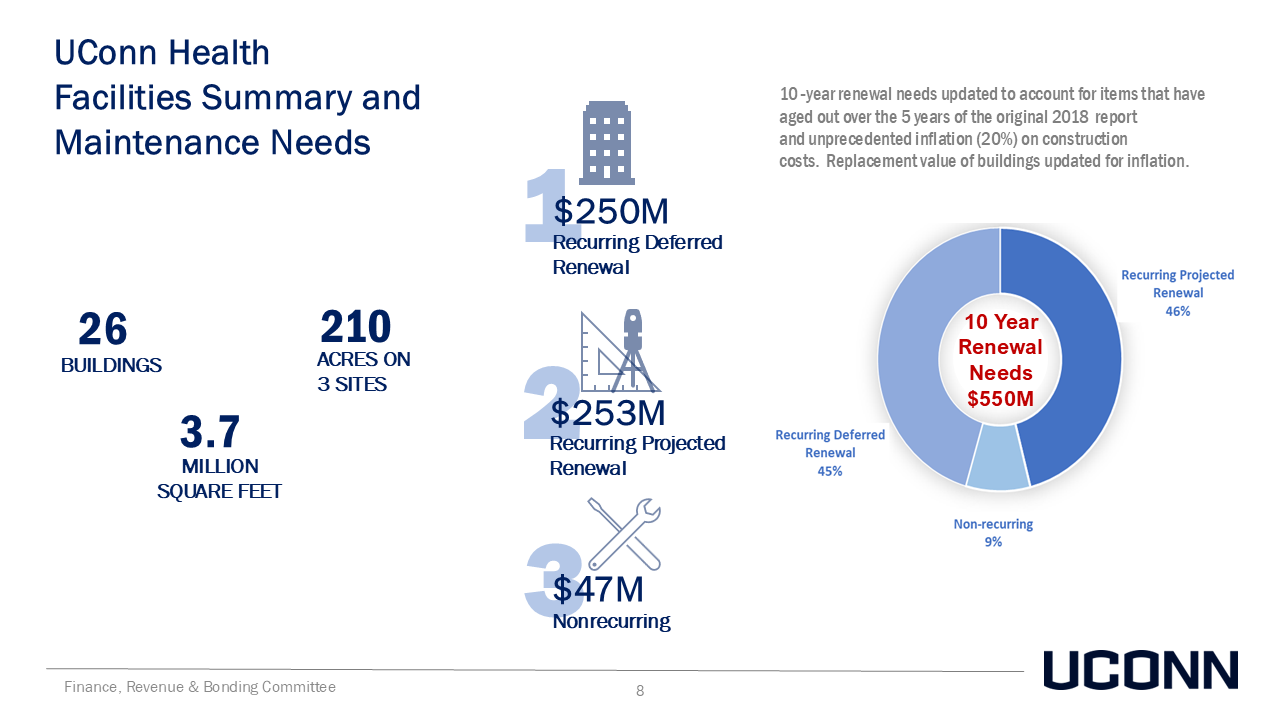
In case you are wondering, as you can see from the graphic below, we have approximately $500M in capital needs. From a definition standpoint, "Recurring Deferred Renewal" represents items at or past the end of normal useful life that have not been addressed, whereas "Recurring Projected Renewal" represents the items that are projected to be at the end of normal useful life within the next 10-year period. Finally "Nonrecurring Renewal" consists of modifications or repairs necessary to comply with fire/life safety etc. These are considered one-time projects. Sample projects are Stair Railing Replacements and elevator upgrades to meet accessibility requirements.
I also thanked the subcommittee for their support in authorizing the bonding for the UConn Health Waterbury partnership.

By the way, this week we also held the first regular UConn Health Community Network Board meeting to approve capital expenditures, and review growth plans.
Switching gears, this week I and the UConn Foundation also met with donors to discuss UConn Health's exciting strategic initiative called the UConn Health AI Institute. The blueprint is still in the development stage, but we anticipate the AI Institute will include the following components:
- Centralized health care clinical, and operational Innovation
The Institute will act as a strategic hub coordinating AI development, and commercial collaboration for rapid local and nationwide impact.
- Clinical and operational validation at UConn Health
With appropriate governance and safeguards, UConn Health will validate suitable AI solutions for clinical, research, and operational application.
- Commercialization partnerships
The AI institute will partner for the commercialization expertise necessary to prepare AI innovations for market and sustainability.
- AI venture activity
If funding is available, the AI institute will likely have an AI Venture aspect which could be student-led, AI institute guided.
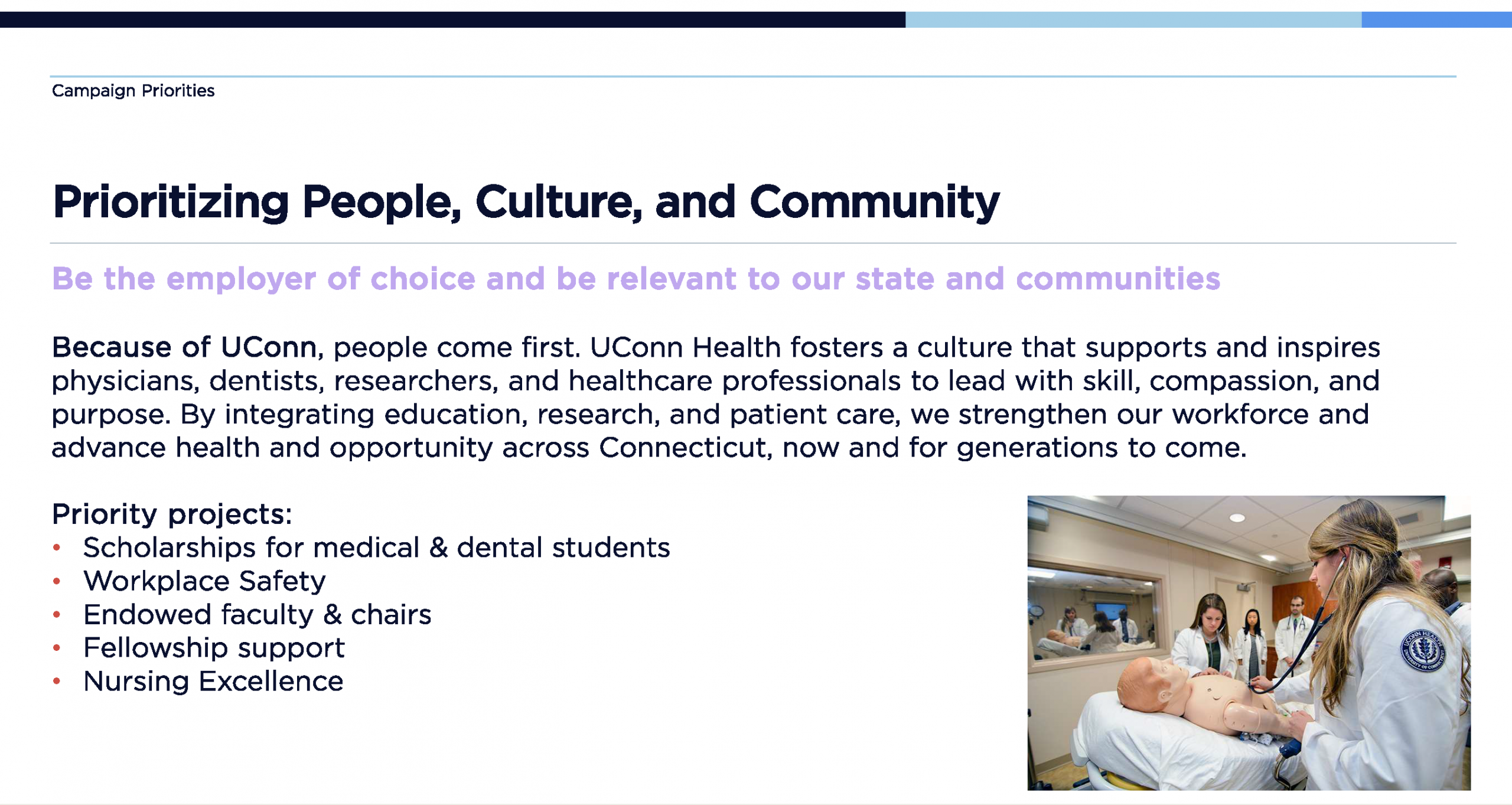
Talking about philanthropy, this week I also presented to the UConn Foundation at their Campaign Leadership Committee Meeting and highlighted the need for funding for a new Labor and Delivery facility.
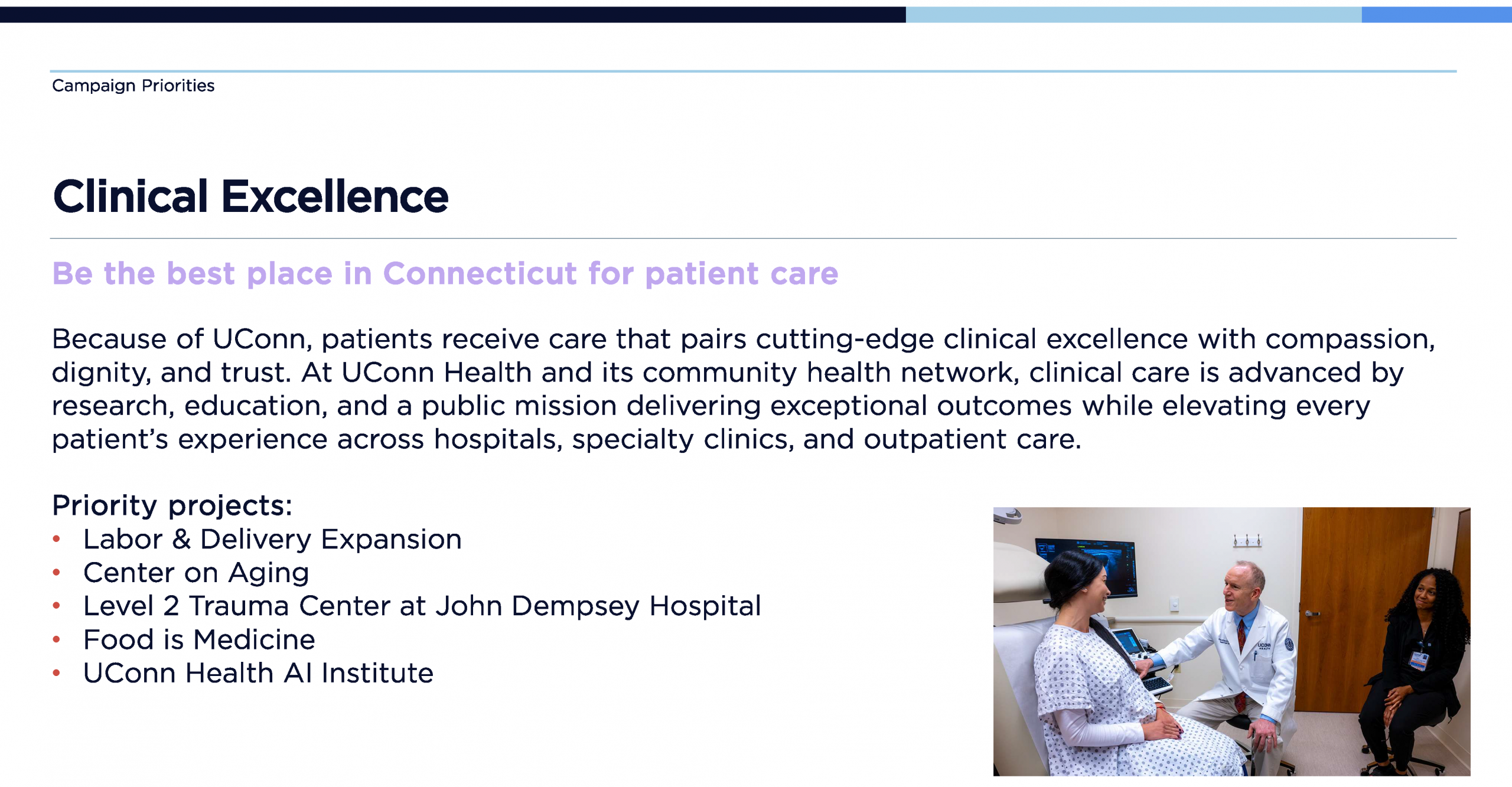
Other priorities that we discussed are noted below:

There have been some significant achievements this week. First, I would like to congratulate Kevin Chamberlin, AVP and chief pharmacy officer, and his team for securing approval by the CT Commission of Pharmacy for the retail pharmacy that will open later this year within the walls of John Dempsey Hospital.


