
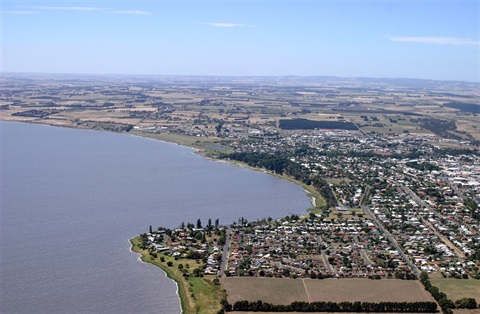
Colac Otway Shire Council, in partnership with Deakin University, FormFlow, Modularity, the University of Wollongong and Urbis, has launched a major initiative to deliver a model for much-needed affordable and key worker housing in Colac and Apollo Bay.
Funded through the Australian Government's Regional Precincts and Partnerships Program, the project will design two shovel-ready, master-planned precincts providing 50–100 high-quality modular homes.
These will be adaptable, sustainable, and capable of rapid deployment to meet changing community needs. The project addresses two critical housing challenges:
- Colac – affordability pressures for workers in manufacturing, health, retail and construction.
- Apollo Bay – severe shortage of long-term rentals due to second homes and short-stay accommodation.
Urbis will lead and manage the delivery of the project for Colac Otway Shire Council, drawing on its multidisciplinary expertise in planning, urban and landscape design, archaeology, transport, circular economy and waste management, and net zero and sustainability. This integrated approach will support the planning approval process and ensure the precincts are ready for construction by late 2026.
Deakin University will lead the social research, housing needs analysis and evaluation framework through its HOME Strategic Research and Innovation Centre. This work will ensure the precincts are inclusive, adaptable, health-promoting, and aligned with the needs of key workers, while embedding a Living Laboratory approach to test and refine innovative housing and community design in real-world conditions.
Deakin Architecture will evaluate the environmental impact of housing designs at all stages in the life cycle and provide advice on ways to mitigate negative impacts.
Deakin Engineering will evaluate and optimise housing structures to maximise performance and minimise material usage.
FormFlow will develop a modular housing system to enable rapid delivery of high-quality housing in regional Australia. Combining a range of housing designs that can be tailored to site specific requirements, with a factory-based production system that can be applied in any region, the system will be capable of delivering affordable, resilient, adaptable housing wherever it is needed.
Modularity, the modular building division of Rendine Constructions will build a proof-of-concept prototype for Colac and Apollo Bay, to evaluate and refine of the housing designs and production system. They will then deliver the projects on both sites once planning approval is granted University of Wollongong will undertake performance evaluations and testing of the modular building designs, aiming to optimise sustainability, resilience, and occupant comfort and health outcomes in an affordable housing solution.
Drawing on their recent collaboration with the Resilient Building Council in developing a Multi-hazard Resilience Ratings Scheme, they will develop strategies to ensure that the building designs maximise resilience to a range of natural hazards. Together, the partners aim to create a repeatable model for regional Australia that delivers high-quality, affordable housing quickly, supports local economies, and strengthens community resilience.
Quotes
Ian Sueren (General Manager Community and Economy, Colac Otway Shire Council) – "This exciting project is about ensuring that we can support a local workforce to service our communities, as well as the significant number of visitors to the region. Affordable, adaptable housing is essential for the strength of our local economy and the sustainability of our communities."
Nat Anson (Director, Urbis) – "By combining evidence-based design with streamlined planning, we're creating a model that can be replicated across regional Australia to meet the needs of key workers."
Professor Matthias Weiss (Deakin University) – "Our research will ensure these precincts are not only well-designed but also deliver long-term social, health and economic benefits for the community."
Dr Matthew Dingle (FormFlow) – "This is a unique opportunity to deliver a model that will dramatically accelerate the supply of high quality, affordable housing that meets the needs of regional Australia."
James Heffernan (General Manager, Modularity) – "The education sector has been reaping the benefits of modular construction since the 1990s with an integrated approach to building and production system design. This project has the potential to do the same for housing – dramatically accelerating supply and improving productivity."
Dr Allan Green (University of Wollongong) – "Resilience is becoming increasingly important with more frequent extreme weather events across all parts of Australia. This project will embed resilient building principles into future communities to protect homes and lives. The Living Lab will provide a feedback loop to continuously evaluate and improve."


