
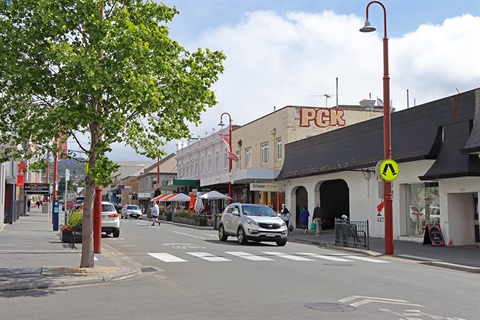
The City of Hobart will replace the raised concrete separators used in the Transforming Collins Street trial following a review of pedestrian trip and slip incidents associated with the treatment.
The decision follows a review by City transport officers after 10 reported pedestrian incidents involving the raised concrete barriers since installation was complete.
The two-year trial is now past the halfway point, with data showing more than 2.48 million pedestrian movements - an increase of four per cent - and cycling movements up by 15 per cent along Collins Street compared to pre-trial levels.
Hobart Transport Committee Chair Cr Ryan Posselt said the change demonstrated exactly how the trial was intended to operate.
The raised concrete separators will be replaced with reflective flexible bollards. Both the concrete separators and the flexible bollards are consistent with the Tasmanian Government's Tactical Infrastructure Design Guidelines. The new treatment will continue to provide a degree of protection and separation for cyclists while improving pedestrian safety.
The works will start on Sunday September 6 and are expected to be completed in one day - but this will be dependent on weather and other unforeseen circumstances. They are expected to cost approximately $25,000. However, around $10,000 of that cost will be offset through the reuse of the concrete separators as vehicle wheel stops in City of Hobart-operated off-street car parks.
Quotes to be attributed to Hobart Transport Committee Chair Cr Ryan Posselt:
"The purpose of the Collins Street trial has always been to test ideas, gather evidence and listen to the community before any long-term decisions are made.
"We have consistently said we would monitor the trial, seek feedback and make adjustments where needed. That's what has happened previously and that's exactly what is happening here.
"While the number of incidents represents a very small proportion of the millions of pedestrian movements recorded on Collins Street, safety will always be our priority.
"The value of a trial is that it allows us to test, measure and learn. That includes monitoring safety, listening to community feedback and making evidence-based changes where improvements can be made.
"After one year, the trial has recorded more than 92,000 cycling movements and 2.48 million pedestrian movements, while also helping the City understand which treatments are working well and which may need refinement.
"No decisions have been made about the future of any trial treatments. The next Council will consider all monitoring data and community feedback before making any long-term decisions about Collins Street."
Quotes to be attributed to Bicycle Network Tasmania Public Affairs Manager Alison Hetherington:
"We are pleased to see the Collins Street bike lane separators changing to address concerns from people riding and walking, after all that's what a trial is all about.
"Concrete separators are used without issue in other cities but they tend to be wider, more visible separators on wider bike lanes.
"The Collins Street trial is a great first step towards providing more people with the option to ride a bicycle to improve their health, cut emissions and save money.
"We look forward to exploring the ultimate design that will make riding more comfortable as part of a permanent improvement to the street."


