
Militia fighters killed at least 22 civilians and injured many more in an attack in late November 2025 on a village in Kwamouth territory in western Democratic Republic of Congo, Human Rights Watch said today. Witnesses from the village of Nkana, about 75 kilometers northeast of Kinshasa, the national capital, said that militiamen with firearms and machetes carried out an apparent retaliatory attack linked to rising intercommunal tensions.
On November 23, at about 4 a.m., Mobondo fighters from the ethnic Yaka community attacked Nkana, witnesses said. The assailants moved house to house, killing mostly ethnic Teke villagers in their homes and as they attempted to flee. Villagers said the fighters had accused Nkana's Teke of refusing to install a new Yaka customary chief and sent messages to some Teke before the attack saying they would be punished.
"The violence in Kwamouth is just one of many deadly ethnic conflicts in Congo," said Lewis Mudge, Central Africa director at Human Rights Watch. "The global focus on the peace accords in eastern Congo shouldn't distract from the unchecked violence and injustice and the cycles of impunity in other areas."
Human Rights Watch interviewed 18 people in November and December, including 5 witnesses, 6 relatives of victims, local medical personnel, and community leaders from Kwamouth territory in Mai-Ndombe province.
Starting in June 2023, the Mobondo militia, named for their mystical amulets and armed with machetes, knives, spears, bows and arrows, and hunting and military assault rifles, have attacked Teke villages, burned houses, and killed dozens of people.
For years, civil society activists, human rights groups, and traditional authorities have warned about the escalating presence and activities of ethnic militias. The recent violence echoes the intercommunal crisis Human Rights Watch documented between 2022 and 2023, when militias from the Teke and Yaka communities killed hundreds of civilians in waves of attacks in the region.
The recent attack underscores the Congolese government's failure to scale-up security in the area despite repeated warnings of violence, Human Rights Watch said.
"When they broke down my door, I ran with my grandson," said a 70-year-old woman about the recent violence. "They shot at me several times. One bullet hit my foot, but I kept running. If I had stayed for one more second, they would have killed us."
Another villager said that fighters shot at his family as they attempted to escape: "My mother was carrying my daughter on her back. The first bullet struck her [his mother] in the heart. The second pierced her ribs and hit my daughter in the stomach." His mother died instantly and his 5-year-old daughter died in the hospital on December 5.
Human Rights Watch documented the deaths of 22 civilians, including 4 women and 4 children. Among those killed were two sons of the village's customary chief, the local Red Cross president, and a provincial tax authority official. A Congolese army soldier, who was guarding the village along with a small marine contingent that fled across the Congo River when the attack began, was also killed. Villagers said relatives buried their family members after the attackers left the area. Others were buried by soldiers when they arrived in the village.
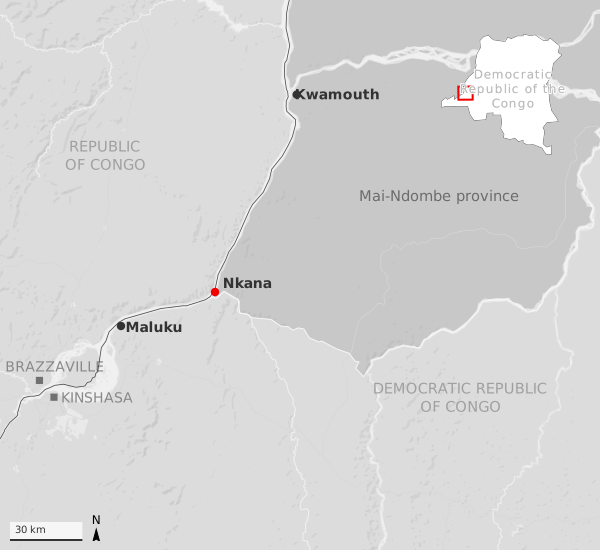
Medical staff in Maluku commune, in eastern Kinshasa, said that several patients arrived in critical condition, while other wounded civilians fled across the river to Congo-Brazzaville to seek treatment.
The attack forced hundreds of residents to flee toward Maluku or to cross into Congo-Brazzaville. Witnesses said that families tried to evacuate older people, the injured, and small children. The army has since tried to encourage villagers to return to Nkana, but many have refused and have thus lost access to their homes and fields, deepening an already precarious humanitarian situation.
Following the attack, Congolese authorities deployed military personnel to the area and announced an investigation into the killings. Residents said that a delegation of Teke community members traveled to Kinshasa carrying the bodies of victims to protest what they described as the government's silence and inaction. Some lawmakers have called on the provincial assembly to adopt urgent measures to address the humanitarian crisis.
Historically, Teke people have owned much of the land and customary titles in Kwamouth territory, a part of the Bateke Plateau (literally translated "the plateau of Teke people,") which extends to the outskirts of Kinshasa. Over the years, members of the Yaka, Mbala, Suku, and other communities from neighboring Kwilu and Kwango provinces have formed the agricultural workforce for landowners in Kwamouth territory or have become farmers in return for a customary tax-which Teke farmers also pay-to Teke customary chiefs.
Mobondo militias have increased attacks since mid-2025, targeting villages along the Congo River, including Mbanzale and Mayala in June, an attack along national road 17 in August, and a September 2 attack in the Limpwobo forest zone. Despite periodic military deployments, no permanent government security presence has been established, leaving rural communities exposed to renewed attacks.
Congolese authorities should ensure a thorough and impartial investigation of those responsible for the militia attacks, Human Rights Watch said. They should also ensure that affected villagers receive medical and mental health support and that displaced people have access to shelter, food, and basic services.
The government should put into effect, with meaningful community participation, a demobilization program for Mobondo fighters announced on December 2 and convene an intercommunal peace forum for Mai-Ndombe province that was announced in September.
"Addressing the communal violence in western Congo requires justice and accountability, effective early warning systems, and a real commitment to breaking the structures that allow armed groups to flourish," Mudge said. "Concerned governments and United Nations agencies should assist the Congolese authorities in making this happen."


