
The tropical cyclone season in the South-West Indian Ocean is having a devastating impact on Madagascar, which has declared a national emergency and appealed for international aid.
Intense tropical cyclone Gezani made landfall in eastern Madagascar on 10 February, with winds of about 180 km per hour and gusts peaking at 230 km/h. The port of Toamasina was worst hit, with severe damage to buildings and infrastructure.
Nearly 270,000 people have been affected and 16,000 displaced. At least 40 people have died, according to national authorities .
Gezani followed hard on the heels of tropical cyclone Fytia at the end of January.
National authorities, with support from the UN and partners, are leading search and rescue, evacuation, shelter and food assistance efforts, according to the Office for the Coordination of Humanitarian Affairs .
Gezani oved into the Mozambique Channel and is tracking towards southern Mozambique, where soils are already saturated after weeks of heavy rainfall and floods.
WMO's regional specialized meteorological centre La Réunion (Météo-France) said that Gezani may regain strength to become an intense tropical cyclone as it passes close to the Mozambique coast on 13/14 February.
Mozambique's southern Inhambane province will see very strong winds, very heavy rainfall, waves of up to 10 meters high and a storm surge of up to 1 meter, according to the forecasts.
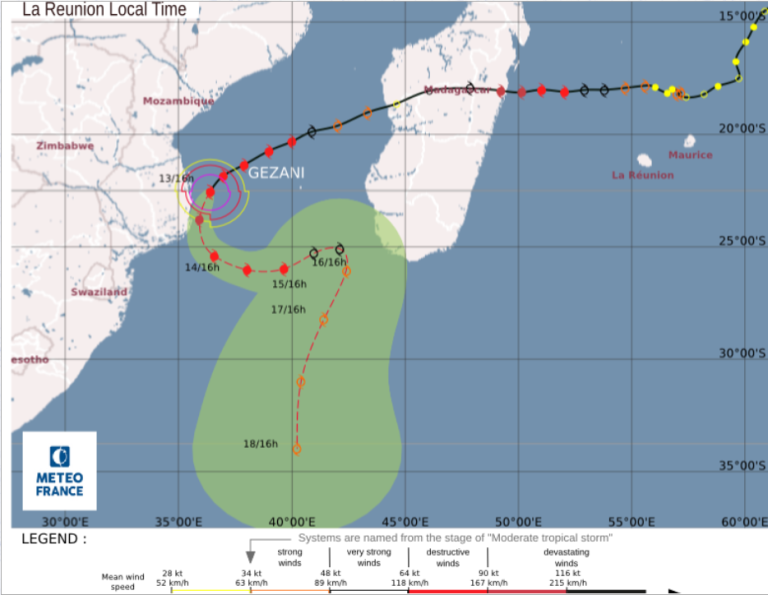
The WMO Coordination Mechanism (WCM) ensured the provision of expert advice to humanitarian agencies, curating information from WMO Members and Centres. In its Global HydroMet Weekly Scan (WCM-GWS) on 12 February, it advised for the risk of floods and flash floods in southern Mozambique, and on 5 February had advised of the formation of the system, based on the RSMC La Réunion information.
The advance forecasts, early warnings and regional and national coordination saved lives and enabled humanitarian agencies in Madagascar to pre-position vital supplies ahead of landfall.
Tania Goossens, head of delegation for the World Food Programme in Madagascar, said the agency was able to use pre-arranged funding to provide anticipatory cash assistance to 30,000 vulnerable people and to prepare food stocks.
Tropical cyclones are one of the world's deadliest natural hazards and it only takes one landfalling storm to set back years of socio-economic development.
According to the seasonal outlook for tropical cyclone season 2025-2026 from WMO's RSMC La Réunion, an average to above average season is expected, with 10-14 named storms, of which five to eight are at tropical cyclone strength.


