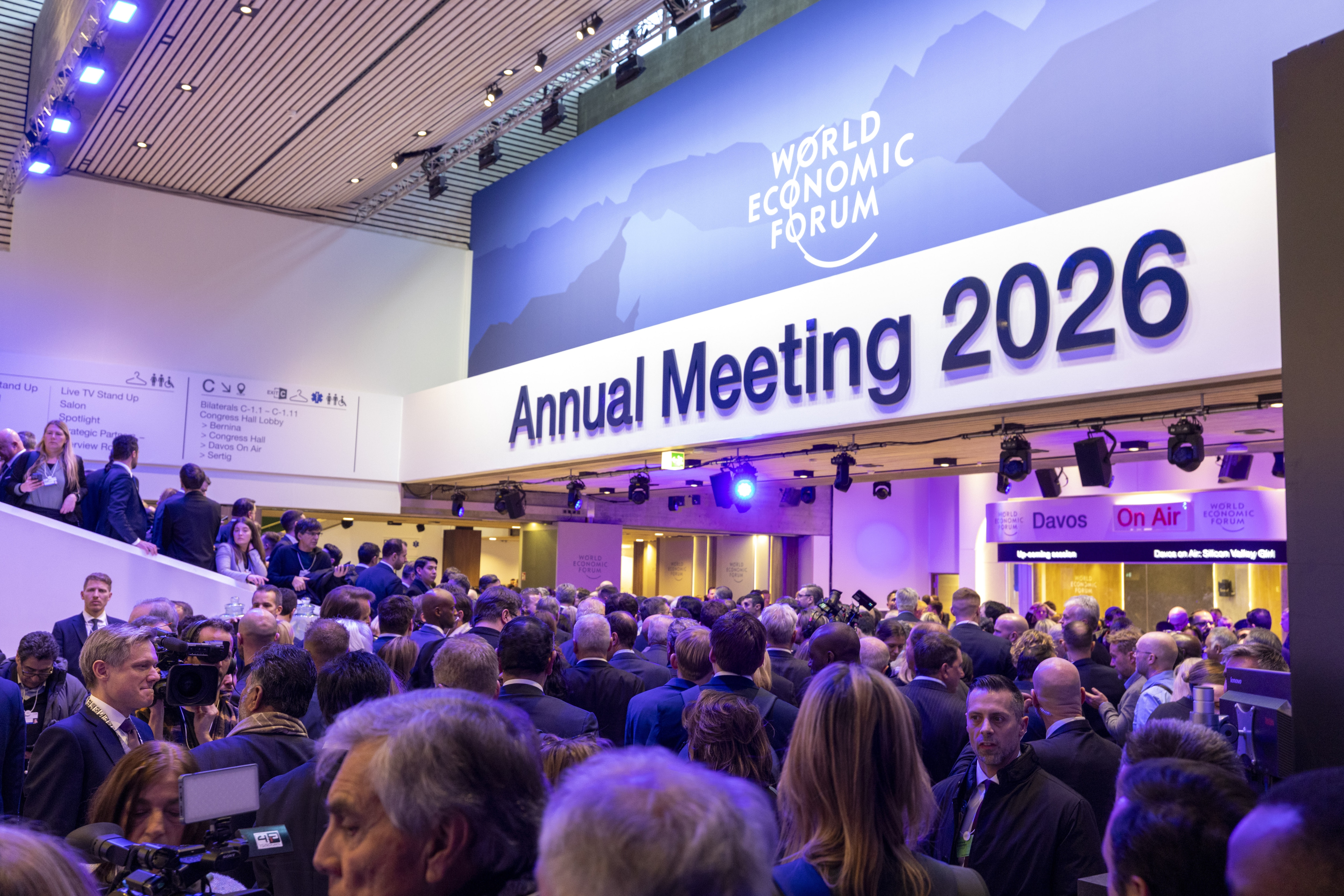
- More than 60 heads of state and a record 400+ political leaders and 830 CEOs and Chairs attended the World Economic Forum's Annual Meeting in Davos, from 19-23 January.
- Davos 2026 was convened under the theme 'A Spirit of Dialogue'. Besides the consequential conversations and key speeches, new initiatives were launched and impacts emerged.
- From digital cooperation on tracking forced labour to water as economic infrastructure, here are five areas that saw concrete action and ambition.
For more than half a century, leaders from across the globe and every walk of life have been travelling up the 'Magic Mountain' to Davos for discussions about the world's most pressing challenges.
But that is far from all that goes on among the snow-capped peaks of the Alps - and Davos 2026 again revealed something more consequential than rhetoric.
While getting diverse - and often divided - people in a room together has proven to move the needle on global issues , the World Economic Forum's Annual Meeting also helps to translate ambition into partnerships, platforms and measurable commitments.
Here is a snapshot of some of the impactful things that happened this year across the five defining questions Davos asked .
1. Cooperating for a better world
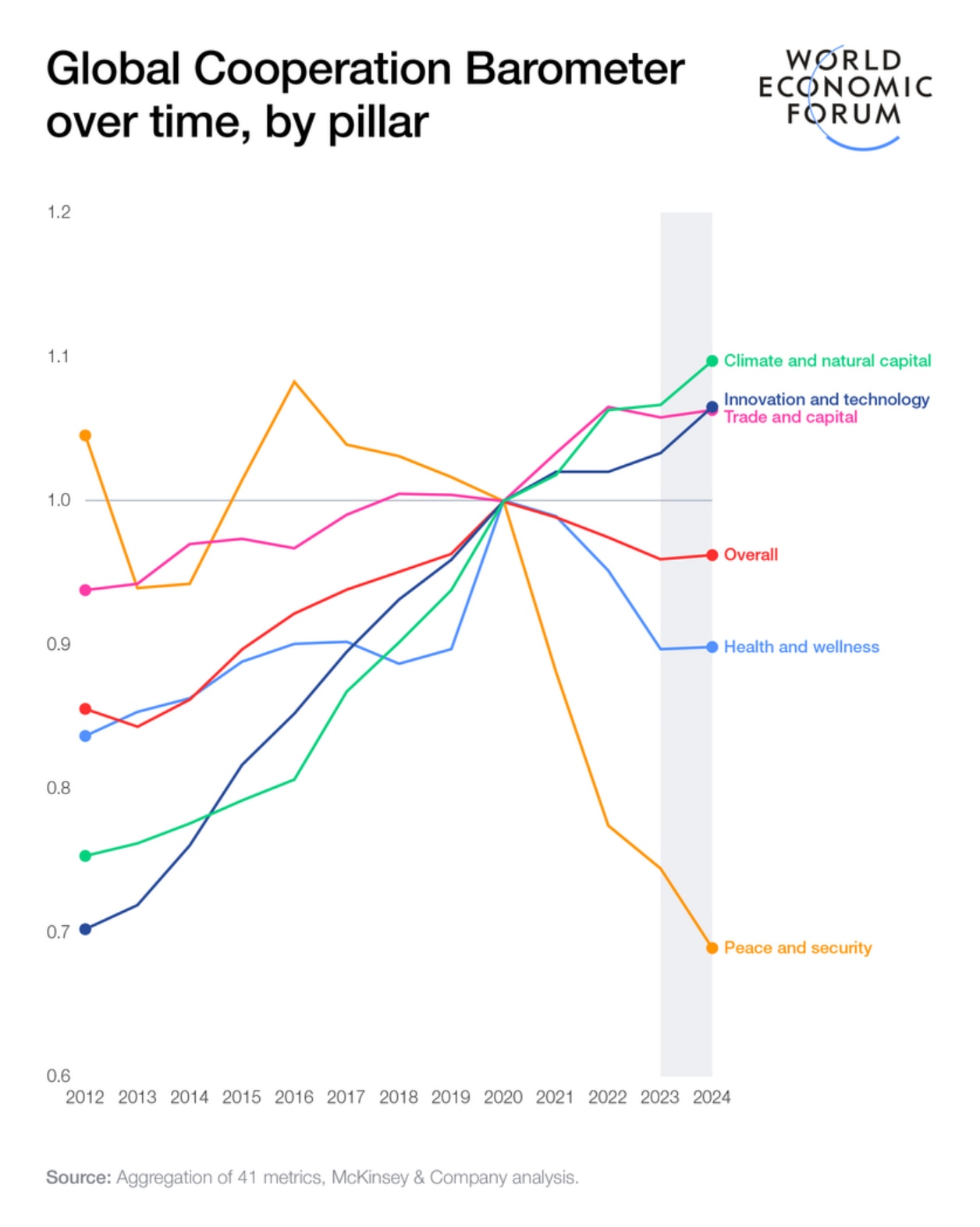
Ahead of the Annual Meeting, the Forum launched the Global Cooperation Barometer 2026 - an annual temperature check of how well the world is collaborating in the face of growing complexity and uncertainty.
It found that although overall cooperation was largely unchanged from previous years, the composition of cooperation is moving from multilateralism to ' minilateralism ' - and is changing across five pillars:
- Trade and capital cooperation flattened
- Innovation and technology cooperation rose
- Climate and natural capital cooperation grew
- Health and wellness cooperation held steady
- Peace and security cooperation continued to decrease
One case-in-point showing increased cooperation in the tech sector is the work of the Global Data Partnership Against Forced Labour , launched at Davos in 2025. Using privacy-preserving AI, the partnership links datasets across firms, governments and NGOs to reveal forced labour patterns invisible to isolated systems.
This year, the partnership - which includes Amazon, Hewlett Packard Enterprise and the International Labour Organization - published its first white paper, Harnessing Data and Intelligence for Collective Advantage: Ending Forced Labour in Global Supply Chains . It details a proof of concept in Thailand that shows this approach in action.

Using multilingual natural language processing and open-source technologies, it demonstrates how federated data and agentic AI can transform fragmented information into collective intelligence - flagging patterns and risk hotspots.
At Davos, one partner, Exiger, launched forcedlabor.ai , a free platform powered by 20 billion records , making supplier risk intelligence accessible to everyone from Fortune 500 companies to small importers. It transforms the issue of forced labour from permanent feature to preventable risk.
This partnership model demonstrates how competitors collaborate when given technical infrastructure and governance frameworks - a template for tackling other complex, siloed challenges.
2. Cities as growth engines
The Chief Economists' Outlook for January 2026 shows cautious improvement from late 2025, although regional divergence remains sharp. US growth is improving (with AI investment driving expansion), Europe is confronting weak growth, while South Asia is exhibiting the strongest momentum.
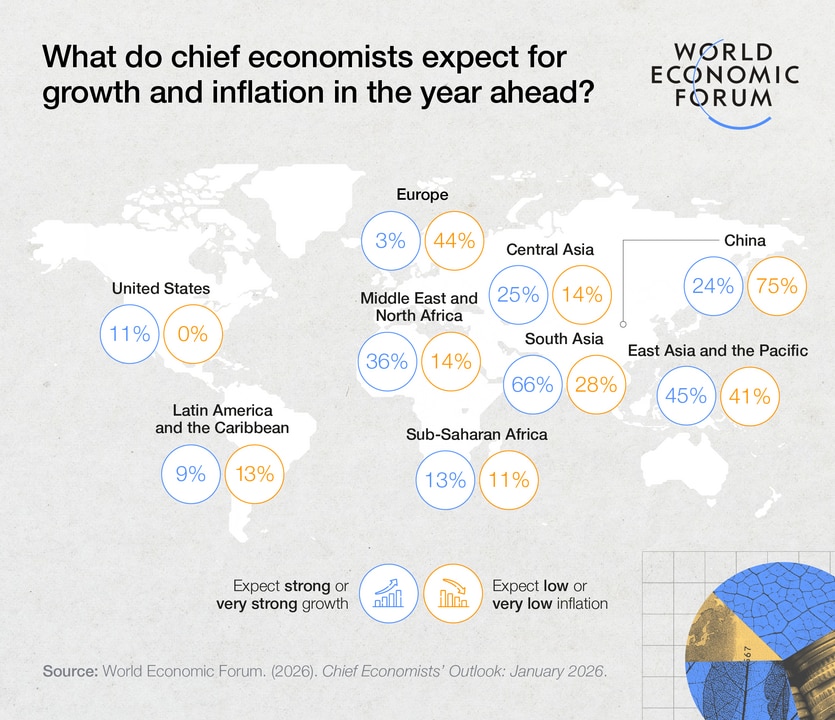
It follows that cities, the powerhouses of national economies - that can attract technology investment and create scalable ecosystems - will capture disproportionate growth in this environment.

The Forum launched the Yes/Cities Global Network , a curated group of more than a dozen world-leading city-based innovation ecosystems across North America, Latin America, Europe and Asia, designed to act as "launch pads" and "landing pads" for innovators, investors and partners seeking to expand across markets.
The network represents more than 100 million people and over $4 trillion in combined annual economic output, supporting cross-city learning, collaboration and the scaling of innovative solutions.
Existing models, such as Yes/San Francisco and Yes/Bengaluru, embed local insight into innovation, ensuring civic purpose aligns with economic growth. Communities become living laboratories for the wellbeing economy rather than one-off pilot projects.
3. Investing in people
Six years into the Reskilling Revolution , the Forum's commitment to reskill a billion people by 2030 has moved from aspiration to industrialized delivery. As of January 2026, the initiative has reached 856 million people across 79 economies , working with 18 industries and supported by more than 350 organizations.
This isn't hand-waving. A new National Skills Accelerator launched in India - expanding the global network to 45 accelerators - aims to rapidly scale industry-aligned training and improve employability for millions of workers.

The accelerators, which have collectively supported 14.8 million people to date, focus on AI, digital skills and human-centric capabilities - precisely the mix needed for entry-level workers who are most vulnerable to technological disruption.
The Forum also launched the Learning to Earning Sandbox , which brings together universities, employers and governments to co-design partnership models that integrate learning with earning - preparing talent for the changing nature of work while helping businesses close capability gaps and economies build resilient talent pipelines.
The Youth Pulse 2026 survey - capturing priorities from nearly 4,600 young people across 489 locations - shows that the next generation views upskilling not as a survival tactic. but as empowerment.
real-world-ai,-not-speculation">4. Real-world AI, not speculation
The promise and pitfalls of AI have dominated conversations throughout Davos for the past few years. This year, it was backed up by evidence.

The MINDS programme (Meaningful, Intelligent, Novel, Deployable Solutions) - the Forum's recognition initiative for real-world AI - expanded to 33 pioneering organizations across more than 30 countries and 16 sectors.
At Davos, the inaugural white paper - Proof over Promise: Insights on Real-World AI Adoption from 2025 MINDS Organizations - launched, showcasing examples of how AI is delivering measurable value.
For example, Ant Group's multimodal AI platform for clinical consultation services achieved 90% diagnostic accuracy with 80% reduction in literature search time.
Over 50% of MINDS applicants were small-to-mid-sized enterprises, proving innovation isn't confined to scale. Successful AI deployment requires embedding systems into daily workflows, redesigning processes to leverage AI, modernizing data foundations and establishing robust governance.
5. Water as economic infrastructure

Climate and energy dominate Davos agendas. In 2026, water claimed unprecedented focus - not as an environmental issue, but as the foundation affecting every sector, every economy, every person.
The €6.5 trillion ($7.7tn) global water infrastructure gap by 2040 threatens billions with absent or outdated systems. In December, the Forum launched a playbook for advancing equitable water access , infrastructure resilience, circularity and innovation. Drawing on 27 best practices, the report shows that solutions already exist and can be adapted and scaled.
As part of ' Blue Davos ', actor and co-founder of Water.org, Matt Damon launched the Get Blue platform - uniting Amazon, Gap, Starbucks and Ecolab with Water.org to accelerate action on water access.
The partnership aims to scale up Water.org's current reach of 85 million people to 200 million by 2030. Corporate activations across fashion, food and technology launch later this year.
Meanwhile, the new ACT Ocean initiative brings business engagement across ocean priorities under one umbrella, with strategic Memorandums of Understanding signed with the UAE Government and the Water Resilience Coalition , supporting the December 2026 UN Water Conference.