
Almost four years since Russia's full-scale invasion of Ukraine, aid teams continue to adapt to the lethal reality of working in a modern war zone.
For frontline workers like Oleg Kemin from the UN World Food Programme ( WFP ), this involves travelling deep into disputed territory along the 1,000-kilometre contact line separating Ukraine from Russia, where attack drones are a deadly menace.
In an exclusive interview with UN News, Oleg describes his work as a security officer and the challenges he faces, trying to deliver food aid to vulnerable communities.
There's little respite even away from the front, he notes, with cities including the capital Kyiv shelled repeatedly and pitched into darkness - as was the case just before we spoke to him. His conversation with Daniel Johnson has been edited for length and clarity:
Oleg Kemin: "Every night like this, with the shelling attacks, it's quite difficult for us; the energy infrastructure of Ukraine is under fire, so each such attack can mean new blackouts all across the country. Also, there are new victims which creates additional tensions.
Let's say that people who are spending sleepless nights in the shelters cannot be as productive as usual. As a Security Operations Officer for the UN, my job is to track those constant air raid alerts, trying to keep our staff safe and warning them about the alerts.
UN News: How do you cope with the constant threat of attack?
Oleg Kemin: Next month it will be four years since the war started. I still remember the first attacks, I still remember the first air raid alert and it was very scary. It's impossible to get used to it, especially when you can see the damage and destruction, but people are somehow getting used to everything.
But from time to time, when you've been at work and you are tired, you do not hear the air raid alert on your phone app, or the air raid siren in the street. Other times you're waking up with the first explosion and it's impossible to move to the shelter, because there is already an attack happening.
You create mechanisms - not to cope - but to understand the situation more clearly, and you follow emergency procedures. For example, if the attack is over, should we start the headcount and assess needs?
All across the country, people who are working in the energy companies and the water companies are doing their best to maintain normal life as much as possible, to restore electricity. In the capital, we have more opportunities to make repairs very quickly, but in some cities - even the left bank of Kyiv - was without electricity for quite a long time.
UN News: Where are needs greatest in Ukraine today?
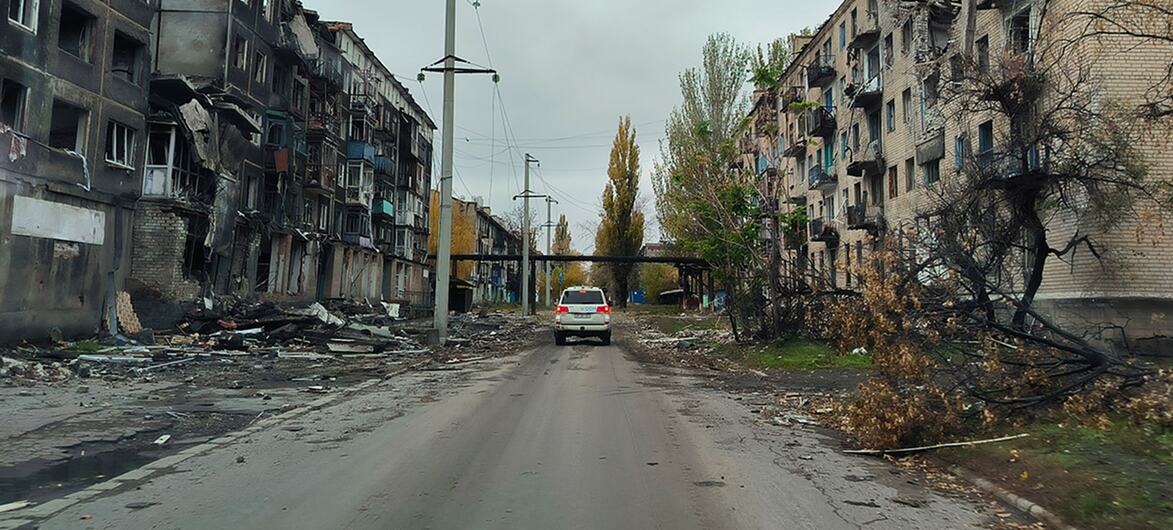
Oleg Kemin: Some of the most vulnerable communities are in Pokrovsk, Kupyansk, Konstantynivka and Dobropillya - they're all in the news today. We used to send aid convoys to these locations. It's really sad to see with the gradual moving of the frontline, how life starts to escape from these cities.
On your first trip it's a normal city, but then the shops start to close, more building become damaged and there are fewer people on the streets. On the final mission, you see only an empty and closed city and people who have no place else to go.
UN News: How are aid teams protecting themselves from drone attacks?
Oleg Kemin: At the moment in frontline areas, there is a high presence of first-person view (remote-controlled) drones. They are relatively small and usually each of them is directed by an operator. When any of our humanitarian convoys are moving toward such a zone, we inform both sides to the conflict of their GPS coordinates using the standard Humanitarian Notification Systems (HNS), so they can safely reach their destination.
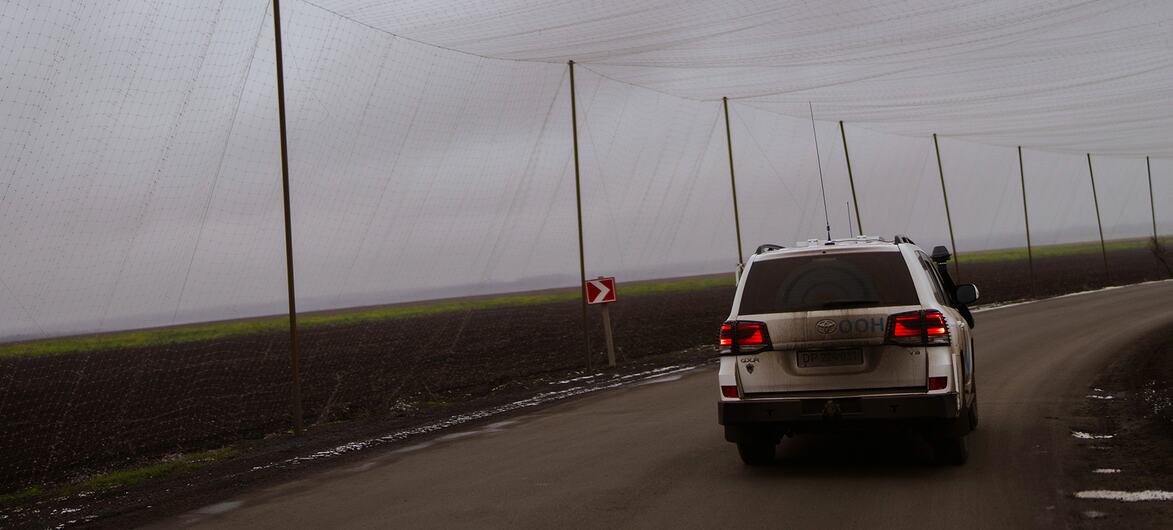
But that only applies to UN vehicles; the rest of the civilian and military vehicles in the convoy can be vulnerable, so to deter drones, the Ukrainian armed forces build corridors of nets mounted on pylons either side of the road for 10 to 15 kilometres.
The small drones don't have enough velocity to penetrate through the netting, so they get stuck in it, and that can offer some protection. Let's say it's the very, very last hope, but at least it exists. In such a corridor, you feel safer, because there is at least some layer of protection around your vehicle.
Of course, wars are constantly developing and there are already ways of penetrating these nets, or drones look for gaps in the netting, especially in the autumn and winter when strong winds can rip the canopy. This is a double risk because if the net wraps around a wheel, it will stop the vehicle and incapacitate it.
UN News: What can you tell us about the people who need WFP's help?
Oleg Kemin: Last summer, we went on missions to remote communities in Kharkiv region (in northeast Ukraine, close to the Russian border). There are villages we assessed which are impossible to reach now, because it's a very active combat zone, but people are still living there.
In one of those villages, when I had the opportunity to ask one of inhabitants, an elderly woman, why she was not leaving the village and she said, 'Here is the tomb of my husband, of my kids, I have nowhere else to go; the only thing I can do is to look after their tombs.'
People are still living in these communities, and to get to them it was impossible by truck, so we removed the back seats from our armoured vehicles, filled them to the very top with food kits, and we literally drove through the mud.
Our partners' vehicles got stuck, so we had to pull them out. People were living so close to the fighting - they were just 4.5 kilometres from the Russian border and drone activity from both sides was very high over there - so, sometimes with such communities, we bring them double the amount of food kits, because we never know if we will be able to reach them in the coming months.
UN News: What more can you tell us about the Ukrainian communities you've reached?
Oleg Kemin: It's elderly people, pensioners especially. A few times people who are living there have been telling us, 'It's our land, it's the house in which I grew up, it's a house which was built by my great-grandparents, it's my land and I don't want to leave!'
Other times, we've met people who've been telling us that they had tried to go to European countries or western Ukraine, but because of their age, they were not able to find a job to make enough income to rent a house, so they had to return home to their war-contested communities. Also, for people with disabilities and their relatives, it's not so easy for them to move from those communities.
The State offers evacuation and assistance, but still a lot of people are planning to stay there. And they're among those we are helping in the communities closest to the front line where shops are closed and no one is bringing food. Further away, if markets are open, our donors provide a little cash-based help so people can choose what to add to their food basket.
UN News: Another key part of WFP's mission is making farmland safe again so that Ukrainians can work their land. What more can you tell us?
Oleg Kemin: Yes, we are involved in mine-clearing work. Ukraine is a huge agricultural country and a huge amount of land - up to 25 to 30 per cent - is polluted with the unexploded ordnance and explosive remnants of war.
So, WFP works in demining to make land available for agricultural works again. As you know, grain from Ukraine helps to feed countries in Africa and almost all over the world, so one of the goals for us is to participate in that activity to make it possible to fight hunger, not only in Ukraine, but using, let's say, Ukrainian grain also all around the globe."


