
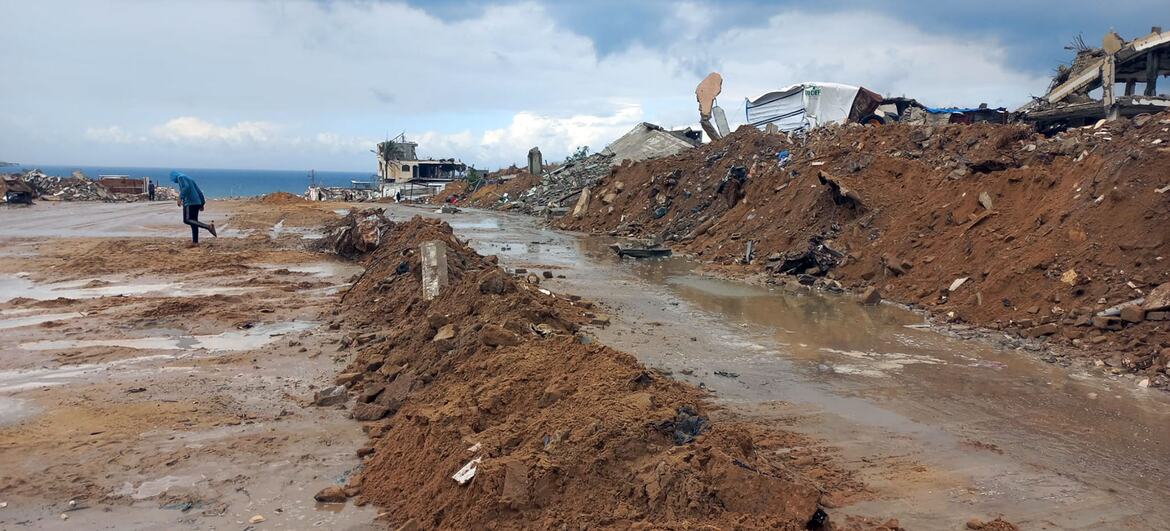
Humanitarian partners in the Gaza Strip are struggling to reach hundreds of thousands of vulnerable people as winter storms batter damaged homes and temporary shelters.
Since the fragile October ceasefire began as phase one of the US-led peace plan, thousands of tents and hundreds of thousands of tarpaulins have been distributed.
Yet partners estimate that over one million people - around half of Gaza's population - still urgently need shelter support. "The needs remain immense, and the harsh weather only deepens the suffering of families living in tents or war-damaged buildings," said the UN Spokesperson's Office on Friday.
Water, sanitation and hygiene services are also under pressure. Storms have damaged already shattered infrastructure, while fuel shortages and limited landfill access have left waste piling up.
UNICEF -supported teams continue to remove around 1,000 tons of solid waste each month, helping protect children and families from health risks.
West Bank demolitions
In the West Bank, demolition of 25 buildings in Nur Shams refugee camp has displaced around 70 families. UN Palestine relief agency, UNRWA , continues to support those who have had to flee from Jenin, Tulkarm and Nur Shams, covering rental costs for three months during the cold winter.
Humanitarian agencies continue to advocate for safe access and the entry of specialised equipment to maintain essential services, underscoring the critical role of UN and NGO partners in delivering life-saving assistance across the Occupied Palestinian Territory.
Lives at stake as Israeli curbs tighten: UNRWA chief
New Israeli restrictions on international non-governmental organisations (NGOs) risk further crippling humanitarian operations in Gaza at a moment of acute need, the head of the UN Palestine refugee relief agency warned Friday.
Philippe Lazzarini, Commissioner-General of UNRWA, said the measures would reduce life-saving assistance for civilians already struggling to survive after months of conflict and deprivation.
In a social media statement on Friday, Mr. Lazzarini said he was echoing concerns raised by principals of the Inter-Agency Standing Committee (IASC) - the forum that brings together heads of UN and non-UN humanitarian organisations.
Matter of survival
"New Israeli restrictions on international NGOs are further compromising the humanitarian operation in the Gaza Strip," he said, stressing that "people in Gaza need more aid, not less, simply to survive".
He warned that the measures would also undermine efforts to assist communities affected by escalating violence in the West Bank, where humanitarian needs have surged alongside displacement and access constraints.
According to the IASC, the planned restrictions include new registration and operational requirements for international NGOs that would significantly limit their ability to deliver.
Humanitarian leaders have urged Israeli authorities to revoke the measures, warning that they would severely disrupt aid delivery and contravene Israel's obligations under international humanitarian law.
UNRWA targeted
Mr. Lazzarini said the latest steps follow the adoption of Israeli legislation targeting UNRWA, which has already had a chilling effect on humanitarian operations. Taken together, he said, they form "a troubling pattern" that risks setting a dangerous global precedent.
"Failing to push back against attempts to control the work of aid organisations will further undermine the basic humanitarian principles of neutrality, independence, impartiality and humanity," he said.
Humanitarian agencies have repeatedly warned that access constraints, insecurity and bureaucratic impediments are preventing aid from reaching people in need across the Occupied Palestinian Territory.
They say any further restrictions could have immediate and potentially fatal consequences for civilians who are dependent on humanitarian assistance.
UN officials and aid leaders continue to call for unimpeded humanitarian access, respect for international law and the protection of humanitarian personnel and operations.


