
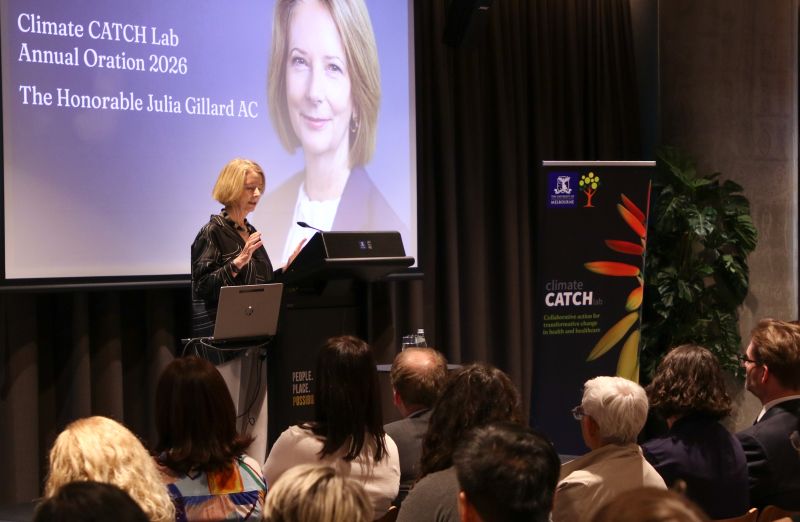
Former Prime Minister Julia Gillard AC has urged leaders across government, health, research and community sectors to work together to address the growing impacts of climate change on human health and wellbeing, delivering the University of Melbourne's 2026 Climate Collaborative Action for Transformative Change in Health and Healthcare Lab (Climate CATCH Lab) annual Oration at Melbourne Connect.
Speaking to leaders from government, health, research and community organisations, Ms Gillard, who is Chair of the global philanthropy Wellcome, reflected on the leadership and collaboration needed to address climate-related health challenges and create more equitable and resilient communities.
"Addressing the health impacts of climate change requires bold leadership that brings people together across traditional boundaries. Governments, researchers, health professionals and communities each have a vital role to play in translating our understanding of these challenges into practical solutions.
"The task now is to build on the evidence, strengthen the partnerships needed to drive change and ensure our response protects the health and wellbeing of communities, particularly those most vulnerable to climate-related risks."
University of Melbourne Vice-Chancellor Professor Carolyn Evans was at the Oration emphasising the critical role of research and education in tackling one of modern history's greatest challenges.
"The impacts of climate on health are becoming starker each year, impacting the health and wellbeing of the most vulnerable people in our communities first. At the same time, the international commitment to high-quality research on climate and to funding life-saving global health measures have regressed, making the work of Climate CATCH Lab ever more vital.
"I would like to acknowledge the important contribution of Julia Gillard's leadership as Chair of the Wellcome Trust and the research it continues to support across a range of fields worldwide, particularly climate and health research here at Melbourne.
"The University of Melbourne is committed to bringing together expertise from across disciplines to generate evidence, inform policy and support meaningful action. The Climate CATCH Lab exemplifies that commitment and the important role universities can play in addressing complex global challenges."
Prior to the Oration, Climate CATCH Lab and Melbourne Climate Futures Director Professor Kathryn Bowen convened a feminist just transitions roundtable with Ms Gillard, co-hosted by Women's Environmental Leadership Australia, where they were joined by senior researchers and advocates.
"At the very heart of the shift to a positive climate future is the work to achieve a fair and equitable transition away from fossil fuels. Women and gender-diverse people are leading and shaping a clean energy future, while centring care for communities and nature.
"Ms Gillard's experience leading policy and implementation at the highest national and global levels made an important contribution to this discussion, as we explore the role universities play in shaping a climate future that is safe and just for all."
The Climate CATCH Lab is a joint initiative of the University's School of Public Health, Melbourne Medical School and Melbourne Climate Futures. As the University's flagship interdisciplinary climate and health initiative, the Lab brings together researchers, educators, practitioners and policymakers to advance evidence-based solutions to climate-related health challenges.
In 2026, it was designated a World Health Organisation Collaborating Centre for Climate and Health Research, Policy and Action.
As Chair of Wellcome, a global charitable foundation working towards a healthier future for everyone, Ms Gillard's address reflected the Lab's focus on the leadership, evidence and partnerships needed to respond to climate-related health challenges and strengthen resilience in communities around the world.
The Oration forms part of the University's broader climate and health agenda, bringing together researchers, policymakers, health leaders and community organisations to advance evidence-based solutions that protect health and support more resilient and equitable futures.


