
New practical guide calls for maritime industry to take measurable action on gender equality
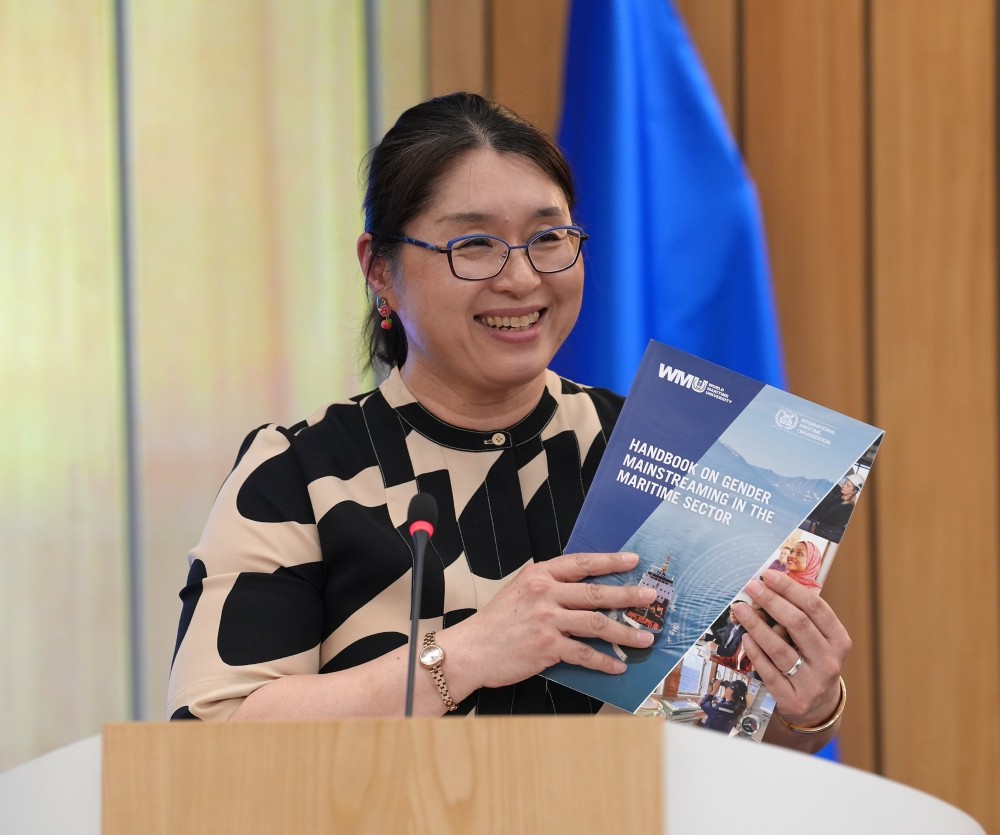
The new handbook was launched as part of an event held at IMO headquarters in London to mark the International Day for Women in Maritime 2026.
The World Maritime University (WMU) and the International Maritime Organization (IMO) have released a new Handbook on Gender Mainstreaming in the Maritime Sector, calling for action to address persistent gender inequality across the global maritime industry.
The handbook, authored by WMU Professor Momoko Kitada, was launched on the International Day for Women in Maritime on 18 May. Professor Kitada is also the recipient of the 2026 IMO Gender Equality Award.
The publication is the first of its kind, aimed at closing the gender gap in the maritime sector, where women account for just 1% of the world's seafaring workforce and hold only 19% of ministerial roles responsible for maritime affairs.
Watch the video
Professor Kitada explains what the Handbook on Gender Mainstreaming in the Maritime Sector is all about.
A practical tool
The handbook provides practical guidance for maritime administrations, shipping companies, ports, shipyards and maritime education institutions on how to integrate gender considerations into policies, recruitment, training, workplace safety and leadership development.
It includes tools tailored to maritime organizations for gender analysis, the development of gender equality action plans, and monitoring and evaluation.
Presenting the handbook, Professor Kitada emphasized that gender mainstreaming is an effective strategy, process and methodology which works for everyone's benefit:
"Gender mainstreaming requires leadership to implement. No matter our role or level in an organization, we can exercise gender mainstreaming in both large and small capacities."
Moving beyond rhetoric
In the foreword, IMO Secretary-General Arsenio Dominguez said the industry must move "beyond rhetoric and toward measurable action," adding that a more diverse maritime workforce is more competent, safer and more sustainable.
He stated: "Gender mainstreaming is the strategic tool we must employ to bridge this gap. It is not a secondary objective or a 'women's issue'; it is a globally recognized methodology used to ensure that every policy, every regulation, and every operational practice is scrutinized through a gender lens."
WMU President Maximo Q. Mejia, Jr. said in the preface that the handbook was designed to serve as "a roadmap to definitive change," helping organizations implement practical measures to create more equitable workplaces.
He noted that WMU itself had reached gender parity in its Malmö MSc intake for 2025 after decades of targeted efforts to increase opportunities for women in maritime education.
Access the handbook
To access the Handbook on Gender Mainstreaming in the Maritime Sector, click here.
For more resources, see:
- Photo gallery from the launch event
- Video recording of the IMO event to celebrate ID4WIM 2026
- Event page - International Day for Women in Maritime 2026
- IMO Women in Maritime Programme
- World Maritime University


