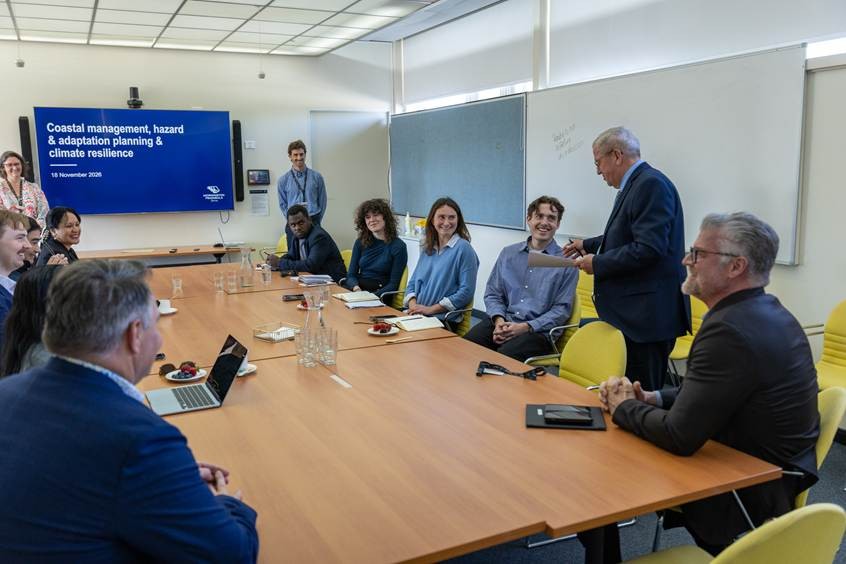
Representatives from the international delegation from Tonga, the Philippines, the Solomon Islands and the Maldives, alongside representatives from the Department of Foreign Affairs and Trade (DFAT), Mornington Peninsula Shire staff and Mayor Stephen Batty.
The Shire's work to protect its coastline and prepare communities for a changing climate was the focus of a visit by an international delegation last week.
Officials from Tonga, the Philippines, Solomon Islands and the Maldives met with the Shire at its Hastings office as part of a Department of Foreign Affairs and Trade (DFAT) program in Victoria from 16-20 November 2026.
The visit provided an opportunity to share the Shire's approach to coastal management, hazard and adaptation planning and climate resilience, while supporting the delegation's broader interest in the blue economy and conservation.
The Mornington Peninsula has 192 kilometres of shoreline, roughly 10 per cent of Victoria's coast, with the Shire directly managing 64 kilometres of foreshore. The coastline is central to local life and underpins a $1.8 billion annual tourism economy.
Rising sea levels, severe storms, erosion and landslips are placing increasing pressure on coastal communities, infrastructure and the environment. The Shire is responding through practical foreshore works, long-term planning and measures to strengthen community resilience.
This includes maintaining boat ramps, carparks, coastal paths and beach access, and advocating for state funding to upgrade facilities. At Portsea Front Beach, the Shire is campaigning for permanent engineering and sand-restoration solutions to address severe sand loss, guided by Victoria's Resilient Coast framework and Traditional Owner knowledge.
Through its Our Coast, Our Future strategy, the Shire is developing staged adaptation pathways for 10 priority coastal townships, including Mount Eliza, Mornington, Sorrento, Flinders and Hastings.
Without action, coastal hazards could cost the region an average of $8.6 million a year through 2040, rising to more than $67 million a year by the end of the century.
The Shire's Planning Scheme requires new coastal developments to account for at least 0.8 metres of sea-level rise by 2100. Following recent landslips, an interim Erosion Management Overlay has also been introduced while further detailed geotechnical mapping is completed.
The Shire's developing Climate Resilience Plan also focuses on preparing the community for heatwaves, bushfires and flash flooding. Work includes upgrading Council roads, drainage and community buildings to withstand future conditions, maintaining firebreaks and protecting the Green Wedge, urban tree canopy and coastal bushland as natural buffers.
Mayor Stephen Batty said when we think about what makes the Mornington Peninsula special, our coastline is always at the top of the list.
"Ultimately, adapting to a changing climate isn't about standing still - it's about making informed, proactive choices today. By combining practical foreshore care, forward-looking planning and community resilience, we are working to ensure the Mornington Peninsula remains safe, thriving, and resilient for generations to come," Cr Batty said.