
Japan's parliamentarians have seen first-hand how International Labour Organization (ILO) initiatives supported by Japan in India are addressing labour and social challenges.
A six-member delegation of the Japanese Parliamentarians' League on ILO Activities visited India from 13 to 18 September 2026.

The programme included policy dialogues and visits to workplaces supported through Japan-ILO cooperation. Participants observed initiatives aimed at promoting formalization and protecting children, improving occupational safety and health, and extending social protection to workers in emerging forms of employment.
"It was valuable to see first-hand how the principles and standards promoted by the ILO are being translated into concrete action in India. Through our discussions with government, employers, workers and beneficiaries, we were able to understand both the progress that has been made and the challenges that remain," said Norihisa Tamura, Chair of the Japanese Parliamentarians' League on ILO Activities. "I hope that the experience from India will further strengthen cooperation between Japan and the ILO in advancing decent work and protecting workers in a changing world of work."
The delegation heard from the Government of India, employers' and workers' organizations and project partners about progress in advancing formalization and eliminating child labour at a closing event for the Japan-funded PRS (Promoting Rights and Social Inclusion through Organization and Formalization) and PPLL (Policies, Partnerships, Learning & Local Empowerment) projects. Workers and other beneficiaries shared their experiences and the changes they had seen through the initiatives.
The delegation also held exchanges with Indian employers' and workers' organizations. Discussions highlighted the importance of social dialogue and partnerships among government, employers and workers in translating labour standards into practice.
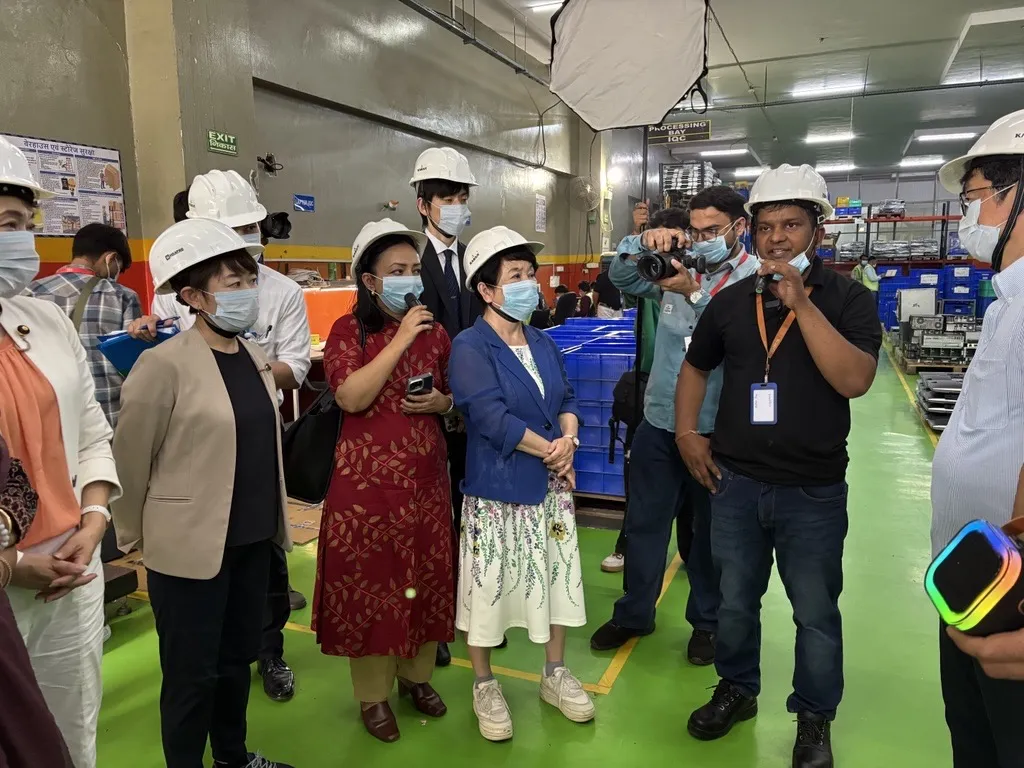
At Deshwal Waste Management in Manesar, the delegation visited an e-waste recycling facility supported through the Japan-funded E-safe initiative. The visit provided a first-hand look at the transition from informal to more formal and safer e-waste work, including recycling operations, supply chains and workplace safety measures.

At the Urban Company Skilling Centre in Ghitorni, the delegation explored the realities of platform work and the role of skills development, digital systems, and social protection. The visit included demonstrations of how platform workers are trained in technical skills, service standards, and safe working practices. The session highlighted efforts to connect platform workers with India's social protection system through e-Shram, the national database of unorganised workers launched by the Government of India in 2021.

"Japan's partnership with the ILO is grounded in a shared commitment to advancing decent work and ensuring that workers are not left behind as economies and forms of employment evolve. This visit demonstrated the value of bringing international labour standards together with practical, locally driven solutions," said Kaori Nakamura-Osaka, Assistant Director-General and Regional Director for Asia and the Pacific of ILO.
The League is a cross-party group of members of the Japanese Diet that promotes decent work and good working conditions through support for the ILO and international labour standards. Its members undertake study visits to countries where the ILO provides support, meeting with governments, employers' and workers' organizations and other stakeholders.
The delegation was led by Norihisa Tamura, former Minister of Health, Labour and Welfare and Chair of the League, and included members from various political parties. The visit was supported by the Embassy of Japan and the ILO.


