
Drought, heat and growing demand for water are putting increasing pressure on both the availability and quality of our water resources. How can we ensure that the Netherlands has enough clean water in the future? In the new TRANSWATER research project, scientists and societal partners are working together to develop solutions.
Water quality and availability are closely connected
Climate change is bringing more frequent periods of prolonged drought and heat to the Netherlands, while demand for water continues to grow. This has consequences for our drinking water supply, agriculture and nature.
Addressing these challenges requires more than knowledge of water systems alone. Legislation, policy and different societal interests also play an important role. The new TRANSWATER research project brings these perspectives together. The consortium, led by Delft University of Technology (TU Delft), has been awarded €7.2 million in funding from the Dutch Research Council (NWO).
From understanding water systems to making better decisions
Researchers at Wageningen University & Research (WUR) are investigating, among other things, how climate change and human activities interact to affect water availability and quality. How do drought and heat affect the quantity and quality of groundwater and surface water? And what measures can help prevent negative impacts on people and nature?
Under the supervision of researchers Martine van der Ploeg and Ruud Bartholomeus, strategies will be developed to make use of different water sources for drinking water production.
WUR researchers are also working with Utrecht University to develop indicators that provide a clearer picture of the risks posed by drought and heat to clean water resources. These indicators should help water managers and public authorities make better-informed decisions while taking different societal interests into account.
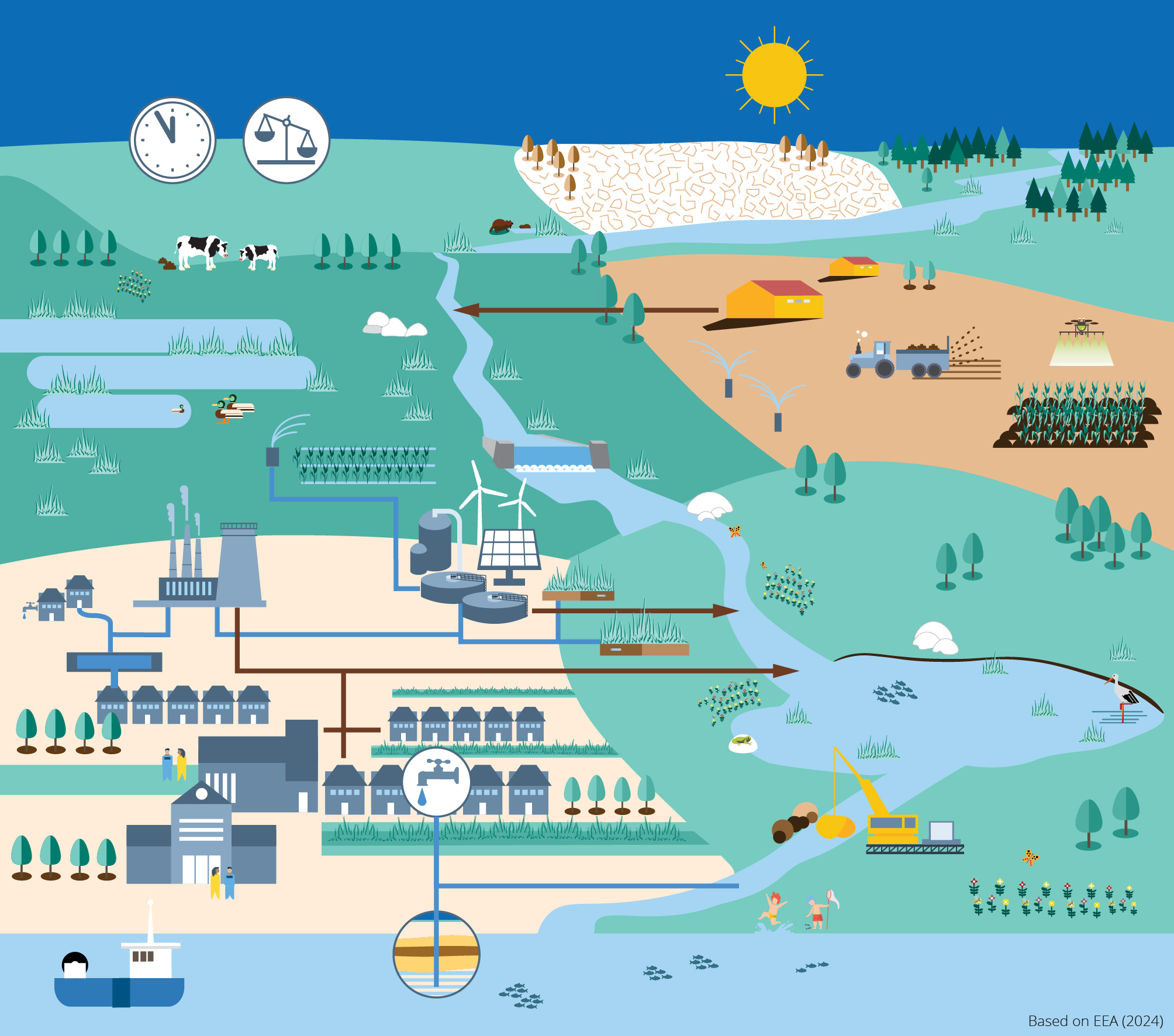
In the Dutch water system, many components are interconnected. TRANSWATER provides assessment frameworks to support better-informed and more equitable decisions on clean water management. Image: Utrecht University Cartographic Lab.
Not just technical solutions, but societal ones too
A future-proof water system requires more than technical solutions. It also calls for new ways of working together and making decisions. Why is it so difficult to fundamentally change the water system, despite the growing urgency? And what legal, administrative and societal barriers stand in the way?
WUR researcher Dave Huitema and his colleagues are focusing, among other things, on the societal consequences of these changes. They are investigating how public authorities can take a more systematic approach to dealing with damage resulting from changes to the water system, and how affected parties can be compensated. They are also developing long-term visions for water management in the Netherlands.
'The question of who should bear the costs of these changes is often a sticking point in political debates,' says Huitema. 'It helps if public authorities can work towards long-term goals for water management while dealing with potential damage to affected parties in a predictable and fair way.'
It is precisely this combination of natural and social sciences that makes TRANSWATER distinctive. The project not only examines the effects of drought and heat on water quality and availability, but also connects these to ecological, health, legal and governance risks.
Working together towards a future-proof water system
TRANSWATER brings together universities, universities of applied sciences, drinking water companies, regional water authorities, nature conservation and agricultural organisations, and other societal partners. In regional Transition Ateliers, researchers and stakeholders will jointly develop knowledge and potential solutions for practical application.
The findings will be translated into potential pathways for change, assessment frameworks and tools to support public authorities and water managers in their decision-making. The ultimate goal is a robust and climate-resilient Dutch water system capable of providing sufficient clean water for people and nature towards 2100 and beyond.
About TRANSWATER
TRANSWATER is funded through the Dutch Research Agenda (NWA-ORC) of the Dutch Research Council (NWO). TU Delft coordinates the consortium. Researchers from WUR's Environmental Sciences Group and Social Sciences Group are involved in the project. Ruud Bartholomeus is a member of the project's steering committee and chairs the committee responsible for facilitating collaboration with societal partners.


