Observed Oceanic Drivers for the Previous Season
During the February-March-April 2026 (FMA 2026) season, the equatorial Pacific made a transition from a weakening La Niña to ENSO-neutral conditions. The negative sea-surface temperature (SST) anomalies in the central and eastern equatorial Pacific dissipated, with the Niño 3.4 index rising to approximately 0.5°C by the end of the season.
Despite the oceanic shift to neutral thresholds, a residual east-west SST gradient persisted across the broader Pacific basin, maintaining a weak, lagging atmospheric response near the Date Line, particularly for rainfall anomalies.
In other basins, the Indian Ocean Dipole (IOD) remained in neutral phase. Meanwhile, wide-scale positive SST anomalies continued to persist in the subtropical and extratropical North Atlantic, and SST anomalies in the North Tropical Atlantic (NTA) and South Tropical Atlantic (STA) remained slightly above average. Wide-scale positive SST anomalies continued to dominate in the North Pacific.1
Outlook for Oceanic Drivers for the Next Season
Following the transition to ENSO-neutral conditions at the end of the FMA 2026 season, the multi-model ensemble indicates a rapid transition to a strong El Niño event. By JJA 2026, the multi-model ensemble mean (MME) is forecast to comfortably clear the El Niño threshold, reaching approximately 1.8°C for the seasonal average. The intensification trajectory maintains a steep upward slope throughout the boreal summer and autumn. Spread among the individual member models is narrow during JJA, indicating very high forecast confidence.
The Indian Ocean is forecast to experience development of the positive IOD phase, peaking concurrently with the intensifying Pacific El Niño. Starting from near-neutral conditions in May, the MME mean for the IOD seasonal average rises to approximately 0.4°C for JJA. Meanwhile, the equatorial Atlantic basin is expected to remain generally warm; SSTs in both the North and South Tropical Atlantic are predicted to stay slightly above normal.
Surface Temperature Outlook for the Next Season
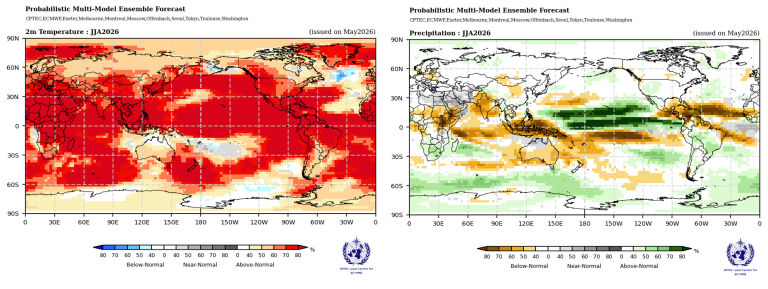
For the JJA 2026 season, multi-model ensemble forecasts project a nearly universal global dominance for enhancement in probabilities for above-normal temperatures. This warming trend is especially pronounced throughout the globe between 60°S and 60°N, where a large increase in probabilities for above-normal temperature is reinforced by high model consistency.
In the Northern Hemisphere, widespread tilts in probabilities for above-normal temperatures are forecast to cover the Northern Hemisphere mid- and low-latitudes. Over North America, enhanced probabilities for above-normal temperatures remain in the highest tier (exceeding 70-80%) across the southern and western regions, Central America, and the Caribbean, and the model consistency is high. Similarly, Europe and Northern Africa exhibit widespread tilt in probabilities towards above-normal temperature. Across Asia, a robust tilt toward above-normal conditions prevails south of 60°N, with the highest confidence anchored over southern and eastern regions, while high-latitude north-central Asia presents a relatively more moderate probability signal.
In the Southern Hemisphere landmasses, strong signals for an increase in probabilities for above-normal temperature dominate. A strong enhancement in probabilities for above-normal temperatures covers regions north of 30°S over South America, with smaller increases to the south. Over Southern Africa, an increased likelihood of above-normal temperatures expands southward, showing strong model agreement across the entire sub-continent. Over Australia while a moderate tilt toward above-normal temperatures is forecast along the western, southern, and eastern coastal margins, there is a lack of a clear signal over northern Australia.
The tropical belt is characterized by a consistent signal for enhancement in probabilities for above-normal temperature, particularly over Equatorial Africa and the Maritime Continent. Ocean basins reflect a heavily structured footprint of the rapidly intensifying El Niño event. Extreme probabilities (exceeding 80%) for above-normal SSTs dominate the Equatorial Pacific east of the Date Line, where the core of the warm region displays maximum model consistency. A widespread tendency for above-normal temperatures also covers the Indian Ocean and the tropical Atlantic. In contrast, a persistent horseshoe-like pattern of below- to near-normal temperature probabilities is predicted across the North Atlantic, straddling the warmer anomalies along 30°N.
Rainfall Outlook for the Next Season
For the JJA 2026 season, multi-model ensemble forecasts project highly structured, a large tilt in rainfall probabilities, exhibiting a classic, strong atmospheric response to the rapidly developing Pacific El Niño. The most dominant feature of the JJA 2026 outlook is a profound enhancement in the probability of above-normal rainfall stretching across the central and eastern equatorial Pacific east of the Date Line with a strong model consistency. This signal is flanked by a horseshoe of below-normal rainfall probabilities. This dry signal encompasses extensive marine zones, manifesting as widespread enhancements in the probability for below-normal rainfall over the tropical Indian Ocean and the equatorial Atlantic Ocean. The Indian Subcontinent features an enhancement in the probability for below-normal rainfall with high model consistency.
Across equatorial Africa, the probabilistic signals display a prominent north-south contrast. Land areas bordering the northern Gulf of Guinea and over the Greater Horn show an enhanced probability for below-normal rainfall. Conversely, southern parts of Africa exhibit an enhancement in the probability of above-normal rainfall supported by moderate to strong model consensus.
Over South America, the rapidly intensifying tropical Pacific forcing generates a rainfall dipole. Northern South America and the northeast (Nordeste) are dominated by an enhancement in the probability of below-normal rainfall. In contrast, there is a weak enhancement in probability for below-normal rainfall anomalies to the south of the dry zone. Over Australia, a weak tilt towards enhancement for probabilities of near-normal rainfall along the far northern coastline is augmented by an enhancement in the probability for below-normal rainfall over the rest of the continent.
1 https://www.cpc.ncep.noaa.gov/products/attribution/images/Attribution202604.pdf