
Majmaah, Saudi Arabia - From 22 to 27 November 2025, Majmaah University, in partnership with CIFAL Saudi Arabia, hosted the Co-Creation Workshop of the UNITAR-UNESCO LEAP-FAST (Leaders in Higher Education Alliance and Programme for Accelerating Sustainability Transformations) Certificate Programme, bringing together universities and sustainability experts from across regions for six days of collaboration, reflection, and collective transformation of higher education.
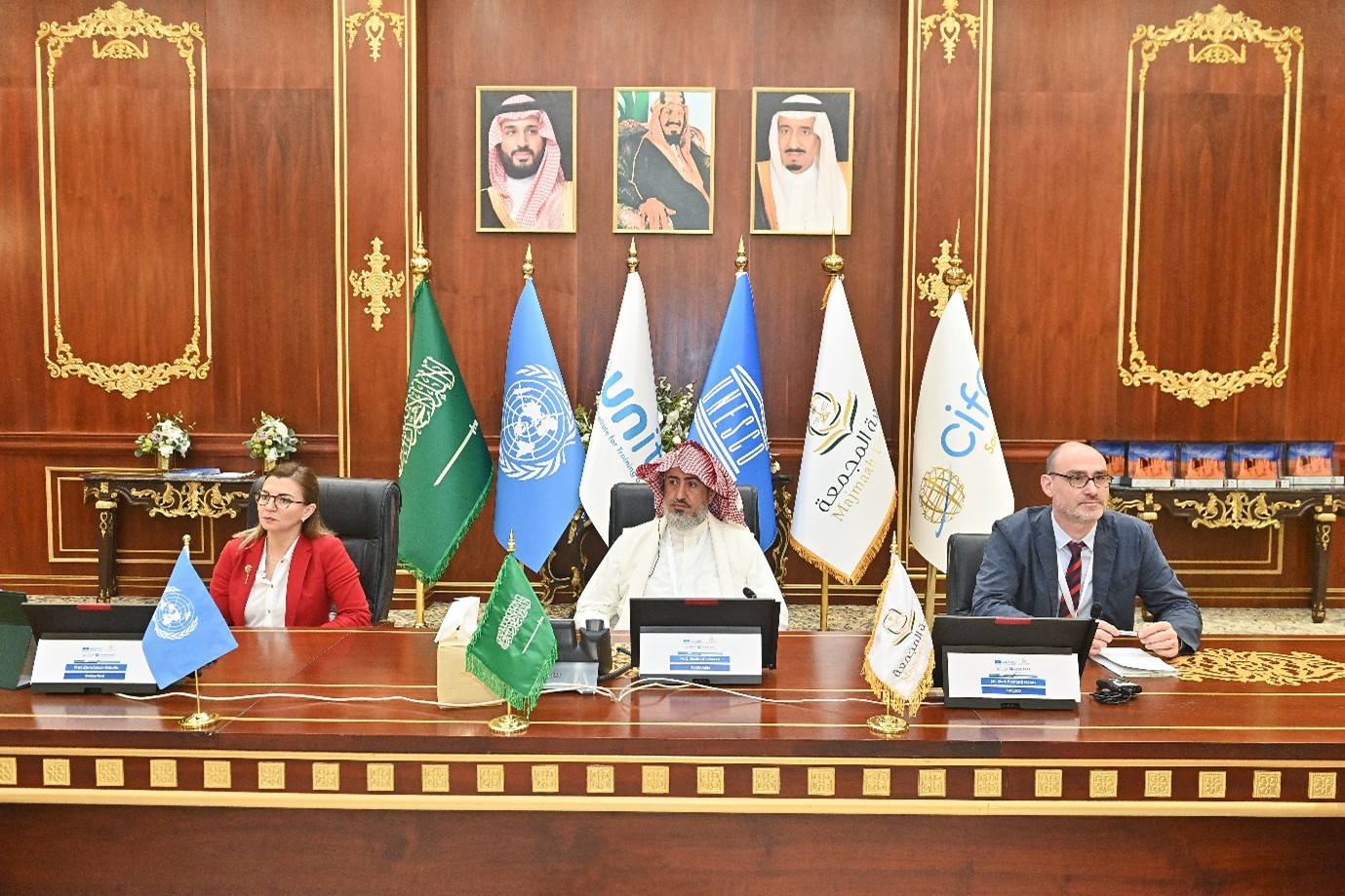
The Co-Creation Workshop formally commenced with welcoming remarks from Prof. Mosallam Aldosari, Vice-Rector for Development and Investment of Majmaah University, followed by addresses from Ms. Ebru Canan-Sokullu, Deputy Head of CIFAL Global Network, and Mr. Mark Manns, Project Officer in UNESCO's Section of Education for Sustainable Development, and concluding with opening remarks from Dr Aiman Albarakati, Director of CIFAL Saudi Arabia. Speakers underscored the strategic importance of LEAP-FAST as a catalyst for systemic change in higher education and highlighted the value of collaborative, cross-regional learning in accelerating sustainability transformations.
The workshop represented the culminating, experiential phase of the 2nd edition of the LEAP-FAST Certificate Programme, which ran from 14 September to 27 November 2025. Designed as a blended learning journey, Edition II combined rigorous online modules, peer learning, and institutional assignments with an intensive in-person co-creation component in Majmaah. The online phase equipped participants with foundational concepts on sustainability in higher education, the Whole-Institution Approach (WIA), Education for Sustainable Development (ESD), and transformative leadership. The Co-Creation Workshop then provided the space to translate this learning into practice, enabling dialogue, experimentation, collective sense-making, and refinement of institutional capstone projects.
Over the six days, 51 participants r epresenting 28 Higher Education Institutions (HEIs) from 15 countries gathered in Majmaah to deepen their understanding of how universities can drive sustainability transitions at institutional, programme, and course levels. Working in institutional teams and cross-disciplinary groups, participants moved from theory to action, testing ideas, challenging assumptions, and co-creating solutions that could be embedded within their own universities.
Following the three levels of the programme, the workshop began with a focus on systemic transformation of higher education and the Whole-Institution Approach, encouraging participants to examine their internal environments and readiness for change. Through "change stories," participants surfaced both momentum and resistance within their institutions, generating collective insight into how to better engage leaders, faculty, students, and administrative structures. As one facilitator noted during peer exchanges:
Real change only happens when everyone sees themselves as part of the solution.
A central institutional theme explored inclusion and equity, inviting participants to reflect on whose voices shape university priorities, and whose perspectives remain marginalised. Moving to the programme level, the Wicked Problem Challenge reinforced the importance of interdisciplinary collaboration, enabling participants to confront complex sustainability issues through diverse disciplinary lenses. Hands-on curriculum redesign sessions empowered teams to embed sustainability competencies and active learning strategies into their programmes and courses. At the course level, participants also engaged deeply with methods to strengthen assessment for learning and student reflection.
The final day brought together the learning journey of both the online phase and the co-creation workshop. Institutional teams finalized and presented their capstone projects, integrating insights gained throughout the programme. Participants also contributed substantive inputs to the Guiding Strategy for Empowering HEIs to Advance the SDGs and recommendations for a forthcoming Leadership Statement.
The workshop concluded with the establishment and strengthening of Communities of Praxis, ensuring that collaboration continues beyond the formal programme. By taking a collective Sustainability Leadership Pledge, participants reaffirmed their commitment to the growing LEAP-FAST movement-positioning universities as engines of sustainability, innovation, and social transformation in their regions and beyond.
Highlights
UNITAR CIFAL Global Network - Ms. Ebru Canan-Sokullu:
We are very pleased to partner with UNESCO and Majmaah University on the LEAP-FAST Programme, and proud that our CIFAL Saudi Arabia is hosting this edition as an academic partner. Through this collaboration, we are strengthening universities' capacities to embed sustainability, equity, and transformative leadership across teaching, research, and institutional practice, in line with the SDGs.
UNESCO - Mr. Mark Manns:
LEAP-FAST supports universities in translating sustainability competencies into interdisciplinary action in higher education institutions.
Majmaah University - Prof. Mosallam Aldosari (Vice-Rector):
We are honoured to host the LEAP-FAST Co-Creation Workshop in Majmaah and to work closely with UNITAR and UNESCO in strengthening the role of universities as drivers of sustainability and transformative higher education.
CIFAL Saudi Arabia - Dr Aiman Albarakati:
It is highly encouraging to see the growing participation of Saudi and Gulf universities in LEAP-FAST. The large and diverse representation from across the region demonstrates a strong collective commitment to sustainability in higher education.


