
UConn researcher talks about the different forms that caregiving can take, the result of absent social safety nets, and how ableism permeates the culture
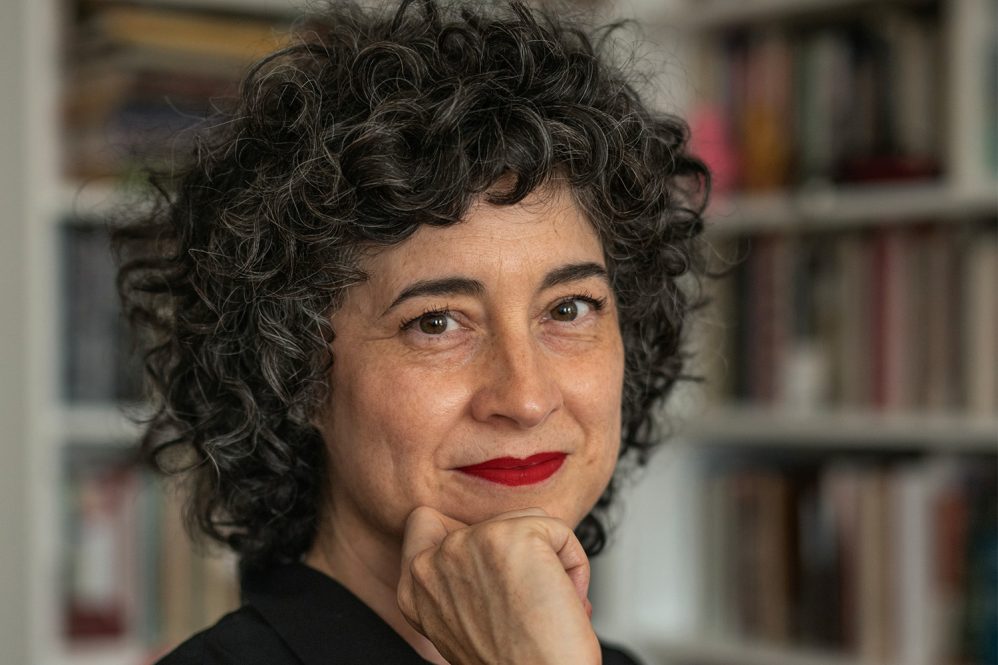
Laura Mauldin is an associate professor in UConn's Department of Social and Critical Inquiry. (Contributed photo)
It may not have been the birthday present then 32-year-old Laura Mauldin wanted to buy herself, but purchasing long-term care insurance was something she knew she needed.
Mauldin, an associate professor in UConn's Department of Social and Critical Inquiry, had been caring for her sick partner the five years prior, watching as cancer destroyed the promise of a long life.
"It's not about being morbid, rather it's about recognizing the inevitability of a completely typical, expectable part of life," Mauldin says of her advanced planning. "Why not just go ahead and in a neutral way have a plan? Then it's there, you don't have to worry, and you can feel more prepared."
A detailed account of her caregiving experience is the launching point for her new book, "In Sickness and in Health," released this month by HarperCollins' Ecco Press, in which she tells the story of a handful of couples from around the country who she came to know over years of spending time with them, oftentimes days and nights.
"I grew to love these people and to care about them," she says. "Their stories tell us something bigger about our culture, about our society, and about our choices around care policy and care systems. Theirs are the hidden stories that are going on behind millions of closed doors."
In her quest to bring discussions about caregiving to the light of day, Mauldin sat with UConn Today recently to talk about the different forms that caregiving can take, the result of absent social safety nets, and how ableism permeates the culture.
As somebody who studies caregiving, how do you define it?
My rule of thumb is if you think you're caregiving, you probably are. A lot of people think, "I just have to help with medication sometimes" or "I just have to help out with getting dressed sometimes." There are a lot of "justs" in those statements. Caregiving can include anything from hands-on direct care with the body to insurance management and care coordination like managing health care appointments. There's managerial and administrative care work, advocacy-related care work, and hands-on bodily care work - not to mention emotive caregiving based on the relationship you have with the person and the way you feel about them. Scholars have tried to neatly define these categories, and nobody agrees, so it depends on who you ask. Caregiving is a mishmash of all these things, and it can be hard to say this counts, but this doesn't, which is why I try not to draw hard lines around it. It saddens me when I talk with people and they say, "I just do … fill in the blank." That minimizes what caregivers do, the labor it takes to give someone care, and doesn't recognize all its different shapes and forms.
So then, the more people in a person's caregiving circle, the better their needs are going to be met?
There's this concept I write about of "The One," and it's how we often consolidate all the care onto one family member - usually a woman, not always but often. We need to remember that people have different skillsets, so care should become a collective responsibility rather than something carried solely by an eldest daughter, or a wife, or a sister who's a nurse. There are lots of different things that need to be done, for example financial management, which is its own unique skillset. One caregiver in my book was excellent at making spreadsheets and knowing that Medicare would charge this amount for this drug until you get past the catastrophic phase. He knew all the lingo of the systems and could navigate them with these beautiful spreadsheets but could not tolerate the sight of blood - and his partner needed wound care daily. He often felt like he wasn't a good caregiver because his skillset was not something we might have thought of as an act of care.
Those in any caregiving role, from administrative to hands-on, can get burnt out, right?
Yes, particularly because we don't have the social safety nets in place to carry the weight of all these different aspects of care or at least to help us with it. You can qualify for one thing, but that doesn't mean you can get into this other thing. Any long-term care safety nets we have are through Medicaid, which is a poverty program that's difficult to qualify for. So, what most often happens without them is all these different aspects of care get consolidated and typically put on one family member, "The One," or maybe a couple of family members, which is a recipe for burnout. Love has to stand in for an absent system, and that's the whole argument of the book. Love is not a plan. We cannot expect love to stand in for an absent system, not without dire consequences for everyone involved when it comes to mental health and issues like burnout and even physical health.
Who needs to hear about your work the most?
I have a double audience: caregivers and the people who receive care. It's important to highlight disabled and chronically ill people's experiences because we can't erase them. And, in fact, the reason caregivers feel unsupported and isolated is because we have a system that is fundamentally influenced by and permeated with ableism, which is the devaluation of disabled people or people who aren't seen as productive for the economy. Because we devalue these people and the care they need, we devalue the people who are providing that care because we don't care about disabled people. These two positions are intertwined and stuck in a broader culture of ableism in which we've abandoned disabled people and, in the process, the people who care for them. Aging into disability or becoming disabled or becoming chronically ill isn't the burden. It's being left alone by the system to care for those people, that's the burden. Aging into impairment, becoming disabled, or becoming ill is the most average human thing to happen. It's not a special case. It's not a personal tragedy. It's just what it is to be alive.
Your younger self probably never imagined you'd be studying caregiving at this depth and how it relates to broader social structures.
Historically, I've studied the category of disability, the experience of disabled people, and how we think about the category of disability. My shift now has gone into the system of ableism. If we go back a hundred years ago, the U.S. was obsessed with immigration, casting it as a problem, and thinking about "dependency," people who are a burden on the rest, which is all disability coded and racially coded. A hundred years later, it's taken different forms, but we still don't have care systems because that's how we basically get rid of people. Our systems are built so that certain people are able to live and thrive and certain people aren't because they don't deserve it. This deservingness of care permeates everything. We see it now in arguments over the Affordable Care Act, arguments over expanding Medicaid, arguments over immigration. All these things are connected to who we think is worth taking care of.
What's it like to tap into your own experiences as part of your research?
I'm a feminist methodologist, someone who thinks about methods of research. Particularly in social sciences and hard sciences, we're taught to be objective, that we should be neutral and not let our personal stories or biases in the work that we do. That's impossible, even in the hard sciences. We are people, and, no matter what, our experiences infiltrate that. I consider it part of feminist praxis to lean into that. My experience is an asset, because I know the questions to ask because I went through it. I know how to pull out that information because I went through it. My experience is both a way into the research and a way to connect with other people. It's also important to me to have my work help people feel less alone, and part of that is saying, "Hey, that happened to me too."


