
He began his studies during the coronavirus pandemic - initially purely digitally, later switching constantly between online and face-to-face formats. For Felix Jahn, it became clear at the time how strongly spaces shape learning processes. Today, he is completing a Master's degree in Architecture at TUM and is a Future Scout for the Stifterverband. In this interview, he explains how space, didactics and technology should interact at universities.
 Natalie Neudert
 Mr. Jahn, as a Future Scout for the Stifterverband, you deal with the future of universities. Why are traditional learning environments increasingly reaching their limits?
In the course of digitalization and competence orientation, courses are changing from synchronous-receptive formats - i.e. events in which many people participate at the same time and mainly listen - to more interactive settings. This development is often slowed down by structures that are too rigid - and by that I mean very specific, physical structures. This is because the physical design of classrooms often makes more collaborative learning settings difficult.
Most learning environments currently still prioritize frontal-receptive settings, such as traditional lecture halls and seminar rooms with a fixed lecturer's desk at the front and fixed seating. As a result, there is an increasing discrepancy between what would make didactic sense and what is possible. Our status quo is dominated by old stock on the one hand and high-tech environments on the other. However, more technology does not mean more meaningful learning environments.
How do you approach the further development of learning environments?
As a future scout, I take a long-term view of possible futures and examine what we can already implement today. Foresight and futuring processes offer starting points here. They show visions of how universities could function in the future and allow us to draw conclusions about how we can take steps in the right direction now.
You helped develop hybrid teaching and learning spaces at TH Köln. What does such a place of learning look like compared to a traditional lecture hall - and what have you learned from it?
Good learning environments are usually not particularly spectacular. They often appear more stimulating, inviting or intuitive, but at first glance there is usually not much more to see. There are exciting examples of this, such as at NTNU in Trondheim, where the advantages of lecture halls and seminar rooms are combined with large stepped group work areas. However, such cost-intensive measures are usually not necessary. Often, even small, conscious decisions can make a lot possible - without significant additional costs.
This also corresponds to my biggest learning in recent years: innovative, hybrid learning environments are not about the best and most comprehensive technical equipment or the most beautiful furniture. The greater challenge lies in the close integration of teaching, learning and space as well as the intuitive accessibility of spatial possibilities.
Digital tools have long been a matter of course in studies. When do they really advance learning - and when do they tend to get in the way?
Most technologies initially offer great potential. It is always important to see them primarily as support in the learning process and to consciously use them as a means to this end. It can often be observed that technology is used to transfer analog processes and habits 1:1 into the digital world, or that technological possibilities are used as an add-on. In this way, they do not seriously advance learning. Great enrichment only occurs when tools are consciously integrated into the teaching concept in order to enable a more diverse, interactive or in-depth discussion.
If you look ten years ahead: What should be a matter of course in learning at universities that is still missing today?
The individualization of learning processes should be a matter of course. To this end, collaboration with teachers should take on more of a guiding than a mediating role and enable two-way learning processes. At the same time, reliable and low-threshold hybrid infrastructures are needed. If we want to learn more individually, the culture of a university community will become increasingly important: in ten years' time, learning should mean learning from each other, engaging in an active exchange and critically questioning things together. And it is clear to me that the university as the physical location of a democratic community will play a central role in this - both in the formal learning space and on the campus itself.
 Natalie Neudert
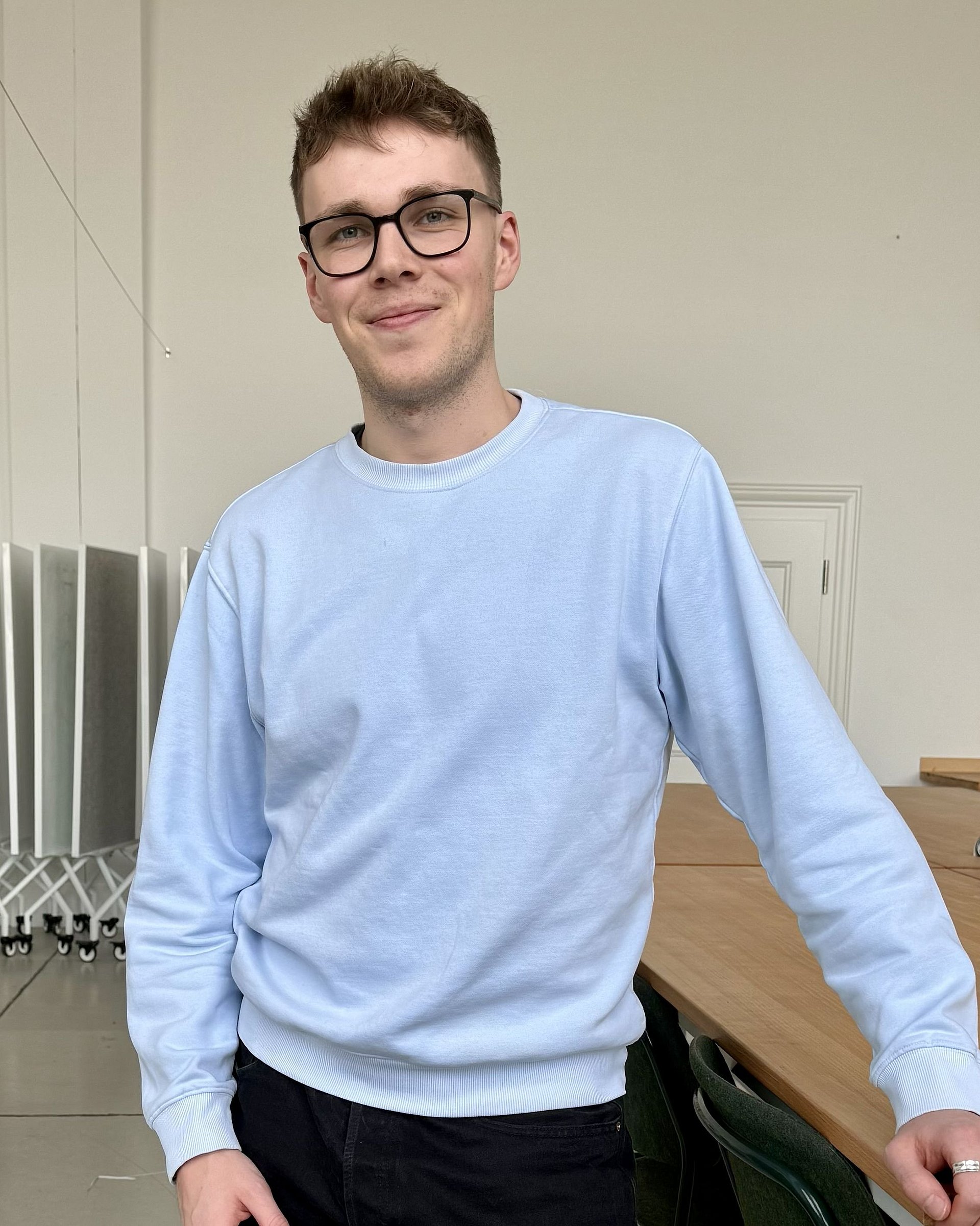
 Felix Jahn is studying for a Master's degree in architecture at TUM. As a Future Scout in the Fellowship Program of the Stifterverband and the Reinhard Frank Foundation, he deals with strategic university development and sustainable learning environments. Previously, he researched hybrid teaching and learning spaces at the TH Köln and co-developed a co-creative method for learning space design. He looks at learning environments from an architectural perspective and combines design methodology with teaching issues. He is also involved as a mentor in the DigitalChangeMaker initiative of the Hochschulforum Digitalisierung.
- Bachelor Program Architecture
- Master Program Architecture
- Fellowship program "Future Scouts" of the Stifterverband and the Reinhard Frank Foundation
- Website of the Stifterverband
- Website of the Reinhard Frank Foundation


