
Five years after Myanmar's military seized power and jailed the country's elected leaders, the United Nations says the country's crisis has only deepened, marked by escalating violence, mass displacement and a military-controlled election that UN officials warn has further entrenched repression rather than restored civilian rule.
The people of Myanmar continue to suffer amid "widespread violations of international human rights law and international humanitarian law," as the cycle of impunity persists, the spokesperson for UN Secretary-General António Guterres said in a statement , on Friday, marking the anniversary.
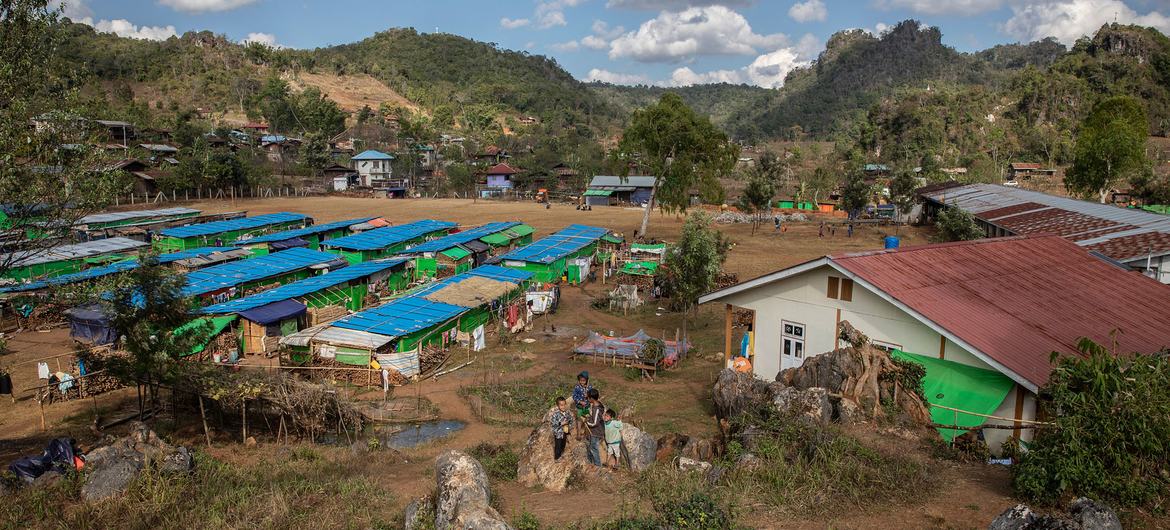
"The suffering of the people of Myanmar has deepened," Farhan Haq, the UN Deputy Spokesperson, said, pointing to escalating military airstrikes hitting civilians, acute food insecurity and nearly 5.2 million people displaced, both inside the country and across borders.
The Secretary-General, he added, remains "deeply concerned by the rapidly deteriorating situation" and its serious regional repercussions, including rising transnational crime, economic volatility and soaring humanitarian needs.
Elections deepen divisions
The grim anniversary has coincided with the conclusion of three-phased elections imposed by the military, which UN officials say have further polarised society and intensified violence instead of providing a credible political pathway.
They warned that the military-controlled ballot has compounded the crisis rather than offering a route back to civilian rule.
The process "failed to respect the fundamental human rights" of Myanmar's citizens and "served only to exacerbate violence and societal polarisation," Volker Türk, UN High Commissioner for Human Rights, said .
The vote was held in only 263 of 330 townships, largely confined to urban areas under military control. Large swathes of conflict-affected regions were excluded, along with displaced populations and minorities, including the Rohingya.
The main opposition National League for Democracy (NLD), which won the 2020 elections in a landslide, was barred from participating. Dozens of other parties opposed to military rule were also banned, and many of their leaders remain detained.
Violence and coercion during voting
The voting period between December 2025 and January 2026 was reportedly marked by intense violence. Open sources documented 408 military air attacks, which killed at least 170 civilians during the election period alone.
On 22 January, a military airstrike on a populated area in Bhamo Township, Kachin State, reportedly killed up to 50 civilians, with no reported presence of combatants.
To suppress dissent, the military arrested 324 men and 80 women under a unilaterally adopted election protection law, including for minor online activity. In one case, a 49-year prison sentence was imposed for posting anti-election material.
Mounting humanitarian and economic toll
The political repression is unfolding alongside a rapidly worsening humanitarian and economic crisis.
Nearly one quarter of Myanmar's population now faces high levels of acute food insecurity, while more than one third are in urgent need of humanitarian assistance. Humanitarian access has been repeatedly obstructed, including in Rakhine State, where desperately needed aid for starving communities has been blocked.
Myanmar's economy has lost nearly $100 billion since the coup , with the gross domestic product (GDP) not expected to recover to pre-pandemic levels for years.
"The military's usurpation of power has also been accompanied by disastrous mismanagement of the country's economy," Mr. Türk said.
Crimes under investigation
At the same time, accountability mechanisms warn that serious international crimes against civilians continue unabated.
Nicholas Koumjian, head of the Independent Investigative Mechanism for Myanmar , said there is evidence that civilians across the country have endured atrocities amounting to crimes against humanity and war crimes since the military takeover.
"The military has carried out air strikes, indiscriminately or deliberately attacking civilians in their homes, hospitals, and schools," he said , adding that many detainees have been subjected to brutal torture.
The Mechanism is also investigating a growing number of allegations of atrocities committed by opposition armed groups.
Rohingya seek justice at world court
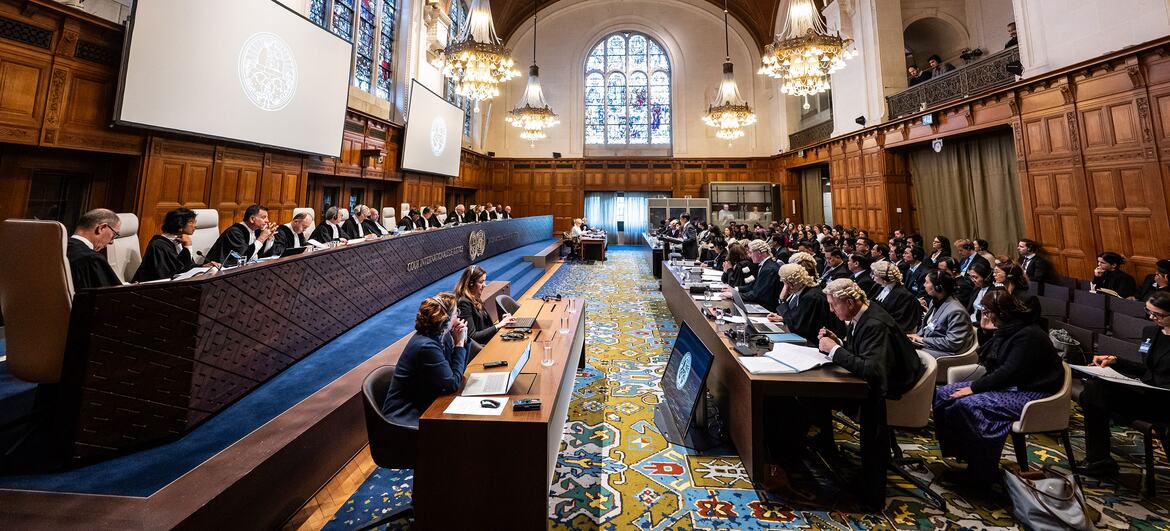
Amid the bleak outlook, an independent human rights expert pointed to a rare moment of accountability as Rohingya survivors testified before the International Court of Justice ( ICJ ) in the genocide case brought by the Gambia against Myanmar.
Special Rapporteur Tom Andrews praised the survivors' courage, saying their testimony allows "the light of truth to shine through the darkness of the most horrific of crimes."
He stressed that justice is not abstract, but "built on the courage of individuals who are willing to speak truth to power."
Mr. Andrews has been appointed by the Geneva-based Human Rights Council to independently monitor and report on the situation in Myanmar. He is not a UN staff and does not draw a salary from the Secretariat.
Calls for unity and a civilian future
The Secretary-General reiterated that a viable path back to civilian rule must be founded on an immediate cessation of violence, a genuine commitment to inclusive dialogue and the swift release of all arbitrarily detained leaders, including President Win Myint and State Counsellor Aung San Suu Kyi.
"Regional and international unity and sustained engagement are needed," the statement said, "to support a Myanmar-led solution that fully addresses the root causes of conflict, ensures accountability and responds to immediate humanitarian and development needs."
The Secretary-General's Special Envoy on Myanmar, Julie Bishop, continues to engage with all stakeholders, in close cooperation with ASEAN and regional partners, in the search for common ground toward a durable resolution and sustainable peace.


