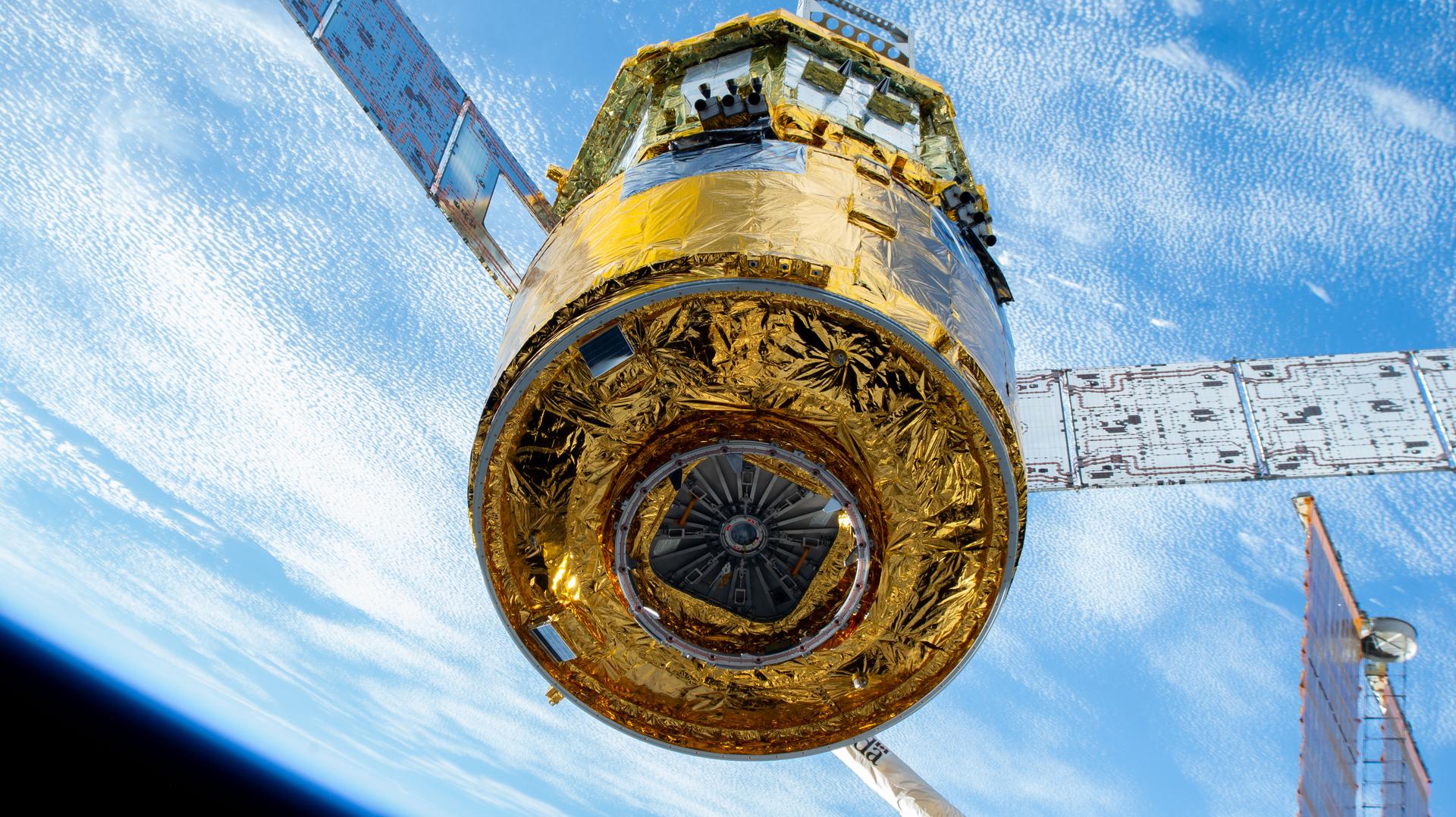
After delivering about 12,000 pounds of supplies, scientific investigations, hardware, and other cargo to the International Space Station for NASA and its international partners, JAXA's (Japan Aerospace Exploration Agency's) uncrewed HTV‑X1 cargo spacecraft is scheduled to depart Friday, March 6.
Watch NASA's live coverage beginning at 11:45 a.m. EST on NASA+, Amazon Prime, and the agency's YouTube channel in advance of the spacecraft's release at 12 p.m. Learn how to watch NASA content through a variety of online platforms, including social media.
On Thursday, March 5, flight controllers will use the space station's Canadarm2 robotic arm to detach HTV-X1 from the Harmony module's Earth-facing port on the station and maneuver it into position for release. NASA will not provide live coverage of the spacecraft's detachment from the orbiting laboratory. NASA astronaut Chris Williams will monitor HTV-X1's systems during undocking and departure.
The HTV-X1 spacecraft will remain in orbit for more than three months acting as a scientific platform for JAXA's experiments. Following the deorbit command, the spacecraft will dispose of several thousand pounds of trash during re-entry into Earth's atmosphere, where it will burn up harmlessly.
The spacecraft arrived at the space station on Oct. 29, 2025, after launching Oct. 25 on an H3 rocket from Japan's Tanegashima Space Center.
For more than 25 years, people have lived and worked continuously aboard the International Space Station, advancing scientific knowledge and making research breakthroughs that are not possible on Earth. The space station is a critical testbed for NASA to understand and overcome the challenges of long-duration spaceflight and to expand commercial opportunities in low Earth orbit. As commercial companies concentrate on providing human space transportation services and destinations as part of a strong low Earth orbit economy, NASA is focusing its resources on deep space missions to the Moon as part of the Artemis campaign in preparation for future astronaut missions to Mars.