
Paying bills, obtaining credit, applying for jobs and more are all part of the 'life-ready' class
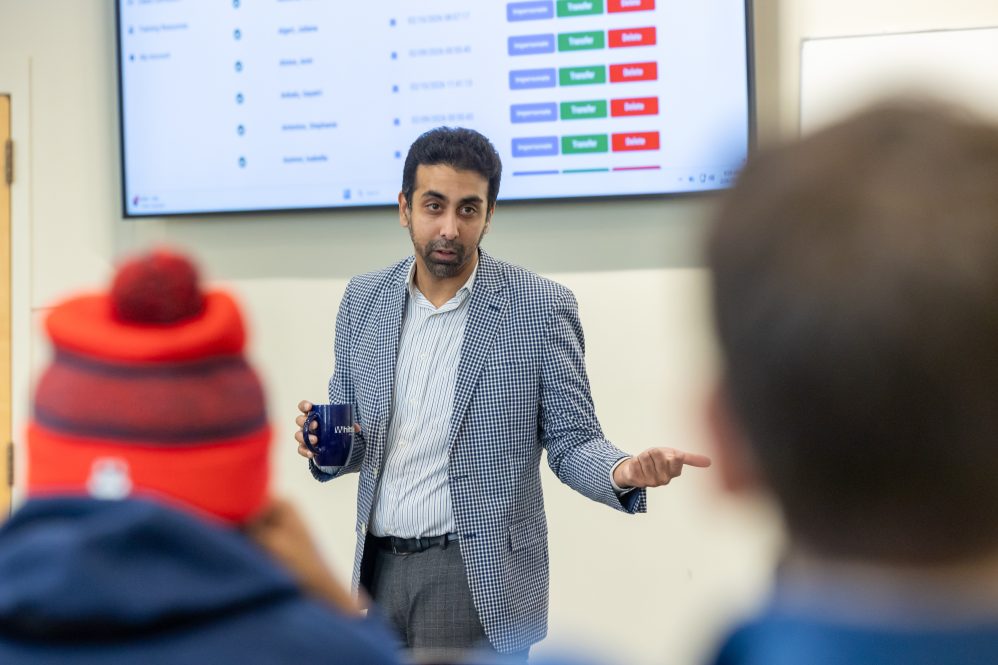
Associate professor of accounting Vishal Baloria speaks to his personal financial literacy class on Thursday, Feb. 26, 2026. (Sydney Herdle/UConn Photo)
When it comes to financial literacy, many Americans struggle with basic concepts – and the lack of knowledge is particularly acute among young adults.
Vishal Baloria is an associate professor of accounting in the UConn School of Business. He teaches "Business 2235: Personal Financial Literacy," a "life-ready" course he designed in 2023 to ease students' stress around managing money, with the objective of having a positive effect on how students make future financial decisions. This three-credit class satisfies the university's Common Curriculum and is open to any undergraduate student.
The course currently has three sessions at UConn Storrs every Tuesday and Thursday from 8 a.m. to 12:15 p.m. and introduces fundamental topics in personal finance. The curriculum focuses on financial literacy, with topics including budgeting, navigating finances during unexpected events, comparing different insurance plans, developing credit scores, investing in the stock market, exploring savings and investment options, learning about individual and small business income taxation, and comparing retirement savings.
The objectives of the course are for students to understand how to prepare and analyze a personal or small business balance sheet; comprehend relevant local, state, and federal tax liabilities; make informed decisions about major purchases; evaluate investment options; and understand consumer credit such as mortgages, auto loans, and business loans.
Ace Carter '26 (CLAS) is enrolled in the 8 a.m. section of the class, with a personal goal of preventing getting taken advantage of financially. Never having taken a finance course in high school, Carter wanted to learn how to invest money and handle taxes.
"I just wanted to learn how to navigate finances as an individual," Carter says.

One of the course's key features – a weekly simulation – is designed to do just that. The simulation is a semester-long exercise where students navigate a multitude of personal finance issues including paying off bills, obtaining credit, applying for jobs, and paying off debt.
Every Monday, students get "paid" $4,000 and have until Friday to pay off various bills. During the week of Feb. 16, students had to purchase a health insurance plan by evaluating which offer would best serve them in real life. The weekly simulation is intended to mimic "a month in real life," where all expenses must be paid on time.
Students can choose to take out loans to purchase vehicles or miscellaneous products. As the course continues throughout the semester, they will begin browsing for living spaces and decide whether to "purchase" a house or rent.
Baloria says the purpose of this weekly exercise is for students to "see the implications of making certain choices."
To imitate real-life scenarios as much as possible, Baloria also plays a "Life Happens" game, where students can randomly earn extra money from an inheritance, or alternately face an unanticipated expense they must cover, such as a hospital bill for broken bones.
Every student begins the class with a credit score of 750, and Baloria expects to see improvement by the end of the semester, ideally a score of 785 or greater. Some goals he expects students to accomplish include having at least $5,000 in an emergency funds account, the majority of their student loans paid off, and some amount of money in a savings account.
The course is offered in the Fall 2026 semester at UConn Stamford and will be offered again in Storrs in Spring 2027.


