
Taught with Washington Post journalist and former hostage Jason Rezaian, the course also explores press freedom
Story by Leo Heffron
February 4, 2026
Ten years ago this January, Washington Post journalist Jason Rezaian was released after 544 days as a hostage in Iran. Since his release, he's been vocally committed to hostage advocacy and the importance of press freedom.
Students at the University of Oregon's School of Journalism and Communication are now benefiting from his personal perspective and experience. Rezaian is co-teaching a new course on the complex world of hostage diplomacy alongside advertising professor of practice David Ewald.
In the course's pilot, which ran in winter and spring terms of 2025, students collaborated with former hostages and their families, met with nongovernmental organizations and government officials and even traveled to Washington, D.C., to contribute to real advocacy efforts on behalf of political prisoners.
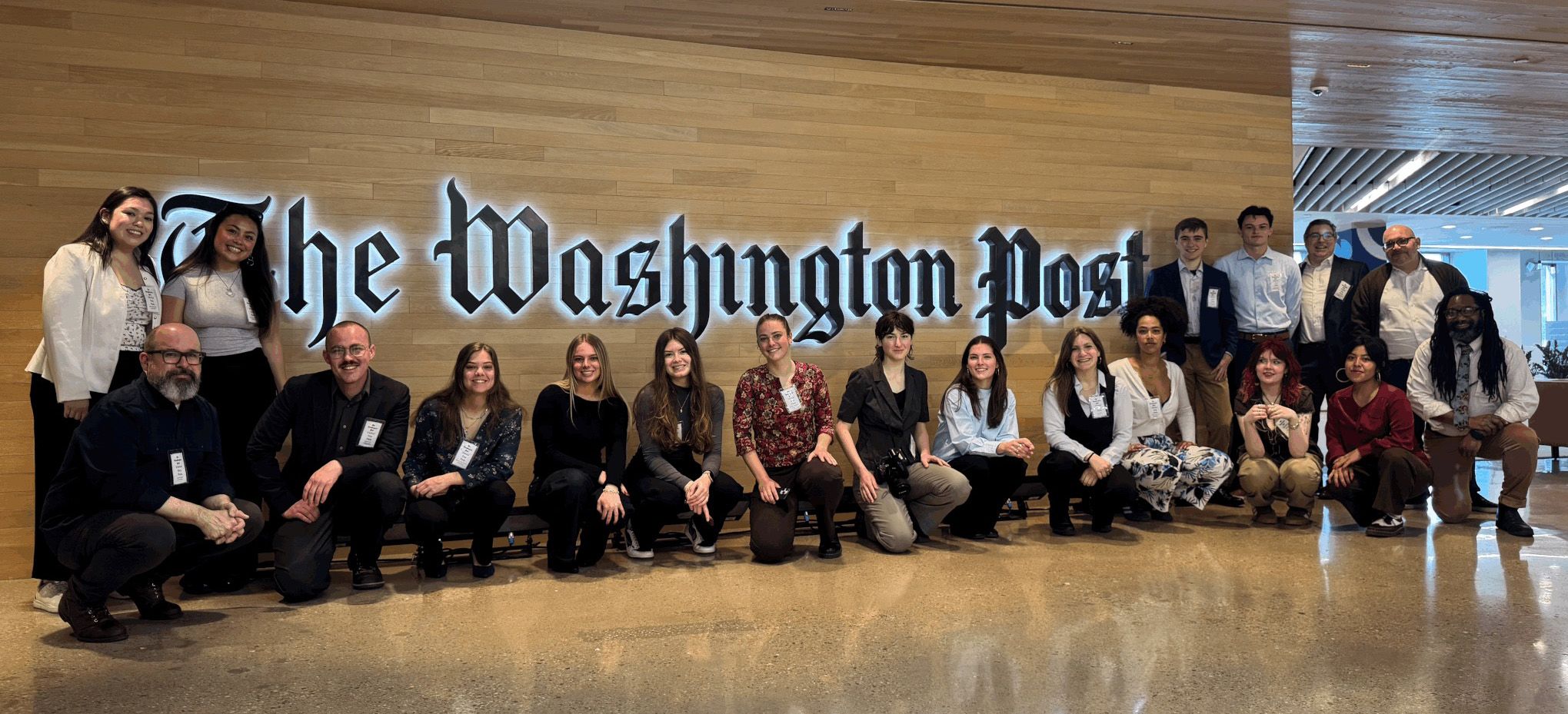
The course teaches students how to stretch their storytelling skills through advocacy and awareness, whether they major in journalism, advertising, public relations, media studies or a discipline outside the School of Journalism and Communication.
"This program is the first of its kind in the country and gives our students a truly unique set of experiences, no matter their specific major," interim Dean Regina Lawrence said. "At a moment of profound change in media, it's so important for the SOJC to do creative and groundbreaking things."
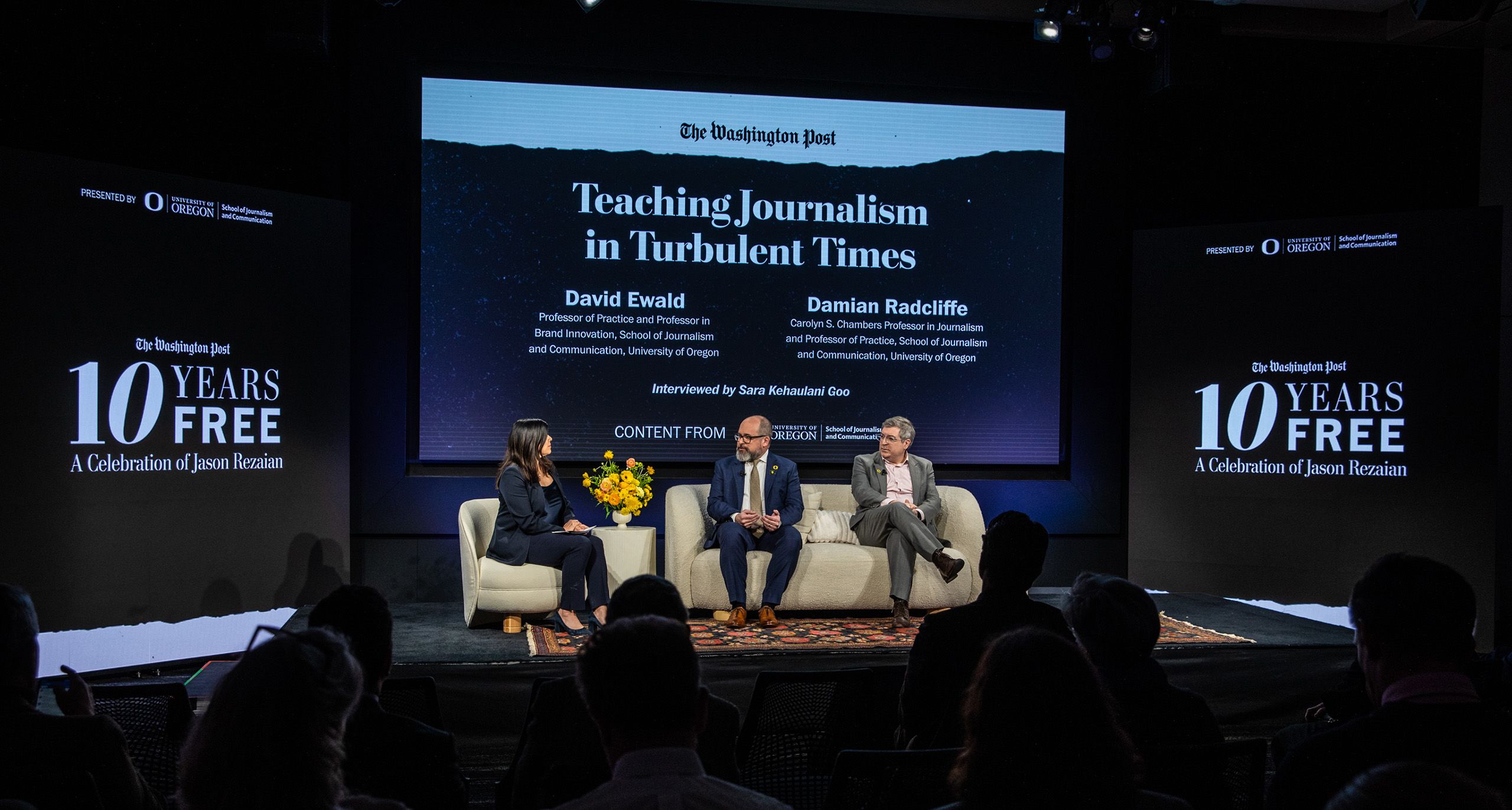
In a nod to that mission and the school's connection with Rezaian, the school was the presenting sponsor for "10 Years Free: A Celebration of Jason Rezaian," a Washington Post Live event held Jan. 29. The event brought together leaders, advocates and supporters of press freedom initiatives, including people who were critical to Rezaian's release.
It also included a conversation with Ewald and journalism professor of practice Damian Radcliffe about the university's approach to training the next generation of journalists.
Hands-on experience
The outline for the hostage diplomacy course began in 2024 when Rezaian came to the UO. Ewald, who has a longstanding interest in hostage advocacy, met with Rezaian, "and we just started dreaming out loud together," Ewald said.
The two pitched their course idea to the School of Journalism and Communication and secured donor funding from Julie and Rocky Dixon to cover travel and other expenses. Rocky Dixon graduated from the UO in 1978 with a bachelor's degree in political science, and Julie Dixon sits on the SOJC's Journalism Advancement Council.
Together, Ewald and Rezaian created a course that connected students with real-world opportunities for learning and advocacy around a challenging political topic.
The course is a "flexible incubator for ideas," Ewald said, which allows for an array of student projects, from podcast episodes to a photo archive of family-made advocacy shirts, posters and similar materials.
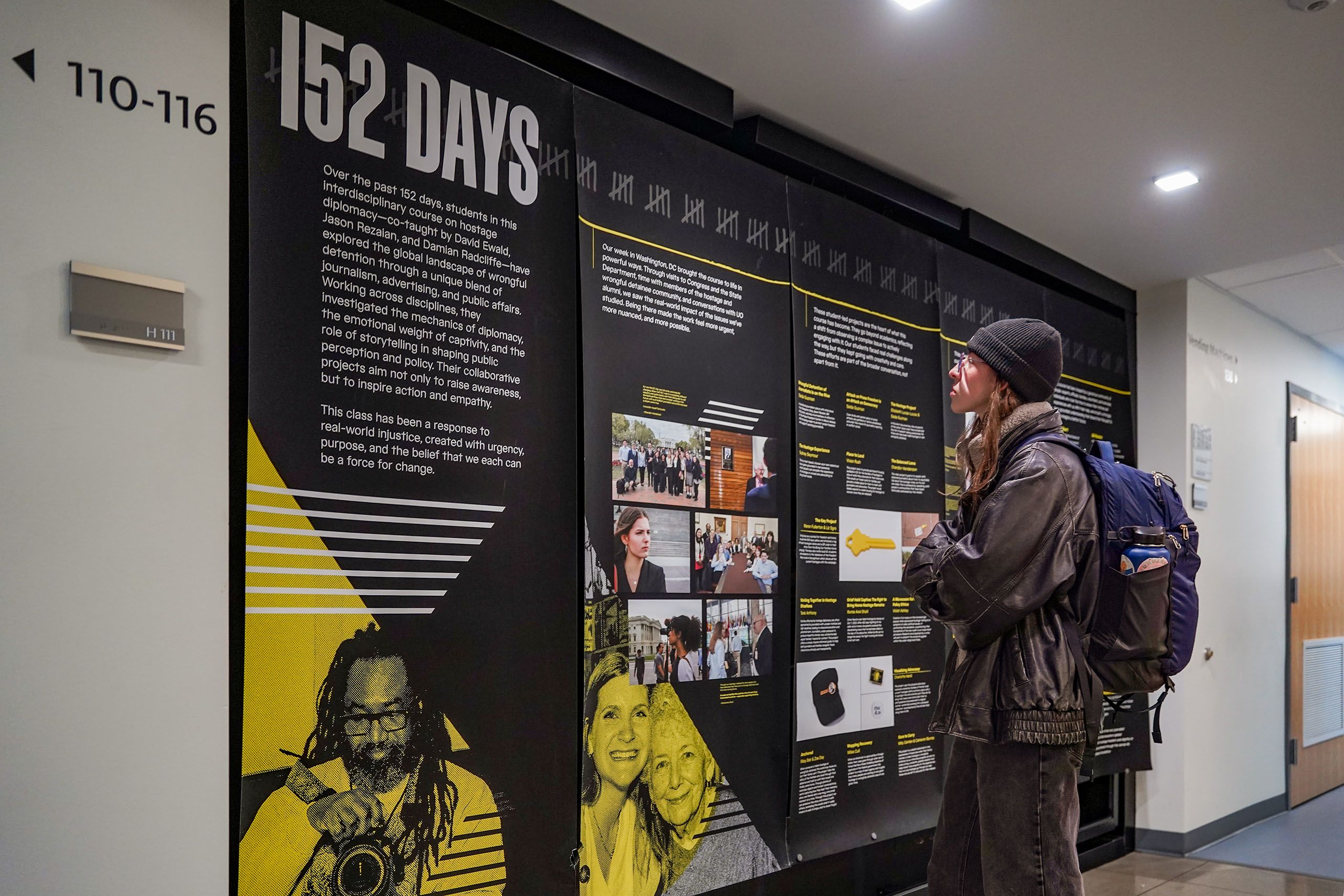
Because it was brand-new, "the course and the expectations were being formed as we went," said Tarek Anthony, a fourth-year double major in political science and journalism. "There were a lot of new ideas, and whatever we came up with was fair game."
For example, working in collaboration with the James W. Foley Legacy Foundation and the Bring Our Families Home Foundation, students in the class acquired 500 keys, painted them yellow - the symbolic color of hostage diplomacy - and attached tags with the names of hostages and a QR code linking to their story.
"We dropped them around D.C., inviting people to a mural unveiling that depicted a group of hostages who were detained," said Maren Fullerton, a fourth-year double major in advertising and political science.
Fullerton also said the goal of their project was to empower families to advocate for their loved ones and, ultimately, help bring them home.
"Our project showed that students are capable of using creative strategies for real-world issues outside of a university setting," she said.
New views on a complex topic
Students from the first class said the course provided them access to opportunities they never expected as undergraduates.
"The mentorship and connections that came from this program were the most beneficial for me personally, especially as an older student," said Chandlor Henderson, who graduated last year with a degree in journalism.
Henderson connected with Karen Attiah, a former Washington Post journalist and opinions editor, and Camila Vergara, a critical legal theorist, historian and journalist from Chile.
Those conversations inspired a podcast he produced for the class, including one episode with Vergara about freedom of the press and how journalists should approach hostage diplomacy.
For Anthony, one of the most memorable moments was hearing from Roger Carstens, the former U.S. special presidential envoy for hostage affairs, via Zoom. Carstens' firsthand account of negotiating for hostages across the Middle East gave Anthony a perspective he hadn't heard in any classroom.
"Our project showed that students are capable of using creative strategies for real-world issues outside of a university setting."
The public often hears the pleas of family and friends advocating for detained loved ones, but "the actual business that's happening behind the scenes is just never talked about," he said.
Learning how to handle emotionally fraught situations with empathy and respect was Fullerton's biggest takeaway.
Talking to former hostages and the families of hostages can be an emotionally delicate experience, Fullerton said. She was motivated by the chance to engage with organizations and people in crisis, not just completing a class project.
"Getting to be in that situation where you are asking somebody questions about their loved one who is being held hostage, you have to be compassionate, and you have to deeply listen," Fullerton said. "That's an important soft skill you don't learn sitting in a classroom."
The course is running again this term and spring term with a new class of students. As it continues, Ewald and Rezaian aim to not only highlight the importance of advocacy and support but also to illuminate the possibilities of civic action.
"We hope to train the next generation of journalists, advocates and global citizens to bring new thought to this vital work with skill and humanity," Ewald said.
The Hostage Diplomacy course is supported in part by Julie and Rocky Dixon. Julie Dixon sits on the School of Journalism and Communication's Journalism Advancement Council. Rocky Dixon graduated from the UO in 1978 with a bachelor's degree in political science.
Read a longer version of this story on the school's website.


