A new group of trainers is now ready to strengthen chemical emergency preparedness and response in their home countries, following the successful conclusion of a pilot capacity-building Training of Trainers programme organised by the Organisation for the Prohibition of Chemical Weapons (OPCW) with support from the Government of Italy.
Over the course of several months, selected first responders from around the world moved beyond traditional training. They learned how to respond to chemical incidents and, more importantly, how to transfer training skills to others. The result will be a growing pool of trainers who will continue to expand knowledge and preparedness at the national and global levels in a sustainable manner.
Key parts of the programme were held at the OPCW Centre for Chemistry and Technology (ChemTech Centre), a purpose-built hub designed to support OPCW training activities.
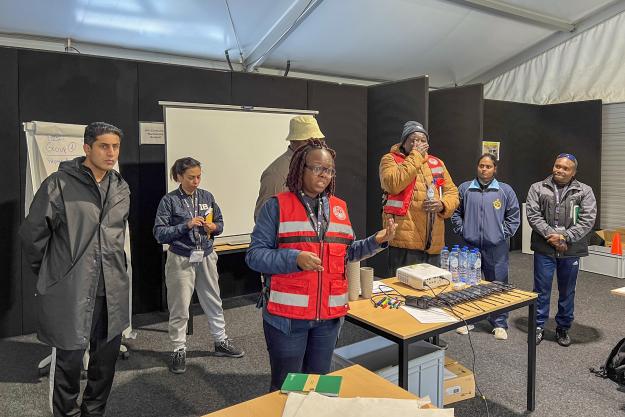
Participants engage in hands-on training during a pilot capacity-building Training of Trainers programme held at the OPCW Centre for Chemistry and Technology in the Netherlands.
Turning training into action
What set this programme apart was its strong focus on an autonomous phase, during which participants applied their skills acquired during online and face-to-face workshops in their national contexts by designing and delivering their own training sessions.
This phase enabled them to translate learning into practice, train colleagues, test approaches, and build confidence as instructors, while being supported by international experts. Participants then reconvened in a subsequent workshop to reflect on their experiences, exchange lessons learned, and further strengthen their capacities. The programme also incorporated practical, field-based exercises held at the Defensie CBRN Centrum in the Netherlands, which provided a valuable opportunity to hone hands-on training skills in realistic settings.
This shift from learning to practice proved critical. It laid the foundation for long-term impact, as participants are expected to continue training others in their institutions and countries. At the same time, they become part of a growing pool of qualified trainers who can support future OPCW activities, further extending the Organisation's global reach and impact.
In Sri Lanka for example, Monali Samarakoon, Flight Lieutenant, and the only female CBRN trainer in the country's military, said that the training experience has motivated her to adopt a more structured approach to evaluating learning outcomes, including the use of pre- and post-training assessments, as part of applying training in her national context.
One of the instructors, Murugiah Muthusamy, Senior Assistant Fire Commissioner and Head of the Hazmat and CBRNe Unit at the Fire and Rescue Department in Malaysia, said that many developing countries face challenges such as limited training equipment, a shortage of qualified instructors, and the need to keep pace with rapidly evolving technologies in this field.
By combining practical exercises with updated knowledge and new technologies, the training enabled participants to sharpen their skills and better respond to challenges in their own countries. He also highlighted the value of exchanging experiences across regions and the importance of continuous learning to keep responders ready, pointing to OPCW's distinct role in delivering specialised capacity-building in the field of chemical emergency preparedness and response.
A multiplier effect for national preparedness
By focusing on trainers, the OPCW is investing in a model that multiplies impact over time.
Each participant leaves the programme not only with strengthened technical and teaching skills, but with the ability to pass that knowledge on.
A participant from Chile for example, Maria Eugenia Cornejo, will be an instructor at the upcoming multicomponent exercise CHEMEX GRULAC: "The programme has strengthened not only my technical knowledge, but also my confidence and ability to share that knowledge effectively with others, enabling me to organise all my ideas into effective t training for the first responders. I now feel well-prepared to take on the role of instructor at the upcoming CHEMEX GRULAC."
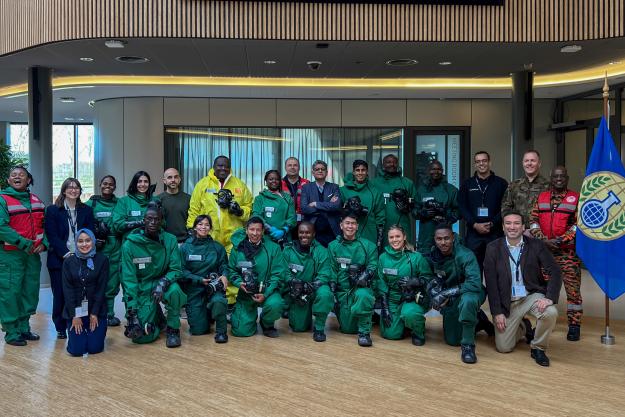
Participants and instructors gather at the OPCW Centre for Chemistry and Technology in The Hague, Netherlands. The pilot capacity-building programme, supported by the Government of Italy, brought together first responders from around the world to strengthen chemical emergency preparedness and response capabilities in their home countries.
Learning from the best
Participants in the training were guided by a team of internationally recognised instructors and experts with years of operational and training experience in chemical emergency preparedness and response. They also have extensive experience in delivering OPCW training programmes, as the Organisation regularly organises training courses in their home countries.
Coming from different regions and professional backgrounds, the instructors brought a wide range of perspectives to the programme. Their role extended beyond teaching: they mentored participants, provided feedback, and supported them through the challenge of delivering their own national-level training.
By investing in people who can train others, the OPCW is building something that lasts: stronger national systems, better prepared responders, and a global network ready to respond to incidents involving chemicals.
Background
Key parts of the programme took place at the OPCW Centre for Chemistry and Technology (ChemTech Centre), a purpose-built hub designed to support OPCW training activities.
By bringing together modern classrooms, specialised equipment and dedicated indoor training spaces, the Centre allows participants to move seamlessly between theory and practice. This integrated environment creates realistic training conditions and supports more effective, hands-on learning.
As the implementing body for the Chemical Weapons Convention, the OPCW, with its 193 Member States, oversees the global endeavour to permanently eliminate chemical weapons. Since the Convention's entry into force in 1997, it has becomethe most successful disarmament treaty eliminating an entire class of weapons of mass destruction.
In 2023, the OPCW verified that all chemical weapons stockpiles declared by the 193 States Parties to the Chemical Weapons Convention since 1997 - totalling 72,304 metric tonnes of chemical agents - have been irreversibly destroyed under the OPCW's strict verification regime.
For its extensive efforts in eliminating chemical weapons, the OPCW received the 2013 Nobel Peace Prize.