
Food trade plays a vital role in daily life across the Pacific. Many island nations depend on imported food and beverages. This shapes what people eat, how healthy their diets are and how secure their food supply can be.
But for years, a key piece of the puzzle was missing - reliable and consistent data on what foods were being traded, in what quantities and between which countries. To help fill this gap, a Pacific Food Trade Database was developed through a partnership between the Pacific Community (SPC), the University of Wollongong and ACIAR. The database provides, for the first time, a clear and consistent picture of food and beverage trade across the Pacific region.
'The Pacific's food systems are deeply interconnected with trade,' said Dr Anna Farmery, the project leader and Senior Research Fellow at the University of Wollongong's Australian National Centre for Oceans Resources and Security (ANCORS). 'Imports are a major part of the Pacific food system, impacting everything from food security to nutrition. But without reliable, consistent data, it's been difficult for the Pacific to track long-term trends or make informed policy decisions.'
Before this initiative, trade data across Pacific Island countries and territories was often incomplete, inconsistent and highly variable. Estimates of quantities were missing, and comparisons between countries were unreliable. The result was that decision-makers were left with an unclear picture of the region's food trade landscape.
The Pacific Food Trade Database was designed to address exactly that challenge. Its core objective is to create a regionally consistent time series of food and beverage imports and exports as detailed and accurate as possible to support both national and regional policy development.
The database emerged from long-standing collaboration between ACIAR, SPC and the University of Wollongong through ACIAR projects on Integrated agri-food system analyses for the Pacific region and Extending integrated analysis for improved food system outcomes in Timor-Leste and the Pacific region.
'SPC brings deep regional knowledge and expertise in trade data management and use, while the University of Wollongong provided the technical capacity to develop globally novel data-cleaning methods,' explained Dr Tom Brewer, a Senior Research Fellow at ANCORS who developed the database. 'The result is a database that's not only rigorous but also regionally owned and relevant.'
The partnership's strength lies not only in producing accessible data but also in building capacity to use it. SPC's Statistics for Development Division continues to lead training and support across the region, ensuring government officials and analysts can effectively use the data.

Turning data into action
Already, the database is proving its value across the Pacific. For instance, in Papua New Guinea government officials from multiple ministries were trained in how to use the database to support national policy development during a workshop in Port Moresby in May 2024, delivered in partnership with SPC's Public Health Division.
Later that year, in Nadi, Fiji, a regional trade workshop brought together representatives from 15 Pacific island countries, including customs, statistics and health officials. Over two days, participants used the database to develop country policy briefs focusing on imports of unhealthy foods.
Mr Peter Ellis, Director of SPC's Statistics for Development Division, said that growing skills and knowledge with trade data will help country members improve decision-making related to trade.
'Access to reliable trade data is critical for Pacific island countries. Trade can make it easier or harder to support healthier and more sustainable food systems. The Pacific Food Trade Database gives governments the tools and training they need to analyse food imports and exports, identify trends and develop evidence-based policy responses.
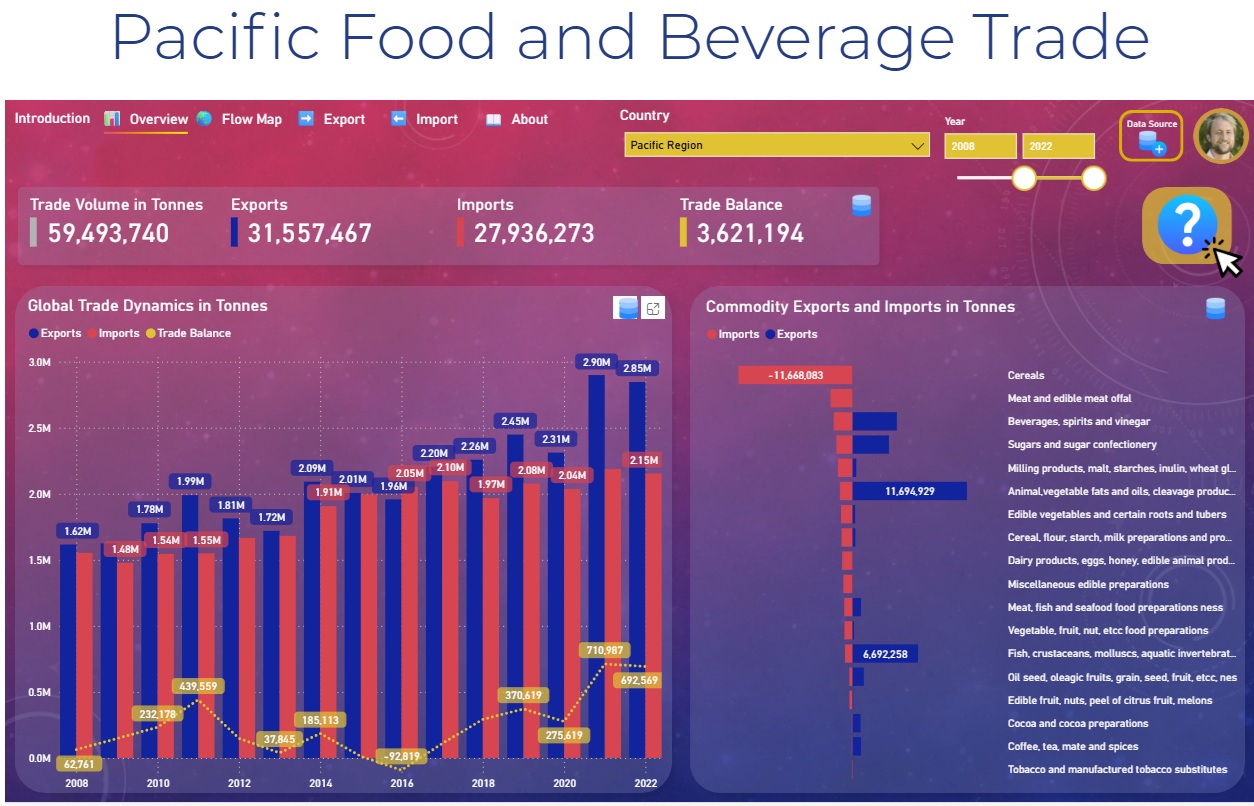
Trade data can empower researchers, industry groups, policy makers and, yes, even the public, to inform the debate on each country's own direction. The database is freely available online and accessible via an interactive dashboard through the Pacific Data Hub.'
Revealing trends, shaping the future
Thanks to its standardisation, the Pacific Food Trade Database offers great potential for analysis. Researchers are already using it to map temporal trends in key food commodities, measure import reliance and identify increases in imports of unhealthy foods.
Dr Tom Brewer said the database continued to reveal surprises since its development. 'We noted that there has been a significant and recent shift in imports from other countries, including both rice and significant quantities of unhealthy foods. While this trend is anticipated, the rate of growth was not. An additional surprise is how little trade occurs between Pacific Island Countries and Territories. Except for significant export and re-export from Fiji to other Pacific countries there is limited intra-regional trade. Enhancing intra-regional trade could build regional resilience to global shocks and climate impacts.
'Finally, we have been surprised by both the increased diversity of foods entering the region and the rapid growth of unhealthy foods and beverages. Better understanding of the flow of unhealthy foods is essential to tackling the regional diet-related non-communicable disease epidemic.'
The database also enables nuanced analysis showing that trade trends vary widely across sub-regions and countries, reinforcing how important it is not to make regional generalisations. Each country has its own unique trade signature.
Over the past two years, the Data Hub's insights have shown growing engagement from governments, researchers and development partners who are using the data to inform decisions around food imports, health and trade policy. As one of the database developers, Dr Brewer said he received numerous direct queries about the database from various organisations such as Pacific Island Forum, international shipping companies and others, highlighting the potential scope of users.
For ACIAR and its partners, the project represents more than just a technical achievement, it's a step toward stronger, data-driven governance in Pacific food systems.
'The database has become a cornerstone of regional food system analysis,' said ACIAR Research Program Manager, Dr Todd Sanderson. 'By improving access to reliable data, we're helping countries make more informed choices about the food they import, consume and trade, and ultimately supporting healthier futures for Pacific communities.
'Partnerships like this show the real power of research, when scientific rigour meets regional expertise, we create tools that can help change the way policy is made. The Pacific Food Trade Database is a foundation for smarter, and more resilient food systems across the region.'
Learn more about the project.


