
A new study reveals how political donations help large landowners reshape agriculture and the Amazon rainforest
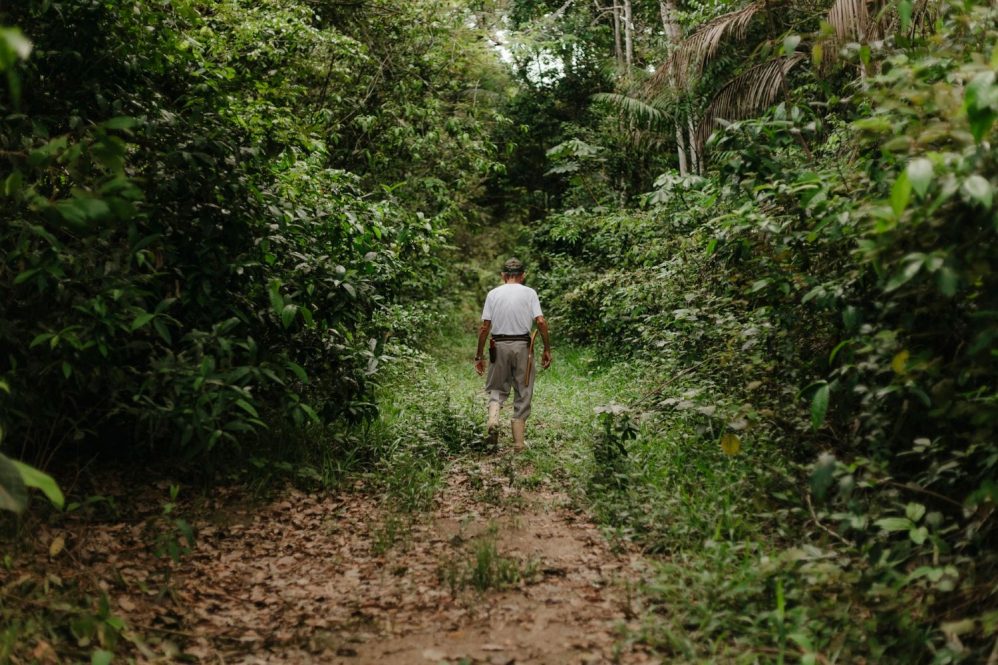
Photo by Kawê Rodrigues on Unsplash
In communities around the Amazon Rainforest, there's a pervasive belief that large landowners use their money to influence local politics to benefit their operations.
Until now, this has been an interesting but unproven anecdote.
Erik Katovich, assistant professor of agricultural and resource economics in the College of Agriculture, Health and Natural Resources, published a study in The Economic Journal proving this chatter has statistical significance.
Katovich's study showed that large landholders in the Amazon who donate to winning municipal politicians, like a mayor, are more likely to develop soybean farming on their properties than those who donate to a losing candidate.
Soybean farming has become an incredibly important crop for the Brazilian economy following the legalization of genetically modified soy seeds in the early 2000s. This made growing the beans, which are native to more temperate climates, easier in the tropical Amazon. Brazil is the world's largest soy producer.
Farmers with large plots of land are attracted to soy farming because it can generate significantly more revenue than cattle farming - one of the other largest agricultural activities in Brazil.
However, converting cattle pasture to soy fields is not trivial. A lot goes into making the Amazon's naturally acidic soil suitable for soy.
"You need to clear out all the stumps, you need to buy tractors, you need to buy fertilizers, you need to hire specialized workers and technicians - it's a challenging thing to make this transition to soybeans," says Katovich.
Given this, it seems that many large landholders have turned to seeking political influence through campaign donations to make the transition easier.
"You can make a lot of money, so it seems like landholders are willing to invest in political influence because otherwise it's hard to make that transition," he says.
Katovich and his collaborators connected three kinds of data to form their conclusions: land ownership records, political donation records, and satellite data showing land use change over time.
The group completed two analyses - property- and policy-level.
On the property level, they were interested in how campaign donations to winning candidates led to changes in donors' land use.
An elected official in Brazil can help landholders develop soybean production in several ways. They can help farmers access "rural credit," which provides farmers with funding to purchase supplies or perform the work necessary to make this transition. They may also help them connect with people who sell the necessary equipment, or influence the building of a road near their property to make it easier to get large equipment in and out.
Importantly, this effect is only observed with large landowners - those with thousands of hectares - not small, family operations of only a few hectares. It was also most significant among first-time soybean adopters.
"Land inequality in the Amazon is already really high, and that existing level of inequality is exacerbated because now the largest landholders can use political influence to get access to valuable new agricultural technology," Katovich says.
On the policy level, candidates who received a large amount of donations from landholders were more likely to govern in favor of agriculture.
"Farmers donate a lot of money to politicians to help them overcome barriers to adopting soybeans, and those politicians repay these favors by governing in favor of agriculture, but they do so in a slapdash, untargeted way that ends up promoting deforestation," Katovich says.
Locally, the loss of the rainforest creates more extreme temperatures, reduces agricultural productivity, and leads to biodiversity loss. Globally, the Amazon, known as "the lungs of the planet" plays a major role in producing oxygen and absorbing carbon. It also produces water that moderates the climate and provides irrigation throughout South America.
Agriculture is the driving force behind deforestation in the Amazon.
One potential positive of the phenomenon Katovich and his team observe is that if farmers are converting already-cleared cattle pasture to soybean production, this could use the land more productively and reduce deforestation.
"If you could intensify the existing, already cleared lands by, for example, upgrading them to soybeans, it's much more productive," Katovich says. "For Brazil's economy that's great, for the landholder it's great, and if that saves you from cutting down new trees, that's great. It's a win-win."
However, at present this is not what's happening. Instead, the transition to soybean farming helps fuel indirect land use change.
Landowners are still cutting down more trees when their existing pastures are converted to soybean fields. Soy production in Brazil has also been linked to increased childhood cancers because of chemical exposures.
Now, Katovich and his team are looking at whether the emergence of soybeans as a viable crop in the Amazon inspired large landholders to invest in politics for the first time, or if they had previously been investing with other goals in mind.
"It could be that this technological change shifted landholders' interests from wanting to invest in political influence to deforest new lands to wanting to invest in politics to plant soybeans," Katovich says.
This work relates to CAHNR's Strategic Vision area focused on Ensuring a Vibrant and Sustainable Agricultural Industry and Food Supply.


