
A new collaborative study, led by University of Utah Professor of atmospheric sciences Kevin Perry, provides policymakers, agency leaders, and the public with the most comprehensive assessment to date of potential dust control options for the Great Salt Lake, as declining water levels continue to expose vast areas of lakebed to wind erosion.
The study, supported by the Wilkes Center for Climate Science & Policy in collaboration with the Great Salt Lake Commissioner's Office, Utah Division of Water Resources and Department of Environmental Quality, considers a wide-range of options to engineer dust control measures for the exposed lakebed-along with their costs, water requirements, and environmental tradeoffs. The study will inform and strengthen ongoing work being done on the Great Salt Lake Basin Integrated Plan.
Dust from Great Salt Lake poses a credible and growing public health risk, with potential regulatory, economic, and ecological consequences if left unmanaged.
"We spent a year evaluating a broad range of potential dust control options for the Great Salt Lake," said Kevin Perry. "This analysis is not intended to endorse engineered solutions, but to provide policymakers with a comprehensive, science-based roadmap outlining the full spectrum of options should dust mitigation be determined necessary to protect public health. The analysis confirms that multiple dust control options are technically feasible, but each entails significant financial costs, ecological tradeoffs and uncertainties that must be carefully assessed prior to implementation."
Science-driven framework for action
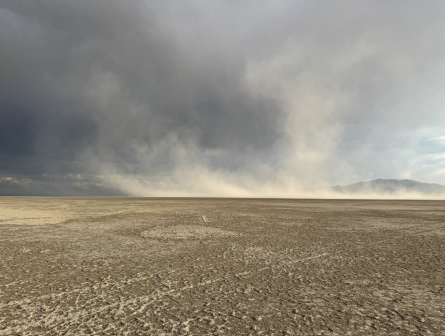
The study does not call for immediate large-scale intervention but instead emphasizes costly dust mitigation programs should be triggered by evidence, particularly repeated exceedances of federal air quality standards in nearby communities where Great Salt Lake dust is a confirmed contributor. The study underscores the importance of expanded air quality monitoring-an effort already underway in Utah.
"We are continuously interested in opportunities to add more tools to our toolbox regarding Great Salt Lake. This dust study helps create a clearer picture of where dust events are occurring, what may be in the dust and what tools we can utilize to mitigate risks," said Great Salt Lake Commissioner Brian Steed.
Evaluating dust control options
The study examines twelve potential dust control measures, ranging from water-dependent approaches such as shallow flooding and brine caps to non-water methods like gravel cover and artificial surface roughness. Each option is assessed for effectiveness, cost, water demand, maintenance needs, and ecological impacts.
Key insights include:
- The most effective dust control measures generally require significant water and long-term investment.
- Non-water alternatives can play an important role where water is limited but often provide fewer ecological benefits.
- Best practice may be a portfolio approach, blending water-based and non-water-based dust control measures to balance effectiveness, cost, and water use. No single solution is appropriate for all areas of the lakebed; site-specific and adaptive strategies are essential.
- Water availability is the dominant constraint shaping what mitigation strategies are feasible.
- Restoring lake inflows is the most promising long-term strategy, with dust suppression as a co-benefit-but it requires basin-wide water conservation.
- Monitoring comes first- without robust monitoring, Utah risks either over-investing prematurely or under-reacting until federal mandates force action.
- Inaction is not cost-free-delaying response increases the likelihood of federal intervention, economic losses, and higher public-health costs.
Informing policymaking and the public
Drawing on lessons from major dust mitigation efforts at Owens Lake and the Salton Sea, the study highlights the importance of long-term planning, sustained maintenance, and careful consideration of unintended consequences. It also explores which tools are available, the costs and tradeoffs of each, and how dust control can support broader water-management and ecosystem-restoration strategies for the Great Salt Lake.
"This report stems from the Wilkes Center's goal to put quantitative information at the fingertips of policymakers and the public, " said John Lin, scientific director of the Wilkes Center and professor of atmospheric sciences at the U. "As the report indicates, numerous potential dust control measures are available, including the 'nature-based' solution to simply get more water to the Great Salt Lake, without costly human engineering. However, before any measure(s) is adopted, we hope that science-driven information about the benefits and costs is carefully considered."
The study is available to read and download on websites for the Great Salt Lake Basin Integrated Plan, the Great Salt Lake Commissioner, and the Wilkes Center for Climate Science & Policy.


