
Farming communities across Fiji are demonstrating that sustainable agricultural development is most effective when it is shaped by local knowledge and strong partnerships.
Supported by ACIAR, the Landcare Fiji Project is working with communities in Sigatoka, Labasa and Taveuni to strengthen livelihoods through agroforestry, regenerative farming and farmer-led learning.
The 6-year A$4.2 million initiative has been helping communities improve productivity and reduce production costs while strengthening the institutions that support them.
Led by RMIT University, the project brings together partners from Australia, Fiji and the Philippines, including Fiji National University (FNU), the Ministry of Agriculture, Waterways and Sugar Industry (MOAWSI), Teitei Taveuni, the Philippines Council for Agriculture, Aquatic and Natural Resources Research and Development (PCAARRD), and the University of the Philippines Los Banos and Mindanao.
Building on local strengths
One of the project's most significant achievements has been adapting the Livelihood Improvement through Facilitated Extension (LIFE) Model to Fiji's unique social and cultural context.
Dr Mary Johnson, Landcare Fiji Project Leader and Research Fellow at RMIT University, said the model offered valuable lessons about how research and development can work together to support communities.
The LIFE model is a community-based agricultural extension approach developed to improve farming livelihoods, build social capital, and foster peace in conflict-vulnerable and remote areas. It was originally created through a collaboration between ACIAR and Philippine partners in Mindanao.
Dr Mary Johnson
Landcare Fiji Project Leader
However, as the project progressed in Fiji, partners discovered that Fiji already possessed a similar community-based philosophy known as the 'solesolevaki'. The word comes from sole (together) and vaki (to do or carry out), and it refers to a communal approach where people contribute their time, labour, skills and resources for the benefit of the group rather than the individual.
According to Mr Solomoni Nagaunavou, Landcare coordinator from the Fiji Ministry of Agriculture, the team saw an opportunity to strengthen an existing concept in Fijian culture and practice, rather than introduce an entirely new concept.
'At its core, solesolevaki is based on the values of collective responsibility and community ownership. The Ministry is pleased to have been selected as one of the government partners in implementing this ACIAR-funded project in Fiji alongside Teitei Taveuni and FNU.'
Mr Nagaunavou said this valuable partnership helped address gaps in the Ministry's capacity to support farmers, particularly in resilient agriculture. The project works with communities in Sigatoka, Vanua Levu and Taveuni, aligning activities with the Ministry's five strategic priorities, including food security, household income and climate-smart agriculture.
Over the past four years, the ministry has delivered training, farmer exchanges and study tours, enabling farmers to learn directly from one another. Simple incentives, such as seed packets, encourage participation and adoption of new practices. The project's impact is particularly evident in Matalolo, where farmers who once relied heavily on purchasing vegetables from external markets are now producing their own vegetables and higher-value crops.
From long-term crops to week-to-week income
Like many families in Matalolo village, Mrs Mereani Aditukana and her husband, Mr Emosi Nage, traditionally rely on kava and taro as a primary source of income. While kava remains an important crop, its long growing cycle meant households often had to wait years before receiving financial returns.
'Planting kava and taro also required walking long distances to farm. It was not until the Landcare project ran an awareness program that we made the decision to adopt alternative crops,' said Mrs Aditukana.
The Landcare awareness training, through the Ministry of Agriculture, encouraged farmers to diversify their production systems by introducing short-term cash crops and sustainable farming practices. For Mrs Aditukana and her family, the decision proved transformative.
'It made a big difference to our financial livelihood. With our organic cash crops, it takes only months to harvest. We also make money every week and go to the market every week,' she said.
Today, she and her husband grow eggplants and long beans in her backyard close to the village, creating a reliable source of food and income.
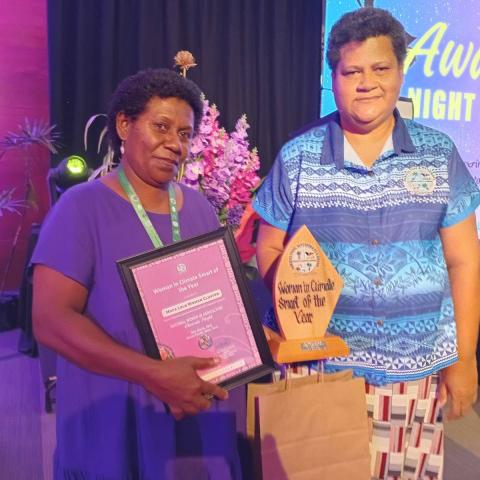
The experience has also strengthened her belief in the important role women play in agriculture and environmental stewardship. In March this year, Mrs Aditukana was recognised nationally after being awarded the Climate Smart Agriculture Woman Farmer of the Year at the 2026 National Women in Agriculture Symposium.
Learning through exchange
A defining feature of the Landcare Fiji Project has been its emphasis on farmer-to-farmer learning and regional exchange.
In September 2024, a delegation of 18 representatives from the Landcare Fiji Project, including participants from the Ministry of Agriculture, Fiji National University, Teitei Taveuni and farming communities, travelled to the Sunshine Coast, Queensland, as part of the ACIAR-supported initiative.
'The Sunshine Coast was selected because of its similarities to Fiji, including its subtropical climate, and shared exposure to climate-related challenges affecting coastal farming communities,' said Dr Johnson.
Over five days, delegates visited commercial farms, agrotourism enterprises and research facilities to explore crop diversification and sustainable farming practices. A particular highlight was the visit to the Noosa and District Landcare Association, where participants observed community-led approaches to land restoration and natural resource management.
For Ms Losevati Diceva, a member of the Korobua Women's Landcare Group, from Navakuru Village, Wairiki in Vanua Levu, the learning exchange was critical.
For me personally, I am one of the youngest members of our women's group, and many of the older women have far more traditional knowledge than I do. Whenever we sit together to discuss our work, I tell them about the new ideas and techniques I learned and encourage them to combine these with their traditional knowledge. As a result of this knowledge-sharing, we now produce many products ourselves.
Ms Losevati Diceva
Today, the Korobua Women's Landcare Group produces a range of value-added products including turmeric powder, ginger powder and coconut oil using locally available resources. The group have also successfully established a nursery within the settlement, where fruit trees and vegetable seedlings are prepared and stored for distribution among members.
Putting people at the centre
According to Dr Johnson, the project's success stems from its people-centred and place-based approach.
'We believe that people are central to solving their own problems and identifying new opportunities, and that solutions must be tailored to the specific circumstances of each place. The strength of the study tour approach lies in collective learning. Participants support one another during the tours and activities, and those connections often continue when they return home,' she said.
Dr Todd Sanderson, ACIAR Research Program Manager Social Systems, Policy and Economics said the project is supporting sustainable pathways for agricultural development in Fiji.
'ACIAR is proud to support research that delivers tangible benefits for farming communities. The Landcare Fiji Project demonstrates how research can be translated into practical action, bringing together scientific knowledge and local expertise to create sustainable pathways for agricultural development. These partnerships are helping communities strengthen livelihoods and build resilience and better manage their natural resources for future generations,' he said.
Landcare legacy
As the project moves toward its final years, the focus is to ensure that knowledge and community leadership continue long after project funding ends.
At the recent 2026 International Conference on Landcare and Sustainable Agriculture in the Indo-Pacific, host FNU launched the South Pacific Extension and Development Institute (SPEDI) to ensure that knowledge generated through research is translated into practical solutions that benefit farmers and rural communities.
Speaking at the event, the former President of Fiji and high chief, the Tui Macuata, Ratu Wiliame Katonivere, described the institute as an investment in the future of agriculture.
'It represents an investment in the future of agriculture and our rural communities by ensuring that knowledge does not remain within institutions, but reaches our farmers, villagers and young people. It creates a bridge between research and practice, between science and tradition, and between the wisdom of our ancestors and the opportunities of tomorrow.'
Through the revitalisation of solesolevaki, strengthened regional partnerships and farmer-led learnings, the Landcare Fiji Project is showing how development can be both locally rooted and globally connected, creating benefits for the future of Pacific communities.
Learn more about the project: Landcare - an agricultural extension and community development model at district and national scale in Fiji (SSS/2019/140).


