
Researcher, pharmacist discuss challenges and triumphs amid an environment of closures
Many Americans count on their neighborhood pharmacies, especially those in rural areas where medical options are limited. But industry consolidations, downsizing and changing insurance reimbursements have left these critical healthcare hubs struggling.
Hundreds of pharmacies shuttered in 2025, changing the care landscape for the over 90% of Americans who currently live within five miles of a pharmacy.
Wanting to understand the root causes of pharmacy closures and their ripple effects in communities, Michael J. DiStefano, PhD, MBE, an assistant professor in the Center for Pharmaceutical Outcomes Research at the CU Anschutz Skaggs School of Pharmacy, interviewed pharmacists across Colorado and Utah. His qualitative study was published in the Journal of the American Pharmacists Association.
Key points:
- Economic challenges putting pharamcies at risk of closure, especially in rural areas, are highlighted in a recent study by CU Anschutz researchers.
- Closures are being driven in part by a lack of new pharmacists to take over independent pharmacies - which are vital to rural communities - and the reimbursement model for prescriptions.
- A CU Anschutz Pharmacy graduate who runs a pharmacy in Rocky Ford, Colo., focuses on his patients and keeping his community healthy to help cope with the difficult time.
Uncaptured frustration
"We've seen news reports and studies published on the impacts of pharmacy closures," said DiStefano, who also has a role in the Department of Clinical Pharmacy. "However, they've all been focused on the patient experience and access, not the pharmacists themselves."
In interviews with pharmacists, DiStefano and his colleagues heard palpable frustration, stories of mental health impacts and examples of how pharmacy closures in both urban and rural environments touch entire communities.
Closures create powerful ripple effects
"It's a series of ripple effects," DiStefano said. "When a pharmacy closes, not only do you see the impacts to medication access and job losses in that community; surrounding pharmacies will experience a series of stressors. All those patients impacted by the closure need to be added to your system, with new patient histories and records."
This creates a feedback loop, where strain is placed on the overwhelmed remaining pharmacies, which struggle with sufficient staffing, overtime and burnout, DiStefano said.
At Harris Pharmacy in Rocky Ford, which has served the rural Arkansas Valley of southeastern Colorado since 1943, staff have felt the aftershocks. Owner Ky Davis, PharmD, a graduate of the CU Anschutz Skaggs School of Pharmacy, noted a recent experience with two grocery stores closing in nearby towns, including La Junta.
"La Junta is a town of around 7,000 people," Davis said. "And with the closures, roughly a third of those people have been displaced from their primary pharmacy and need to find a new one. The closures were announced in early September, so there was not a lot of heads up."
Davis said the closures meant a dead sprint for his team to help patients manually transfer their prescriptions. In some cases, patients and Davis were reaching out to doctors to get new prescriptions rather than transferring because it was so chaotic. The response work is vital, as patients could miss critical dosages of medicine.
"It was really a mess that we're just now coming out of two months later," Davis said. He added that it's important to think of the distances involved with these closures - as a regular patient travels 45 miles for medicine, with some others logging over 100 miles.
A slim pool of rural pharmacists
Interviews for the study also highlighted problems that arise when a rural pharmacy lacks a clear succession plan when leadership changes happen.
"In rural areas, with some independently owned and operated pharmacies, the pharmacists need to eventually retire or tragically pass," DiStefano said. "Unless there's a clear plan in place, it can be difficult to find a younger pharmacist to move and take over that pharmacy."
One study participant described the pharmacy as the "crux of the community" in rural areas. In his case, with no succession plan in place, an impending apothecary closure meant not just the loss of healthcare access, but also the shuttering of the community's meeting place.
A Rural Focus
CU Anschutz Skaggs School of Pharmacy and Pharmaceutical Sciences has a unique focus on giving its students experiences in rural areas. Each CU Anschutz Pharmacy student completes a minimum of two rotations in rural areas across the state.
Harris Pharmacy experienced a bit of luck when Davis felt a pull to return to his roots. The son of a pharmacist, Davis grew up an hour northeast of Rocky Ford in Eads. After briefly considering a different path as a dentist ("I found the inability to have a free-flowing conversation with the patients to be tough," he said, with a laugh), he decided to follow in his father's footsteps.
"I started working in my dad's pharmacy when I was old enough to stock the vials, and I'm 43 now, so I like to say I have 38 years of pharmacy experience," Davis said. "I've done every job there is to do in a pharmacy."
Following graduation from the CU Anschutz Skaggs School of Pharmacy, Davis chose to return to his rural home for his family, the sense of community, and the benefits and challenges of being his own boss.
'A high-wire act'
To Davis, operating a pharmacy - especially in a rural area - is all about problem solving.
"It's a high-wire act in a lot of ways," Davis said. "We don't always have backups of medicine from a pharmacy across the street. We have to overstock some medicines or think quickly when something comes up."
The current reimbursement model - how pharmacists are paid by insurance companies for the cost of patient drugs - creates another challenge.
"One of the downsides of the reimbursement model today is that you get these claims that are underwater," Davis said. "You're losing $80 to fill a prescription and there's definitely a temptation to be like, 'We're not going to do that. We're not going to stock this drug.'"
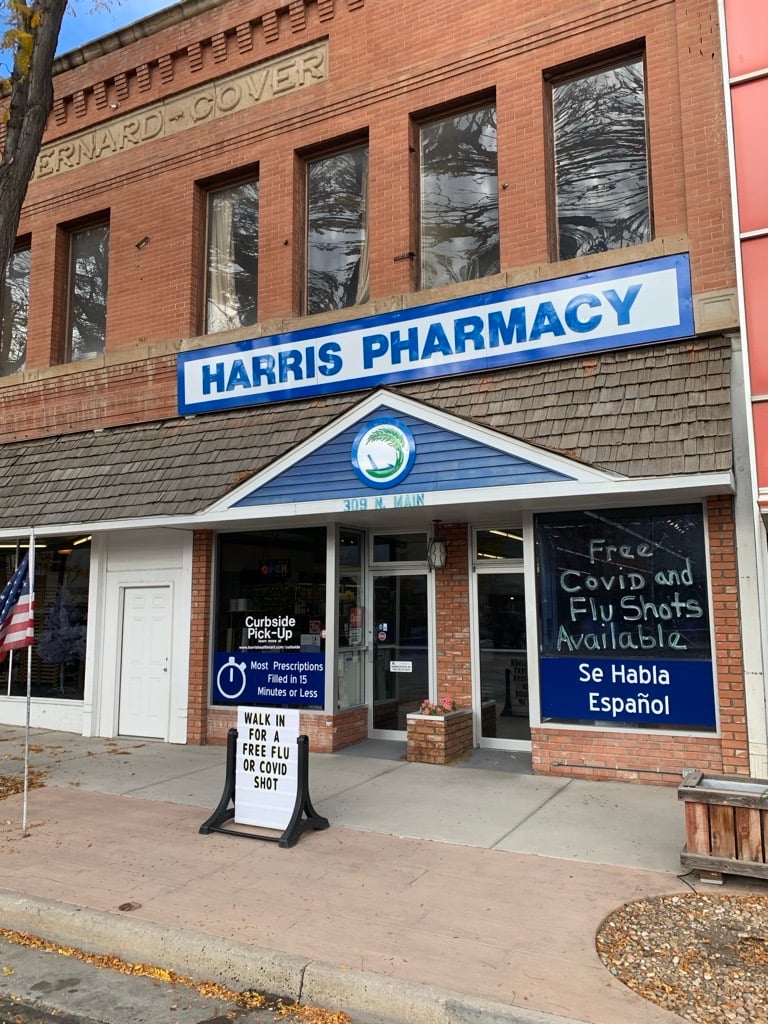
Even when streamlining his work with technology, "it's not sustainable," Davis said of accepting lower reimbursements. "And it's really dangerous and will drive more pharmacies to close."
There are some hopeful signs, however, including a legislative change in Colorado this year that should take some of that pressure off Davis and his peers. House Bill 25-1222 was signed into law in May, making several changes for rural pharmacies, including allowing remote verification of prescription drugs.
And Davis approaches his daily duties as service to his community, not as a race to the bottom.
Keeping an eye on the prize: community
"It's an obligation to our community to take care of them," he said. "So even if we continue to lose money, doing those prescriptions is really a public service for our community. That's the flexibility we have as an independent pharmacy: to take care of people despite that."
Despite the hectic work, Davis lights up when talking about being an independent pharmacist in a rural community.
"It's nice to be somebody that people look to for help. It's always been one of the perks of the job, if you ask me," Davis said with a smile. "Every time you go somewhere, for dinner or a basketball game, you are reinforcing those bonds with your community."
That approach is ultimately how Davis sees the role of independent pharmacies - pushing back against some of the worst features of cost cutting and closures seen at the corporate level, often to the detriment of the patient.
"When you have to deal personally with the ramifications of that as the one working the bench, it's your patients and reputation on the line," he said. "We're entirely pharmacist owned and operated. We want to keep our patients front and center. I would rather take care of our people and community than make an extra 10% margin at the end of the year."
A sustainable approach
Still, the work can wear. Davis regularly missed events for his family and kids because of caring for his patients.
"What burns people out are the events that you miss," Davis said. "You can keep going for a long time when nothing's happening, but when you miss those key events, that's what kills you."
"The bill passed this year has helped a lot," said Davis. "I'm able to leave the pharmacy open and remotely verify or have another one of our pharmacists remotely verify a prescription if I step away."
It's a change that gave Davis a new title he's been waiting a long time for: coach.
"This year, I was able to coach my son's soccer team thanks to this legislation," he said. "To have that flexibility has been really big. I'm not just the pharmacist to the community now, I'm also their kid's soccer coach and that's really special."


