
Key points
- Since commissioning in 2014, CSIRO research vessel (RV) Investigator has mapped more of Australia's vast seabed than any other vessel.
- This has led to many incredible discoveries including, most recently, revealing an unrecorded mesophotic coral reef atop a 3,000 metre seamount in the Coral Sea Marine Park.
- With only 38.5 percent of Australia's ocean territory mapped to a modern standard, there's still much more work for RV Investigator to do and many more discoveries yet to be made.
Australia has the third largest ocean territory on the planet, measuring 13.8 million square kilometres, including the Australian Antarctic Territory . Australia's diverse oceans, seas and waterways form an integral part of our lifestyle, economy and national well-being. These waters have helped sustain communities and cultures for tens of thousands of years.
However, only 38.5 per cent of Australia's ocean territory, made up of Australia's Territorial Sea, Exclusive Economic Zone and Extended Continental Shelf, has been mapped in sufficient detail to inform ongoing sustainable management decisions. Acquiring this knowledge is literally foundational and underpins marine ecosystem understanding, management and development.
A collaboration between Australia's national science agency, CSIRO, and Geoscience Australia is directly addressing this knowledge gap to deliver both high-quality and high-quantity data to characterise the vast seabed that surrounds Australia.
Mapping the knowledge gap
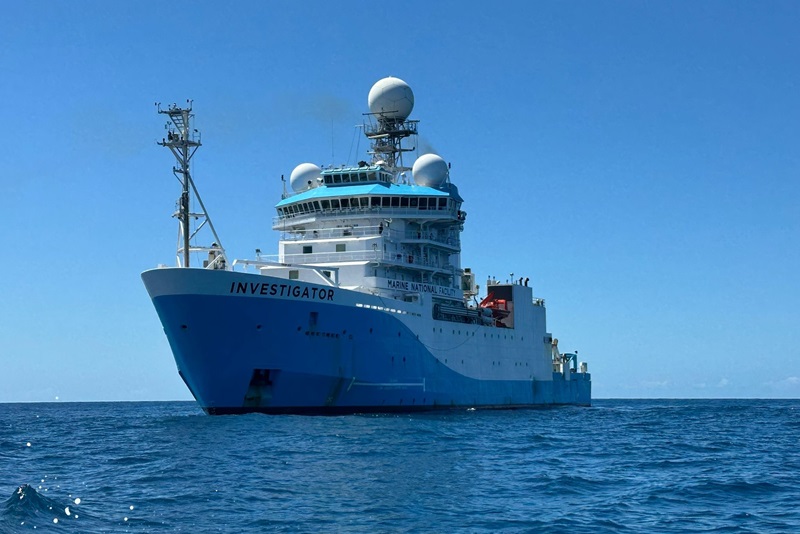
Paramount to this effort has been the collection of seabed data by CSIRO research vessel (RV) Investigator , Australia's only dedicated ocean research vessel.
This 94-metre vessel provides a platform for multidisciplinary marine science. Importantly, RV Investigator continuously collects seabed data during its wide-ranging voyages around Australia and the region, including in Antarctic waters.
These datasets are prepared by a specialist team of geospatial experts from the CSIRO Marine National Facility (MNF) and provided to scientists at Geoscience Australia, who compile them into seamless bathymetry (water depth measurement) maps showing the underwater topography.

Andrew Martini, Director of the Ship Management Program with the MNF, said the seabed data collected by RV Investigator has been unrivalled since the vessel commenced operations in 2014.
"RV Investigator has been a game-changer for marine research and delivers an impressive range of capability, which includes a suite of advanced acoustic systems to enable high resolution mapping of the seabed from coastal areas to full ocean depth," Mr Martini said.
"The vessel is a highly productive piece of Australian research infrastructure and delivers high volumes of seabed information to help us better understand, protect and manage our rich and diverse marine environment."
Since 2014, RV Investigator has made the single greatest contribution of any vessel to AusSeabed , Australia's national collaborative seabed mapping initiative led by Geoscience Australia. The data provided through AusSeabed then makes an important contribution from Australia to Seabed 2030 , the ambitious global program to map the entire seabed by 2030.
Delivering seabed insights
Most recently, RV Investigator has applied its acoustic capabilities to mapping submarine volcanos , uncovering submerged Indigenous landscapes and collecting vital seabed information for Australia's largest marine park, the Coral Sea Marine Park.
The bathymetric maps produced detail the shape and features of the ocean floor and have many scientific and management applications. They help Australian researchers, industry and government understand marine ecosystems, ocean currents and geological processes. The seabed mapping also supports effective resource management, safe navigation and natural hazard assessment.

A hidden reef revealed
The recent mapping in the Coral Sea Marine Park will provide marine park manager, Parks Australia , with essential knowledge to inform evidence-based decision making for management of the marine park.
It also led to a remarkable discovery.
Only partially mapped previously, the mapping of one particularly ancient seamount (underwater mountain) by RV Investigator revealed seabed features that were striking and unexpected. The mapping also identified a small pinnacle atop the seamount which, on further investigation by the science team using underwater cameras, was found to possess a previously unrecorded mesophotic coral reef teeming with marine life.
' Mesophotic' refers to the ocean's 'mesophotic zone' , which is typically defined as being 30 metres to 150 metres deep, at which depth there is limited penetration of light.
Without the seabed mapping, this unique and significant coral ecosystem would not have been discovered.

Such discoveries have not been uncommon for the science teams aboard RV Investigator given the extensive areas of ocean they have covered. Within Australia's maritime jurisdiction, coverage of all CSIRO seabed surveys accounts for 14 per cent, or 1.9 million square kilometres, of the total 13.8 million square kilometre area mapped. To put it in perspective, that's equivalent to more than 27 times the land mass of Tasmania.
Collaboration for national benefit
Dr Jodie Smith, head of the Oceans, Reefs, Coasts and the Antarctic Branch at Geoscience Australia, said that without CSIRO's contribution, 9 per cent of Australia's maritime jurisdiction, or 1.2 million square kilometres, would not have been mapped at all.
"Without the joint work of Geoscience Australia and CSIRO there would be large gaps in our current seabed knowledge," Dr Smith said.
"The biggest value lies in the areas that CSIRO have mapped exclusively, both inside and outside Australia's maritime jurisdiction. Particularly the Antarctic region where the maps provide a vital contribution to the worldwide understanding of this unique environment."
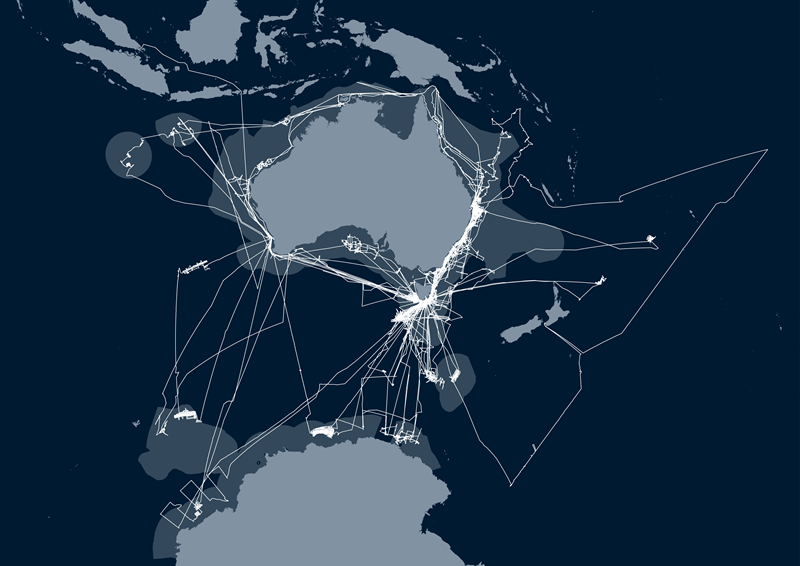
This collaboration between CSIRO and Geoscience Australia, supported by the many research partners on voyages of RV Investigator, is continuing to put more of Australia's incredible marine estate on the map. However, there is still much more to be done. Large areas of Australia's seabed remain unmapped and, undoubtedly, there are many more significant undersea discoveries yet to be made.
RV Investigator is part of the Marine National Facility, national research infrastructure funded by the Australian Government, including support from the National Collaborative Research Infrastructure Strategy (NCRIS) , and operated by CSIRO on behalf of the nation.


