
From Australia's subtropics to the volcanic soil of South Korea's Jeju Island, a new research partnership is taking root, after Southern Cross University was awarded a grant designed to forge bilateral relations.
The project, Australia-Korea Subtropical Innovation Strategy: Roadmap for climate-resilient agriculture, was successful in securing a one-year $50,000 grant from the Australia-Korean Foundation (AKF) .
Dr Kwanho Jeong, a Southern Cross University Research Fellow in crops, leads the new partnership with Jeju National University to establish a bilateral Australia-South Korea research network exploring ways to support innovation in macadamia and coffee production in the east Asian nation.
The AKF grants aim to develop partnerships, collaborations and people-to-people links in areas of shared interest in the bilateral, regional and global context between Australia and South Korea, while facilitating each nation's ability to engage with the other.
"I was super excited to receive the AKF grant to open opportunities to strengthen collaboration that supports development of macadamia and coffee systems suited to Korea's changing climate," said Dr Jeong.
"As climate change expands subtropical agriculture in Korea, particularly in Jeju, our project addresses the growing need for adapted systems for emerging subtropical crops."
MAIN PHOTO: Macadamia nuts in whole and open shells.

Jeju Island is Korea's largest sub-tropical island.
Known affectionately as the 'Islands of the Gods' and located off the south coast, Jeju Island is Korea's largest sub-tropical island. The island's main agricultural products are tangerines, carrots, cabbages, white radishes, and garlic.
"The reason I wanted to connect with Jeju National University was mainly because it is one of the few places in Korea where research is being conducted on subtropical crops," said Dr Jeong.
The South Korean government has been making efforts to secure genetic resources of tropical fruits and crops that may become increasingly important under a warmer climate.
"While considering potential collaborations with a Korean university on macadamia research, I thought this could provide a good opportunity to connect Southern Cross University's research with South Korea's efforts to prepare for climate change," said Dr Jeong.
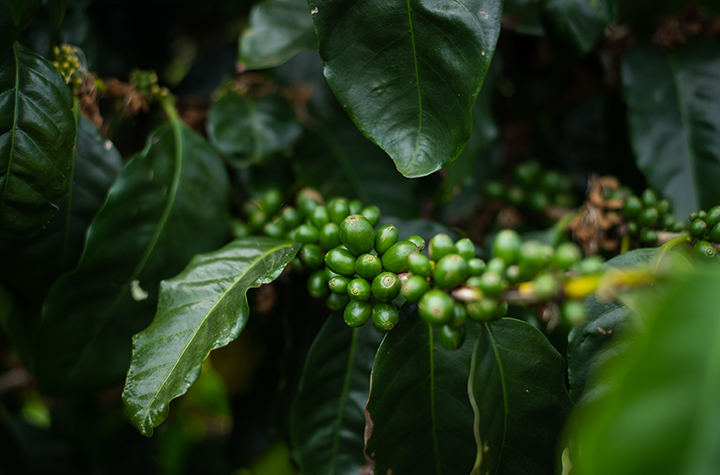
A coffee plant at Southern Cross University's trial site in the Northern Rivers.
"I therefore approached Jeju National University to discuss the potential of using macadamia as a tropical crop and genetic resource in the context of adapting to global warming.
"They showed strong interest in this area, and this led us to seek funding through the Australia–Korea Foundation to develop a stronger and more meaningful research collaboration between our institutions."
Dr Jeong plans to connect researchers from both universities through workshops, knowledge exchange and reciprocal site visits.
"The outcomes for Australia, through Southern Cross University's leadership, are stronger international partnerships and new knowledge to support climate-resilient agriculture for the future," said Dr Jeong.
Dr Jeong's team is made of Southern Cross University's leading coffee and macadamia researchers: Professor Terry Rose, Professor Tobias Kretzschmar and Dr Jay Anderson.
"Currently, South Korea does not grow coffee or macadamia crops. Through knowledge sharing, Jeju National University will gain insights from Southern Cross on best practices to start those horticultural industries," said Dr Jeong.
"At the same time, I want to involve AI techniques for predictions and modelling for crop cultivation. Southern Cross University will gain insights from South Korea with their advanced AI techniques.
"As well, South Korea is an expert on breeding citrus crops, oranges and mandarins, and some tropical fruits. The Southern Cross University team is keen to learn new information from Jeju National University."
This is the second international grant opportunity for Dr Jeong in as many months. He was successful in securing the University's first Maitri Scholarship to investigate low phosphorous rice production in India.


