The joint attack launched by the United States and Israel on Iran began on Feb. 27 and has sparked a fast-moving conflict that could expand across the Middle East.
Author
- Warren Mabee
Director, Queen's Institute for Energy and Environmental Policy, Queen's University, Ontario
Iran's response has already included strikes on U.S. bases in surrounding countries as far away as Qatar and Oman, and has announced the closure of the Strait of Hormuz , going so far as threatening to set ships on fire if they enter the strait.
The Strait of Hormuz is a 55-kilometre-wide narrows between Iran and Oman, separating the Persian Gulf from the Arabian Sea. It is a particularly important piece of global real estate in terms of the energy sector and one of the busiest and most strategically significant shipping routes in the world.
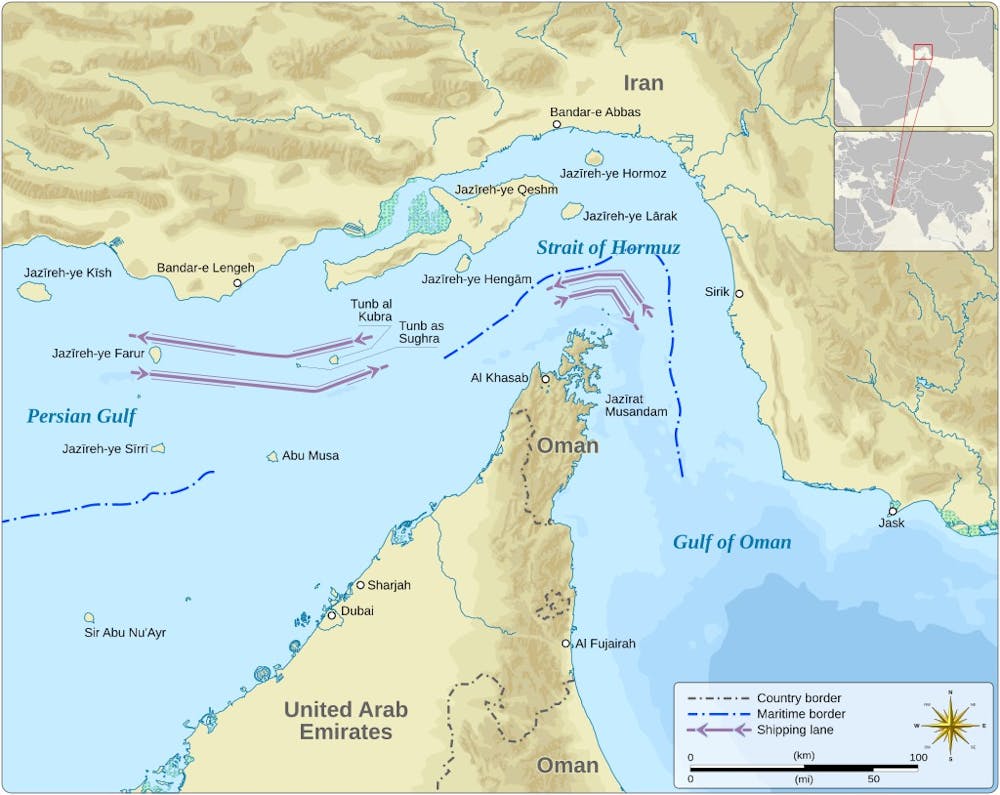
The closure has disrupted oil and gas shipments from the region and rattled markets around the world. Overall maritime traffic through the strait has dropped by 70 per cent since the closure, with 18 loaded and 37 unloaded tankers remaining in the Persian Gulf.
About 13 million barrels of oil per day normally move through these waters - about 31 per cent of global oil shipments . Blocking passage through the strait will certainly affect world oil prices.
Even a short-lived closure of parts of the strait in February 2025 led to a six per cent jump in the price of oil .
Why the Strait of Hormuz matters
Closure of the strait affects major ports belonging to Iraq, Kuwait, Saudi Arabia and the United Arab Emirates, as well as Iran itself. For several of these countries, the strait is the primary route through which oil reaches global markets.
On March 2, Brent Crude - the global benchmark - reached about US$79 per barrel before declining slightly, about eight per cent higher than last week's prices. West Texas Intermediate, the North American benchmark, reached US$71 per barrel - a six per cent increase.
Those price movements are already being felt at the pump. Gasoline prices in both Canada and the U.S. have begun to rise, although not as dramatically as commodity prices.
Increases could persist as long as the conflict continues to disrupt tanker traffic through the Strait of Hormuz.
Throughout the last 50 years, oil price increases have often presaged an upcoming economic downturn . Some events, such as the first and second oil crises in the 1970s and early '80s, led to structural changes in global economies.
Could this happen again today?
Lessons from the first oil crisis

The first oil crisis began in October 1973 when the Organization of Arab Petroleum Exporting Countries (OAPEC, later OPEC) put an embargo on oil exports to the United States as a response to U.S. support of Israel.
This resulted in a quadrupling of oil prices within two months , causing a stock market crash and a recession in the U.S. At the time, the OPEC nations were well co-ordinated and the U.S. did not have sufficient domestic oil production capacity to meet its own needs .
While the U.S. had the economic wherewithal to be able to import oil from other sources, this action kept global prices high and many other countries suffered from elevated costs. The fallout from the first oil crisis affected the auto sector, the energy sector and energy policy across the U.S.
Today, OPEC nations are not working in close alignment with Iran. Instead, many of these nations - along with Russia and other oil-producing nations - have agreed to boost production by about 206,000 barrels per day in an effort to stabilize markets.
Parallels with the second oil crisis
Today's conflict in Iran may have more parallels with the second oil crisis. In 1979, the Iranian Revolution led to a drop in global oil production of about seven per cent .
Although this drop was small, the price of crude oil doubled into the early months of 1980, which led to fuel shortages and economic downturns in many countries, including Canada. Today, however, Iran plays a smaller role in the global oil market, producing about four per cent of total annual output .
According to the U.S. Energy Information Agency , the largest energy producers are the U.S. (22 per cent), Saudi Arabia (11 per cent) and Russia (11 per cent), followed by Canada (six per cent) and China (five per cent).
Iran's ability to influence the global market has been reduced while the U.S. role has dramatically increased. The market is therefore less likely to respond with major price increases in the face of the current conflict.
The wildcard in the current situation is the Strait of Hormuz. The largest port for Saudi exports of oil is Ras Tanura on the Persian Gulf, where the local refinery was recently hit in a drone attack .
A total closure of the strait would mean potential loss of at least five million barrels per day in shipments from Ras Tanura, which are unlikely to be taken up quickly by the port at Yanbu on the Red Sea , especially with refining capacity now impacted by the conflict.
Implications for Canada
For Canada, the conflict is likely to lead to higher prices for gasoline and diesel , as well as increased prices for imported goods. Although Canada is a net oil exporter, domestic fuel prices are tied to global benchmarks and reflect international volatility.
At the same time, the Canadian oilpatch often benefits from higher global prices . Elevated prices can boost revenues and investment in the sector, even as consumers face higher costs at the pump.
While debate persists about the long-term future of Canada's oil and gas industry , the Iran crisis creates an opportunity for Canada to make better use of our existing infrastructure, driving growth in the oil sector and strengthening Canada's role in the global market.
Expanded connectivity to the West Coast via increased capacity on the Trans Mountain pipeline could allow Canadian producers to supply Asian markets that depend heavily on shipments from the Persian Gulf. However, taking advantage of the opportunity means moving quickly, as other oil-producing nations will also move to fill this gap.
U.S. President Donald Trump has said that conflict will last at least four to five weeks , but potentially much longer. Ultimately, Canada could play a role in helping the world to respond to the crisis.
Whether the present crisis is a short-term shock, or whether it is the beginning of a larger geopolitical event, will depend largely on developments in and around the Strait of Hormuz in the days and weeks ahead.

Warren Mabee receives funding from the Natural Sciences and Engineering Research Council.