
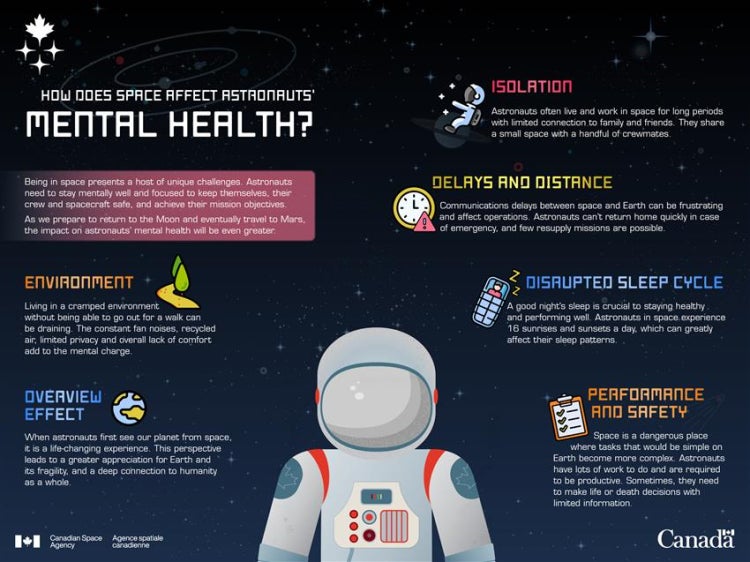
Living and working on the International Space Station is cramped, challenging and filled with risk.
It's also pretty awe-inspiring.
"You're seeing the Earth in a way few people ever will," says Jennifer Stellar, an associate professor in the department of psychological and brain sciences at the University of Toronto Mississauga.
"It can be dangerous and scary, but it also offers these opportunities for awe, connection, love, gratitude and compassion - positive human emotions."
That range of experiences can have a significant impact on the mental health of astronauts, particularly those engaged in long space missions, she adds.
Just how they cope with stress, and process emotions like gratitude and compassion, is the focus of a new research project Stellar and several others are conducting, with the support of the Canadian Space Agency.
"We know a lot about what happens to genes and bones and blood (in space)," says Stellar. "But we have a lot to learn about what it does to your mind to be up there."
The research project is called "Stress, Transcendence and Resilience in Space - Coping, Meaningful Work and Growth Among ISS Astronauts," or C-STARS for short.
It launched this fall and will explore how personal traits and psychological resources play a role in resilience during and after spaceflight.
"The human species isn't always going to be restricted to living on Earth, so if we are going to live on the moon and Mars, we need to know that psychological part, too," says Stellar, who is the director of the Health, Emotions and Altruism Lab at U of T Mississauga.
"We don't just want to survive when we get there, we want to thrive."
The research group is led by principal investigator Jelena Brcic of the University of the Fraser Valley. In addition to Stellar, the team includes co-investigators Jason M. Harley of McGill University and Kirsten Robertson of Brock University as well as student Patrick Nicoll of the University of Victoria.
The researchers will survey U.S. and Japanese astronauts before, during and after their eight-month missions.
The project will collect data to measure physical health, including cortisol levels, while psychological insights will be shared by astronauts through interviews and self-reported diaries. But first the researchers need to sign up six to 10 willing participants.
"It's totally voluntary," Stellar says, noting there are usually more than 200 experiments being conducted on the space station at any given time.
"(The astronauts) have precious little time and they get to choose what they spend it on, so right now we are just asking 'please do our survey.'"
Stellar says she has performed similar studies, but this one has unique challenges - not the least of which is getting the information to Earth.
"Getting data back from space isn't easy, there's a lot of levels and security," she says.
Stellar says the research team hopes to use the findings - which it plans to collect and analyze through 2031 - to help improve conditions not just for astronauts but also for those who work in high-stakes situations closer to home, including in remote or confined environments such as military crews, search-and-rescue teams and wildfire firefighters.
"We owe it to these people who put their lives at risk for us to ask questions that move humanity forward, and to learn the emotional responses that can help them cope," she says.
"We don't want to just look at negatives like stress, fear or anger, but positives, too. Working in extreme environments can be a double-edged sword: the stresses are stronger, but the feeling of awe is also larger."


