
A star on the court and in the classroom
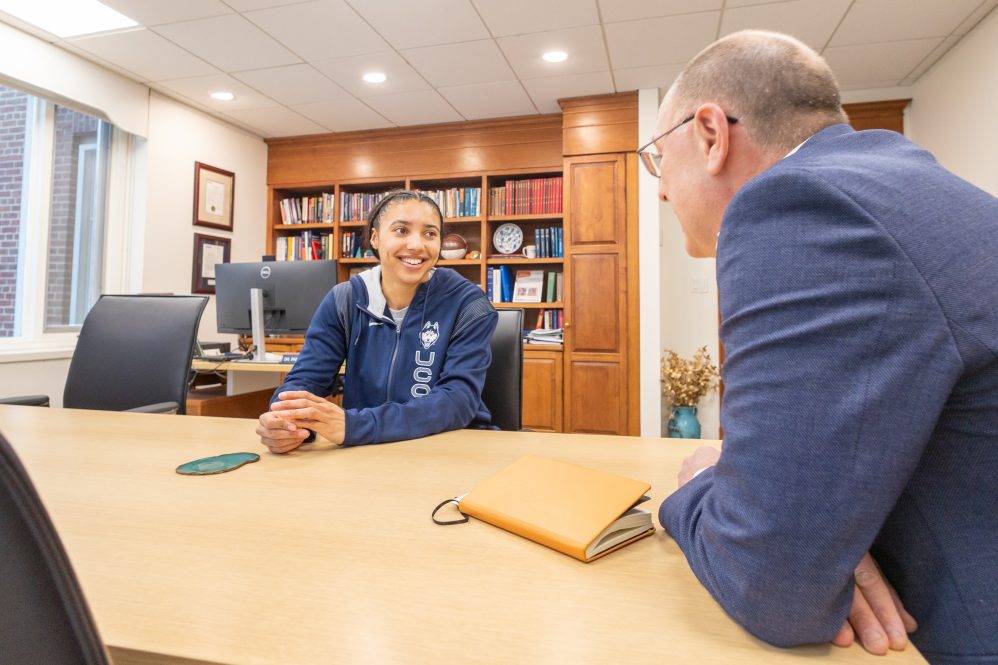
Azzi Fudd '24 (CLAS) '26 MBA chats with UConn Interim Provost and Executive Vice President for Academic Affairs Pamir Alpay in his office on Thursday, March 5, 2026. (Sydney Herdle/UConn Photo)
For UConn women's basketball standout Azzi Fudd '25 (CLAS) '26 MBA, learning in school is the same as playing defense.
"It's effort," says Fudd, the recently named 2025-26 BIG EAST Women's Basketball Scholar-Athlete of the Year. "What you put in is what you're going to get out."
A star on the court and in the classroom, Fudd came to UConn from her hometown in Arlington, Virginia, with more on her mind than just college hoops. She came with ambition that went well beyond basketball - something that she says is embodied by what it means to be a Husky.
"When you come to a university like UConn, when you are wearing UConn across your chest, it stands for excellence," says Fudd. "It stands for greatness. And that shouldn't only mean on the field, on the court, on the ice, wherever you play, but it should also be included in the classroom."
While she didn't initially know what she wanted to study, she knew she wanted to complete two degrees - one undergraduate and one graduate - in four years. Coming to UConn with an open mind, and no prior academic credits, Fudd found her way to UConn's Communication program through the College of Liberal Arts and Sciences and completed an ambitious program of study to earn her bachelor's degree in 2025.
"Looking back, it was hard," she says. "I took classes each summer, and in the fall and spring. I was always taking classes."
After finding herself really engaged in a finance class intended to help student-athletes understand the intricacies of NIL, Fudd opted to follow up her undergraduate work with a Master of Business Administration from the UConn School of Business, which she's slated to complete this spring.
But putting two intensive degree programs under her belt, on top of an NCAA championship and multiple career honors – including the 2025 NCAA Final Four Most Outstanding Player, and more than 1,000 career points – doesn't come without a lot of hard work - or without a little bit of support along the way.
Days after her BIG EAST recognition, and with the Huskies clinching their sixth consecutive Big East conference title on the road to 2026's March Madness, Fudd sat down with Interim Provost and Executive Vice President for Academic Affairs Pamir Alpay to talk about her off-the-court UConn success story - and the helping hands she had at UConn during her journey to "double Husky" status.
—
Pamir: On the basketball court, there's a team around you. But you have a team around you as well on the academic side. Can you talk about that just a little bit, and about how they had your back as you were going through all these classes?
Azzi: Yeah, 100%. I mean Ellen [Tripp, director of UConn's Student-Athlete Success Program] has been…
Pamir: Just amazing?
Azzi: Yes. I would not have been able to finish in three years, and then start and almost finish my MBA. I wouldn't have been able to do any of that without her. She is the best. I can't brag about her enough. And having someone who knows what's going on, how to navigate this space, she laid out a plan for me, made it all organized, clear for what I needed to do to graduate, what classes I needed to take.
And like you said, you have a team, you've got to communicate. Being an athlete, you have to communicate with professors all the time about missing class, traveling, practice times, whatever it is, rescheduling exams, needing extra work. I would say that I was alright at it. There were time when, you know, I'm a college kid, I'm learning. There were a couple times where I messed up, I didn't communicate early enough, had some issues. But having Ellen, who just always has your best interests in mind, having her to help me - I can just go to her office, I messed up, I need help with this, I didn't communicate early enough, my professor's mad at me. Just having someone who understands what you're going through and can help you take a deep breath. It's going to be ok. It's not the end of the world, even though it feels like it.
Pamir: Yeah. It's really not.
Azzi: But professors here really, for the most part, have been amazing and super helpful and easy to work with. Even in my grad program, I was nervous about that, because everything is through Zoom and I'm a people person, so I'd rather be in person than through a computer. I've been super grateful for how my relationships with my professors have been.
Pamir: That's excellent.
Azzi: And then you add tutors - the tutors in the program have also been amazing. I haven't used one in a while, but just having them available to you to get you going at the beginning. I've had one for midterms and finals before, and just having that as a resource helps. Sometimes you just need someone to help jog your memory and refresh or reteach you in a different way.
Pamir: I can't imagine the transition for you. You come in from high school, you come in and you have to be a student, and then you have the additional duties on you as a student-athlete at the highest level. A lot of people complain about coming from high school to college, you had it even more so with the demands on you, right? So, it was quite challenging, I bet. I'm glad you had that team around you.
Azzi: Yeah, Ellen and everyone in the program make it as easy as it can be for that transition, because it is a lot all at once. Being on a basketball team, being a student, you're thrown into these classes. But freshman year for us, you have mandatory study hall, and so that really makes you get your work done. You don't have a choice. You have to sit there regardless. So you sit there and waste time, or sit there and get your work done. At first, obviously you're going to complain as a freshman, like why do I have study hall? But that makes you sit down and work and just use your time efficiently.
Pamir: So, in terms of down the road, right? I think you're going to be the #1 draft pick.
Azzi: We're focused on a championship first.
Pamir: Right! But, I'm thinking on the road ahead - five years, seven years down the road. How will these degrees help you? How do these degrees help you as you transition into a potential professional basketball life in the WNBA and beyond? Is it too early to tell?
Azzi: I don't know exactly what I want to do outside of basketball down the road, but I feel like these are two degrees that can help in any area and aspect of life. Comms, I mean, like I said, I'm a people person, and that just helps me navigate my relationships and how to interact with people, whether it's online or in-person.
And then with my MBA, my goal was to help me just understand a little bit more about NIL and what I'm doing off the court right now. But going forward, my hope is eventually that a relationship I make through NIL, through basketball, will kind of spark that interest of, wait, okay, post-basketball, I could see myself here, this is a really interesting area. I could see myself going down this road a little more.
But business is so important in basketball, whether it's your basketball contract, whether it's with my podcast, figuring all that stuff out. Just knowing whether I go down the business route, whatever, having an idea of what the behind-the-scenes looks like. I mean, I thought I was going to be falling asleep in my business law class, and it was one of the most interesting classes I took. It was very interesting.
And learning more about the marketing side - I have a marketing team that helps me with my social media, but learning what they went through to be doing what they're doing and helping me now, it's been really interesting.
Pamir: That's so cool. One last thing - student-athletes coming in, up-and-coming student athletes, what would be your advice to them? How would you guide them? Now that you're through two programs at the University, and you maintained your academics together with your athletics, what would you tell them as they transition from the high school life coming into the University and then also having a career as a student-athlete?
Azzi: I'd probably say that, coming in as an athlete, a lot of times there's that misconception that only sport matters. No, you need to treat your academics with the same competitive spirit that you treat your athletics.
Pamir: I like that. Thank you. Thank you for being part of this community as an athlete, as a student. It's just - it's amazing what you're doing.
To learn more about some of the ways that UConn supports student-athletes on their academic and athletic journeys, visit uconnhuskies.com/sports/student-athlete-success-program.


